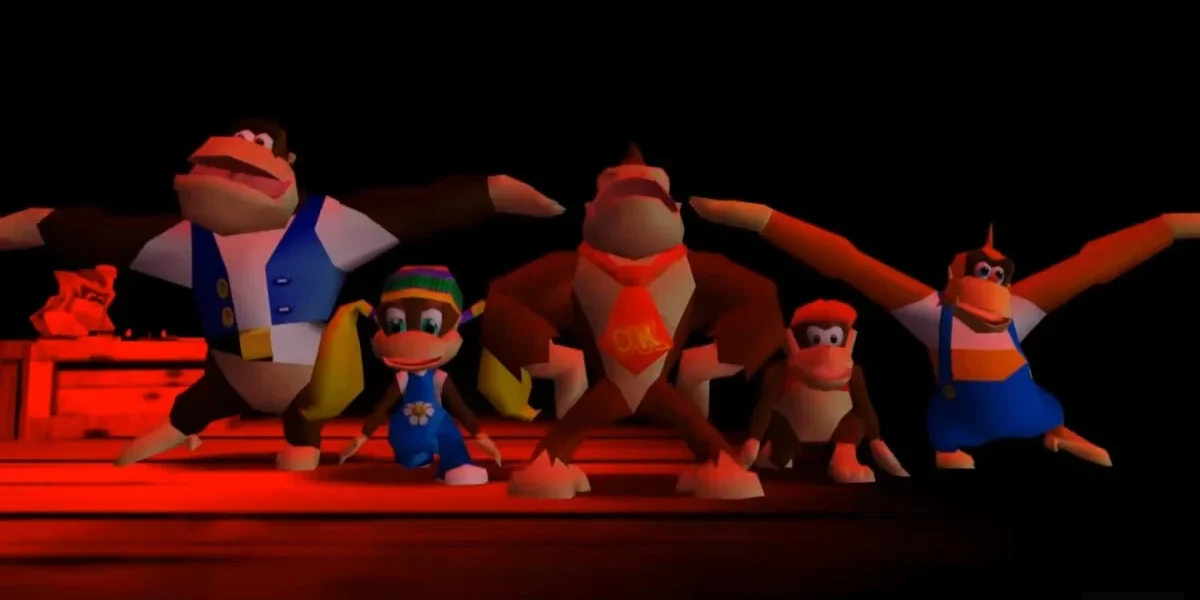
From early interviews with composer Grant Kirkhope, I’ve always known that the DK Rap was conceived as a playful novelty rather than a serious track. Yet, the whimsical tune has become a beloved emblem for anyone who grew up with the N64 or Nintendo at large.
I was unaware that the recording took place in a cramped hallway, with the game director and an unlikely programmer—perhaps chosen for his penchant for shouting “Zits,” “Rash,” and “Pimple” into a microphone while listening to Tupac during late‑night sessions—capturing the track.
I discovered these details from the very programmer, Chris Sutherland. Referring to him as a “random guy” feels dismissive; his career spans more than my lifetime. He began at Rare, programming the Game Boy title The Amazing Spider‑Man, and contributed to Sneaky Snakes, Battletoads, two Donkey Kong Country releases, and Banjo‑Kazooie before moving on to Donkey Kong 64. His résumé continues with Banjo‑Tooie, Viva Pinata, Kinect Sports, and most recently, a reunion with former Rare teammates at Playtonic Games on Yooka‑Laylee and its spin‑offs.
Sutherland identifies primarily as a programmer, a role he has pursued for 37 years. Yet, he has also carved out a succinctly prolific career as a voice actor—an often‑overlooked facet of his legacy. Fans will recognize him as the announcer in Killer Instinct, Carrington in Perfect Dark, and the vocal embodiment of Banjo and Kazooie. During Rare’s Donkey Kong era, he lent his voice to Diddy Kong and, likely, K. Rool. In fact, his voice‑acting portfolio now eclipses his programming résumé.
During a video call, he admitted that the phenomenon arose by accident, not by design. Back then, Rare—and many studios—didn’t have a dedicated voice‑acting department, so developers were often asked to supply their own audio.
By the time Donkey Kong 64 was in development, Sutherland had already recorded for Battletoads Arcade, producing the iconic shouts of “Zits,” “Rash,” and “Pimple.” After that, he became the go‑to person whenever a voice was required.
The workflow evolved into a spontaneous routine: while coding, a call would come from the audio team asking, “Could you hop in and record a few sounds?” The developer would reply, “Sure, I’m available,” and the session would last no more than ten minutes, rarely exceeding thirty, cementing this ad‑hoc approach as standard practice.
As Kirkhope has said in the past, the DK Rap was never intended to be a huge thing. It wasn’t a massive production. Sutherland doesn’t even really recall being super aware of it prior to recording it. Kirkhope composed it, while game director George Andreas wrote the lyrics and did most of the performance.
When assistance was required, Kirkhope turned to Sutherland. Though his only background was occasional sound work, Sutherland possessed a theory that made him an ideal collaborator.
During late‑night sessions, I would sit with headphones, immersing myself in rap tracks—Tupac, DJ Jazzy Jeff, and others—though I had no formal musical training. I simply listened, as many of us do, and perhaps he sensed my taste in rap.
Sutherland believes Andreas might have assumed he possessed rap skills. They both approached the task with a casual, “It can’t be that hard, can it?” mindset, yet the reality proved far more challenging.
There was no dedicated recording booth. Instead, the audio team’s office featured a narrow corridor lined with blankets. They’d pull the drapes aside to dampen the sound and start recording, only to be interrupted with feedback like, “You’re out of time, come back, you need to do it this way.” The makeshift setup made the space stifling, especially in warmer climates.
Kirkhope frequently halted them—almost every few seconds—because they’d veer off the beat. Sutherland recalls the sessions feeling interminable, realizing he lacked any musical sense or rhythm.
Ultimately, the team achieved a result that Sutherland described as “acceptable,” a milestone that likely owed much to Kirkhope’s meticulous edits.
While Sutherland’s vocal contribution is modest in quantity, its influence is profound. Andreas carries the bulk of the lyrics, with Sutherland stepping in for select lines such as “He’s the first member of the D.K. crew! Huh!” and other Rare personnel lending their voices to the spirited “D.K.! Donkey Kong!” refrain.
Yet it is Sutherland who delivers the unforgettable opening line of the rap: “So they’re finally here, performing for you.”
During our call, he attempted to recite that line, but the passage of time slipped his memory: “So, it’s finally time!” He openly admitted that the lyrics have blurred over the years. Sutherland recalled a visit to a video‑game museum café in Nottingham, where he overheard a conversation that included a spontaneous rendition of the DK Rap. “I wasn’t sure if it was appropriate to join in, but I asked, ‘Do you know who I am?’”
❓ Frequently Asked Questions (FAQ)
Where was the DK Rap recorded?
The DK Rap was recorded in a cramped hallway at Rare’s studio during late‑night sessions, a setting that added to its playful and spontaneous vibe.
Who was involved in the recording of the DK Rap?
The recording featured the game director and programmer Chris Sutherland, who was known for his quirky vocal interjections while listening to Tupac, along with other studio staff.
What other roles has Chris Sutherland played in the gaming industry?
Beyond programming, Chris Sutherland has contributed as a voice actor, worked on titles from The Amazing Spider‑Man to Yooka‑Laylee, and has been a key figure in both classic Rare projects and modern indie releases.
News Source: Kotaku





Comments
Be the first to comment.