

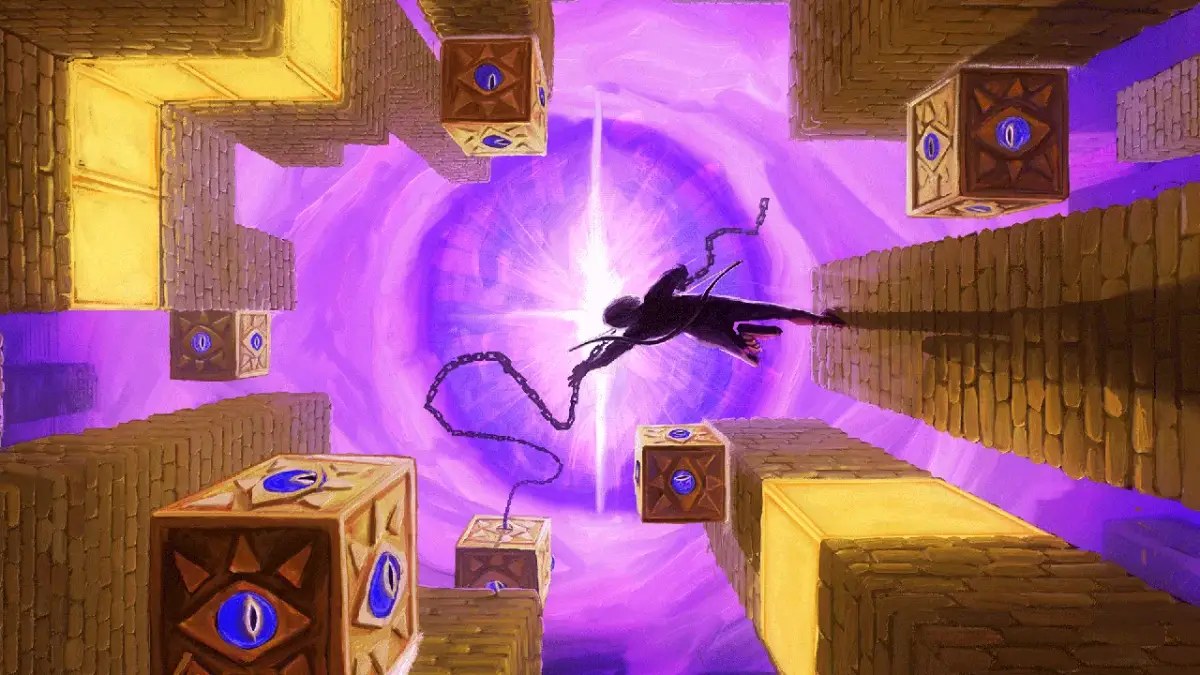
Nearly two decades after Valve’s first-person puzzle classic transformed the genre, a solo developer has delivered what many are calling 2026’s strongest entry in the space. He Who Watches, developed by Bobby Vanden and published by Draknek and Friends—the studio behind celebrated puzzle titles—released this year as a mind-bending experience that takes Portal’s core design philosophy and applies it to a perspective-shifting gravity mechanic. For reviewers who witnessed the original game’s cultural impact in 2007, the return of that sense of wonder has proven rare indeed.
The result is a title described as challenging, dense with secrets, occasionally disorienting, and without question one of the best puzzle games available this year. It arrives at a moment when few releases have managed to capture the same sense of impossible magic trickery that made its predecessor feel revolutionary on debut.
A Familiar Premise With a Trippy Twist
With very little narrative hand-holding, He Who Watches places players in the role of an archer exploring a strange structure packed with puzzle chambers. The goal is to clear rooms and progress into new areas while searching for glyphs and seeking out a god-like being trapped somewhere within the space. It can be classified as a 3D Sokoban game—a term used to describe puzzle games where you push boxes—where players grab hold of boxes by firing arrows at them and reposition them onto switches or out of their path.
The premise sounds straightforward enough: get through the exit door of each room by moving boxes, firing arrows at switches, and applying clever spatial reasoning. But that simplicity belies what follows.
“He Who Watches takes the core ideas that made Portal feel one-of-a-kind and applies them to a unique, perspective-shifting concept. It’s challenging, rich with secrets, a little nauseating, and, without a doubt, one of the best puzzle games you’ll play in 2026.”
Reviewer assessment
The Gravity Mechanic That Breakes Brains
The trick that separates He Who Watches from its inspirations is the ability to walk on the walls and ceiling of each room, flipping gravity to match your orientation. Pick up a box while standing on the ground and set it down, and it stays put as expected. But drag that same box up to the ceiling and drop it, and it remains stuck overhead. From this single premise emerge puzzles reviewers are calling genuinely brain-breaking.
Naturally, sprinting around every surface of a room in first person can leave players feeling queasy—a small price for an inventive mechanic executed with precision through tight puzzle design.

What stands out most is that the game refuses to be a one-trick pony. Rather than treating its gravity trick as a mere visual gimmick, developer Bobby Vanden threads multiple ingenious ideas built around it. Deep into playthroughs, players encounter chambers centered on transport beams that push boxes along glowing green lines. Boxes can jam those beams’ trajectories, transforming them into walkable bridges—and with further experimentation, the tool becomes almost programmable, letting players arrange machines that move boxes exactly where needed.
A Hint System That Solves a Classic Problem
If any of this sounds overwhelming, Vanden appears to have anticipated the concern through what reviewers are calling a brilliant hint system. Every room includes an optional mini-puzzle chamber designed to teach the core concept behind the puzzle at hand. Confronted with a seemingly impossible gap, players might find a simpler exercise demonstrating how to move a box across it.
This approach addresses one of the most persistent failures in the genre: hitting a puzzle and having no idea what the game is asking. Here, intent is never unclear—only the execution proves tricky.
“It’s a stroke of genius that solves one of the worst blockades in puzzle games… That’s never unclear here; it’s only the execution that’s tricky.”
Reviewer assessment
Looking Ahead
Players still working through He Who Watches describe taking their time to savor each solution, finding consistent delight even after thirty minutes of being stumped. The sense that answers feel sensibly constructed and fair keeps people coming back—a quality reviewers note is uncommon in games described as creatively euphoric.
As 2026 continues to build its puzzle game lineup, He Who Watches has already established itself as a standout, proving that nearly twenty years after Portal’s debut, the genre still holds room for genuine surprise. Whether it becomes the definitive puzzle experience of the year remains to be seen, but its inventive design and thoughtful pacing have already earned it a place among the year’s most acclaimed releases.























Join the conversation