


Control Resonant is delightfully weird: a sequel that isn’t afraid to fly its freak flag as it pits you against all manner of supernatural phenomena wreaking havoc on Manhattan. But between bosses that resemble Francis Bacon-inspired nightmare fuel and other spooky occurrences, The Board is undoubtedly the scene-stealer of Control Resonant—and that’s without you even seeing them!

The Board is louder than ever as it accompanies Dylan Faden in Remedy’s new game, seemingly trapped in the powerful shape-shifting artifact that he uses to smash his way through The Hiss and The Patterning. A successful run elicits booming words of encouragement from the paranatural entities that make up The Board, each interaction being the equivalent of a shotgun blast of indecipherable bass that’ll tickle your audio receptors.
So what goes into designing and developing a “character” like The Board? A surprising amount of technical wizardry and experimentation, as Lucas Pierrot, audio lead on Control Resonant, explained.
The Board is right here, and you get to experience the full council
Compared to Control, The Board’s audio identity is very different. Gone are the sounds of telephonic voices, replaced with something more uniquely alien and commanding. Why the change? As Pierrot explained, The Board spoke to players through a hotline in Control, but in Control Resonant, they have a direct line of communication to Dylan, and by extension, the player.
“From an audio perspective, the main shift is now [that] The Board is speaking directly into Dylan’s mind, in full definition,” Pierrot said. “In the original Control, the board talks through the hotline, an old phone connecting you to a remote mysterious place, hence the static and muffled audio. Here there are no filters anymore. The Board is right here, and you get to experience the full council.”
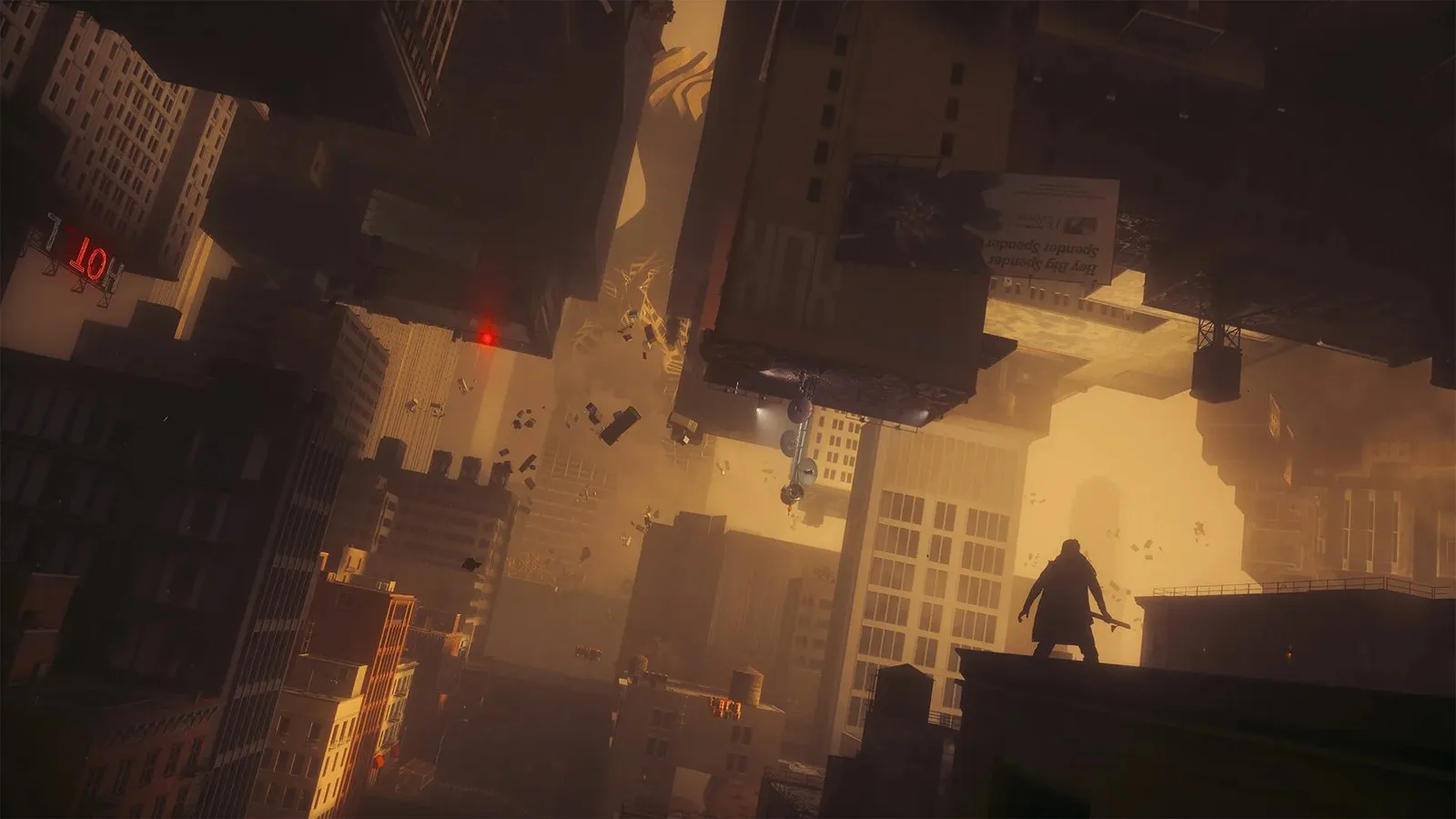
A symbolic version of anger
The Board was the first audio concept made for Control Resonant, with work on the entity dating back to September 2021, Pierrot said. Creative director Mikael Kasurinen mentioned to Pierrot that “The Board is now on a warpath,” and that sentence stuck with him as he crafted them, referencing the Māori Haka war dance and other elements to bring forth a “ritualized anger” in their design.
“I thought about how to make The Board feel and sound like they are furious and frustrated. They can’t be angry like a human being would be. They are these otherworldly entities, so I searched more about a symbolic version of anger, a ‘ritualized anger’ if you will. I took inspiration from the Haka, the Māori war dance,” Pierrot explained. “I tried to understand why this is working and what I could use. I wrote down a few elements I wanted to keep, for example: Sometimes they sing in unison, but sometimes only the lead voice is in front. They have a rhythm, a pulse, that gives weight to the words. Using their own bodies as drums. Even if you don’t understand the language, that does work. You feel the power, the tension. I wanted to find a similar vibe.”

It sounds interesting and powerful
How do you make a multidimensional being sound angry? Pierrot says that he started by using a specialized microphone to record at a high frequency, thus allowing the sound team to manipulate the audio to a high degree. Pierrot says he recorded chanting and singing loosely inspired by Gyuto monk recordings he’d been listening to, as well as speech and stories. One fan theory online is that throat singing was used for The Board’s sound, but Pierrot says that’s the opposite of what he actually ended up doing.
“I can’t do that! So instead of trying to get a special sound using [a] technique I couldn’t master without training, I did the opposite and worked from the voice itself. We all have natural resonances in our voices, our formants. I found the natural resonances in my voice and built several Board members from there, so it sounds interesting and powerful.”
It’s kind of like tuning an instrument
Eventually, Pierrot came up with five Board member identities (“Let me be clear that this isn’t a narrative element from the game”) to experiment with. Five was the magic number, allowing the audio design to work as intended, whether their profiles spoke in unison or individually.
“Sometimes those members speak as one, in unison, and that gives strong powerful words, and sometimes only one will comment,” Pierrot explained. “That gives variety and makes The Board a bit more interesting: an entity with complexity and nuances. On some answers, I tried to make them disagree or not caring. I needed all the lines written by the narrative team to match the narrative intents too. At its core, the design is simple: It’s about playing with voice resonances, killing some, underlining others and making different Board members unique and consistent across … the board (sorry). Each Board member has a role in building a sentence or intent, so they blend well together. It’s kind of like tuning an instrument.”
The Board is basically gibberish
Is there an actual language being spoken by The Board? Could linguistics experts and people who have watched far too much Arrival dig into the sound files and reverse-engineer Board-speak? Yes and no, Pierrot said. There is a partial language at play here, repeating words that might not be so random, because creating an entity that could communicate with you meant that rules needed to be established for fine-tuning the “gibberish” of The Board alongside player bias. Long story short, what you hear might be all in your head as you translate the sounds in your own personal capacity.
“We have to create a base of a language, so we perceive intelligence. Perceived intelligence will give you emotions. For The Board to feel scary, unsettling, or even funny sometimes, you need that structure. It’s even because they are so serious all the time audio-wise, that the fun sentences can work–it creates a ridiculous contrast. About rules, I can mention one, ‘the pulse.’ It’s a low, soft kick that emphasizes certain words. I used this to give weight when necessary to have a nice flow. You can see it as some sort of trick to articulate sentences. It gives rhythm and punctuation.
An important part of the design is that the Board is basically gibberish, not affiliated to any language. So, when you hear a word, you tend to hear what you want to hear … and that’s pretty neat in terms of audio design, as players can fulfill their fantasies. You want to hear The Board praising you for performing an Execution? You can! Maybe you hear them saying ‘Absolute cinema, Combo!’ et cetera, but if you prefer to think they’re arrogant and only feel disdain for slaying a weak enemy … you can hear that too!”
You can even listen to a few Easter eggs, as players have discovered that The Board can bust out some tunes when you’re relaxing in The Gap–no, not the store. As for other Easter eggs? Pierrot isn’t ready to reveal if there are still more waiting to be discovered. “So the singing in The Gap, I thought it would be nice to have The Board chilling there for a bit when Dylan took his sweet time. This kind of chanting is probably what I recorded the most. As for other Easter eggs … no comment!”
Like any great creation, The Board has also escaped captivity and has begun making its presence known online with memes. One fantastic example is this mash-up of Control Resonant and The Simpsons, and Pierrot says he and the Control Resonant team appreciate the memes.
“When the game is out, know that most of us developers are lurking in many streams to see how people react. I saw some people just screaming ‘ABOBA’ in several Twitch streams every time The Board speaks. I have no clue what it means, but I found it hilarious–really enjoyed that. I was really happy to see that the audio design in general is appreciated by most people, that they enjoy it. It was a lot of work from all of us. Thanks to all players; they are the reason we do this job. I hope you keep enjoying the game for a while!”
Control Resonant launched in September, earning a place among the best games of 2026 thanks in part to how different it is from its predecessor, its scary buses, and the many cool little details lurking in the background. “Alongside the stellar art direction and a surprisingly touching story, Control Resonant’s gameplay loop feels more mainstream than anything this team has made since Max Payne,” Mark Delaney wrote in GameSpot’s Control Resonant review.
Have thoughts, questions, or benchmarks on this topic? Join the discussion on our forums.
Join Discussion ➔





















Bergabunglah dalam percakapan