
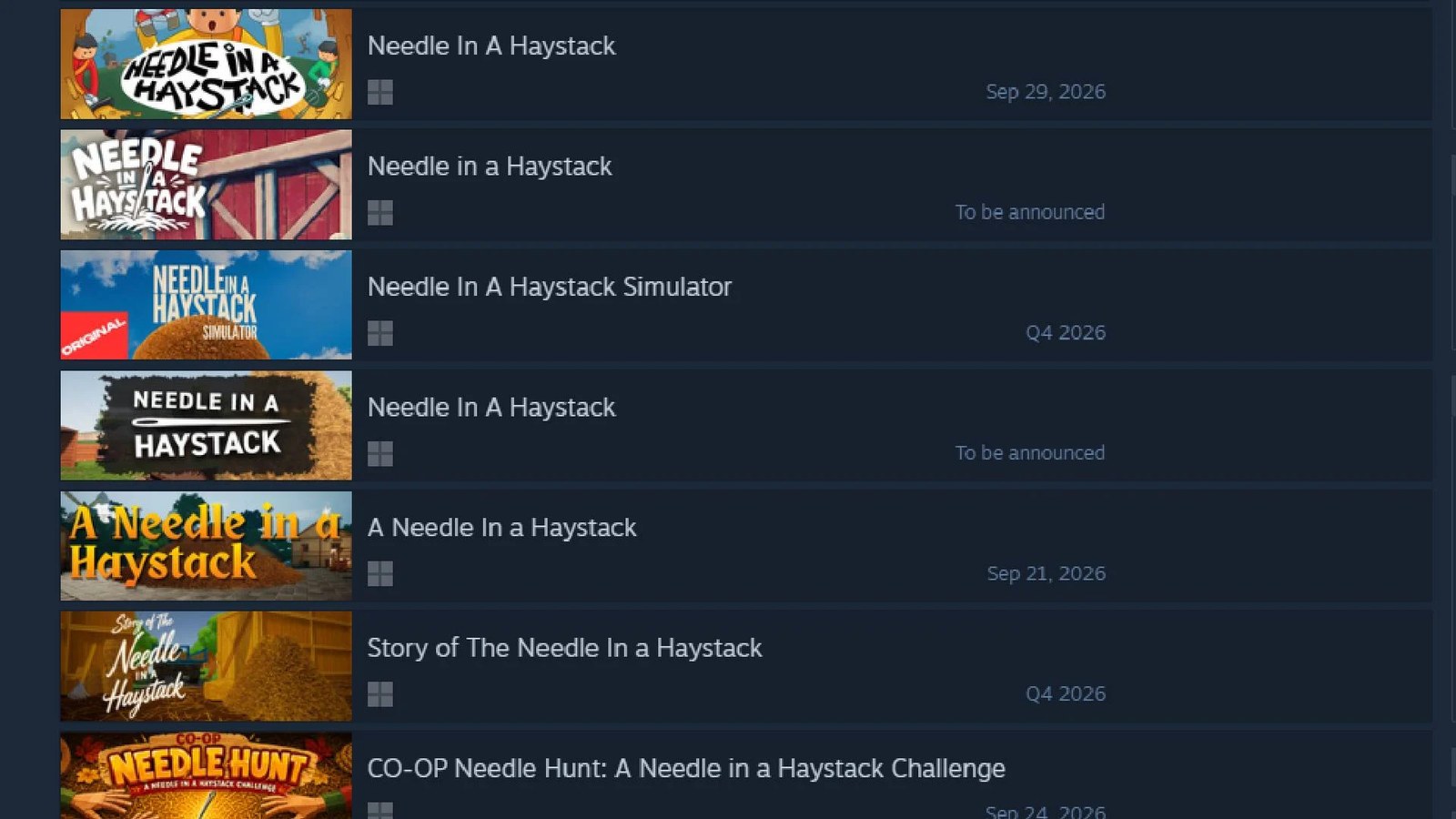
Just weeks after going viral for its deliberately tedious premise, Needle in a Haystack Simulator has become the poster child for a wave of AI-assisted copycats flooding Valve’s Steam store. Following an August reveal clip that amassed more than 50 million views on Twitter, at least ten similarly titled games have since appeared on the platform, several of them slated to launch before the original itself, which is not scheduled for release until Q4 2026.
The phenomenon was first flagged by Reddit user Final_Narwhal_2557, who documented the proliferation of look-alike titles crowding search results. The most blatant clones carry nearly identical names such as A Needle in a Haystack, CO-OP Needle Hunt: A Needle in a Haystack Challenge, and Story of The Needle in a Haystack, alongside the painstakingly named Needle in a Million Haystacks. Other entries take slightly different approaches with titles like Hay! One Billion! and Find the Needle.
A Formula Copied Almost Verbatim
A quick glance at each clone’s Steam page reveals remarkably few deviations from the original concept, which tasks players with locating a single needle buried in an enormous haystack. The near-identical packaging has drawn criticism beyond mere title theft, as many of these games lack the AI disclosure statements that Valve now requires developers to complete during store submission.
The speed at which these titles surfaced suggests automated production methods played a role. A handful feature logos dripping with what critics have dubbed the “ChatGPT sheen,” reinforcing suspicions that generative tools were used to assemble and publish the games in a matter of days rather than months.

I can’t help but feel bad for the developer of the original Needle in a Haystack Simulator, who had to add a big, unsightly red box to their game’s Steam key art to clarify that it’s the original, and whose Steam description is now bogged down by a mention that it’s “the one and only.”
Gamer24h analysis of the clone situation
The situation echoes similar episodes elsewhere on the platform. The surprise hit Meccha Chameleon continues to spawn countless copies that differ only in minor details, such as transforming player models into animals or adding exaggerated features, while the cozy organization game Librarian: Tidy Up the Arcane Library! has already been embroiled in its own AI controversy after Steam became flooded with games tasking players with organizing various locations.
The Broader Problem for Players
Beyond the frustration of developers whose work is imitated almost instantly, the proliferation poses a genuine problem for consumers. With more games being released than ever before and events like Steam Next Fest increasingly crowded with low-quality AI content, distinguishing legitimate titles from opportunistic knockoffs has become considerably harder.
The original developer’s need to brand their own product as “the one and only” underscores how the situation damages trust in a marketplace that already struggles with volume. Analysts suggest that without intervention, finding quality games will grow ever more tedious—an irony not lost on observers given the needle-in-a-haystack premise itself.
Looking Ahead
The original Needle in a Haystack Simulator remains its only confirmed release date at Q4 2026, leaving players with ample time to navigate an increasingly crowded field. Meanwhile, there are growing calls for Valve to introduce clearer policies aimed at curbing the flood of derivative AI-assisted titles before discoverability on Steam deteriorates further.























Join the conversation