
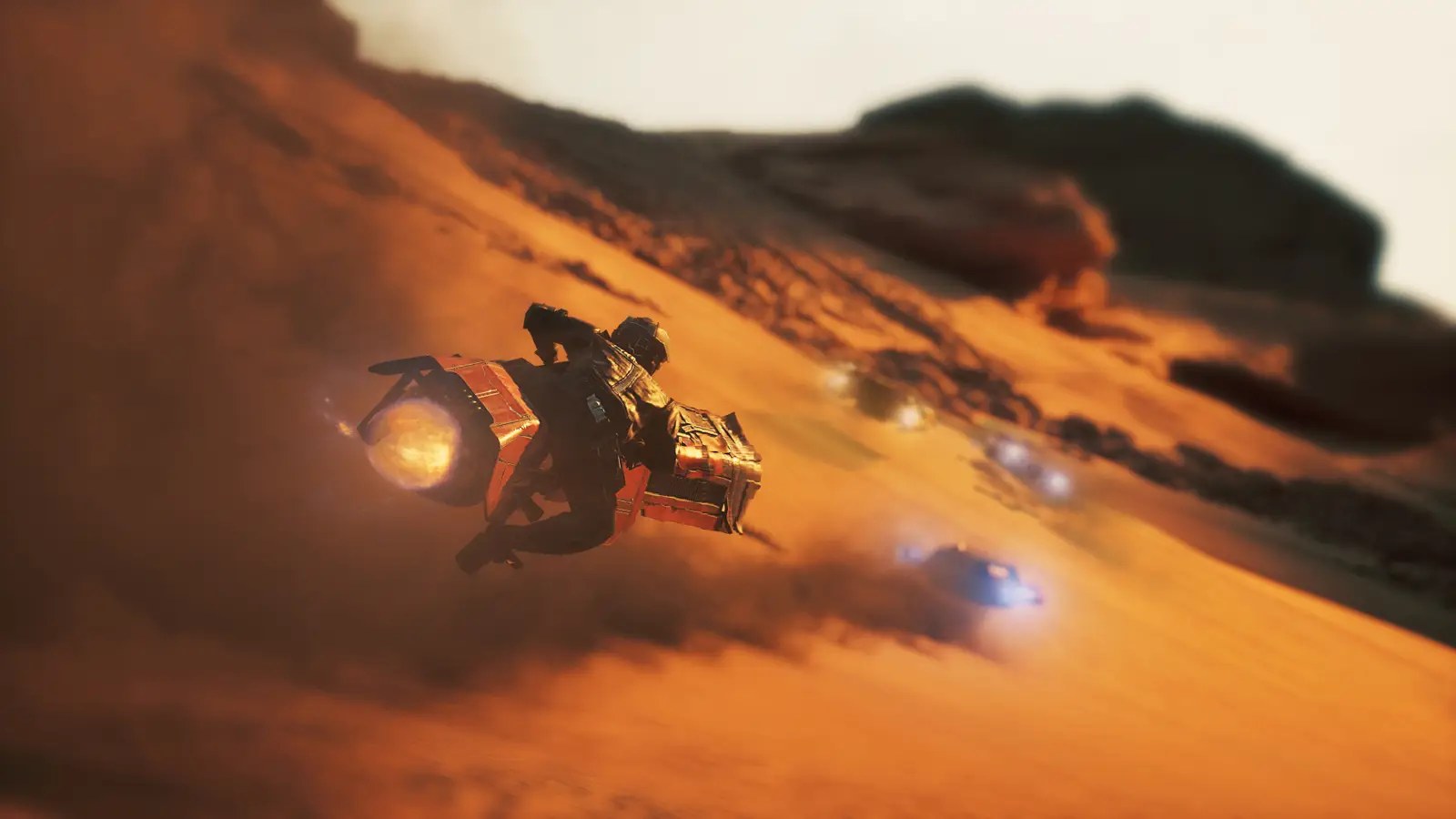
After more than two decades without a new entry, Star Wars: Galactic Racer has arrived as the first racing game in the franchise since 2002, and reviewers are calling it the most original arcade racer of a generation. Developed by Fuse Games, the studio founded by former Criterion Games staff behind Burnout and Need for Speed, the title launched its review cycle this week ahead of an Oct. 6 release on PlayStation 5, Windows PC, and Xbox Series X.
The game has drawn particular praise for combining blistering arcade speed with a roguelite structure rarely seen in the genre. Rather than offering a straightforward season pass or career mode, Galactic Racer builds its campaign around run-based Tours of randomized events, where repeated crashes or failing to place among the top three can send players back to the start of an entirely new Tour.
A Pure Arcade Racer With Roguelite Depth
The distinction reviewers are drawing matters. Where Mario Kart and its imitators belong to a kart-racing subgenre and titles like Forza Horizon sit at the approachable end of real-world driving sims, Galactic Racer belongs squarely to the arcade tradition of immediacy and velocity — one where the brake pedal is essentially a foreign object and pure racing meets high-concept game mechanics built around boost. In that lineage sits Burnout, and reviewers note that this is a purebred arcade racer in spirit.
But it is also a quasi-RPG, with stat boosts, status effects, and buildcrafting playing a central role. At the start of each run, players choose from three vehicle types, 14 racing styles with distinct traits and starting abilities, and game-modifying Favors. Throughout a run, they earn upgrades, abilities, and parts that enhance their craft under specific conditions.
There hasn’t been a racing game this structurally innovative in a long, long time. There hasn’t been an arcade racer this good in even longer.
Fuse Games reviewer analysis
Those conditions add another layer to the design. Planetary conditions affect things like cornering and engine cooling, while some courses thread through acid rivers that can disable electrics if a player is unshielded. Much of the game revolves around optimizing how players cycle between two boost mechanics: the safe Afterburner and the more dramatic Ramjet, which can blow up if it overheats. A build focused on Ramjet cooling can maintain its boost indefinitely, though others may favor shields or offensive takedown abilities instead.
A Steep Learning Curve
The complexity is not lost on reviewers, who note that the game offers little in the way of tutorials and can leave players deep into a run before they fully understand how certain status effects are acquired or best exploited. The difficulty compounds this: one seasoned racer described being shocked by how hard the title is, with crashing out of a run several events in simply for hitting a wall too often on an unfamiliar track feeling brutal.

The art style is evocative and unmistakably Star Wars, but its naturalism does not overload tracks with visual cues, making them harder to read at speed. Reviewers acknowledge the learning curve is steep and that there is much to manage during a race — yet insist the payoff arrives when players finally master the systems.
Campaign Is King, With a Multiplayer Surprise
The campaign mode is clearly what the game was designed around, casting players as Shade, a freelance pilot entering the Galactic Racing League and challenging an aristocratic champion whose family enslaves the protagonist’s people. Without overloading on story, it delivers plenty of Star Wars color and memorable characters, including the stout, mustachioed alien who runs the league and serves as an avuncular backer.
The roguelite structure gives these systems room to breathe, while other single-player modes remain simpler. Scenarios offer truncated five-race tours starring other racers, useful for understanding build options, while the Arcade mode is mostly time trials — including podracing, the inhumanly fast discipline from The Phantom Menace, with Sebulba himself appearing as a competitor.
The most pleasant surprise, however, is multiplayer. Multiplayer Tour condenses a campaign run into five races, complete with a build phase and a championship race that decides the result. A betting system lets players earn extra rewards by predicting their own finishing places and overall winners — a fresh take on online racing that reviewers believe will find its audience if Fuse Games can balance it properly.
Looking Ahead
Star Wars fans with fond memories of Episode 1: Racer are likely to embrace the rich fan service and handsome production values, though they may find the complexity and difficulty a confusing awakening. Even devoted racing game enthusiasts might be surprised how long it takes to adjust to the uncompromising design — but reviewers agree the reward for sticking with it is immense.
Star Wars: Galactic Racer will be released on Oct. 6 on PlayStation 5, Windows PC, and Xbox Series X. The game was reviewed on PS5 using a prerelease download code provided by Secret Mode. You can find additional information about Polygon’s ethics policy here.























1 comment