

 •
•Ralph Bakshi’s 1992 film Cool World is now available for free streaming on YouTube, marking the first time the cult noir-fantasy feature has been officially released in that manner. The film, which was a box-office failure and remains one of the most critically panned movies of its era, can be watched at no cost as it celebrates roughly 24 years since its original release.
The announcement comes alongside an extended retrospective on Bakshi’s career and the troubled production behind Cool World, which many viewers still regard as one of cinema’s strangest entries in the noir-fantasy genre.

A director ahead of his time
Bakshi began directing animated features in 1972 with the R-rated adaptation of R. Crumb’s Fritz the Cat. He went on to produce an early animated version of The Lord of the Rings, which remains among his most celebrated work, alongside original films such as American Pop, Fire and Ice, and Wizards.
His final project before retiring from filmmaking was the 2015 Kickstarter-funded indie short Last Days of Coney Island, which was briefly made available for free on YouTube.
A recurring theme in Bakshi’s career, according to the report, is that his work was often too surreal for audiences, critics, and film executives alike. Yet influences from his style can be traced through the surrealist R-rated cartoons of the 1990s—such as Liquid Television and Aeon Flux—and much of what later appeared on the Adult Swim programming block.
The story behind Cool World
Cool World follows Jack Deebs (Gabriel Byrne), a man who has just been released from prison after spending 10 years incarcerated for murder. During his time inside, Jack created a popular indie comic called Cool World, starring the femme fatale Holli Would—though he keeps secret that Cool World and Holli are based on what he believes to be recurring hallucinations.
Upon his release, Jack is physically transported into Cool World, revealing it to be a real dimension where cartoons known as “doodles” inhabit a stylized 1940s Las Vegas. Holli has brought Jack there hoping he can help her transform into a human—a “noid”—so she can escape the world.
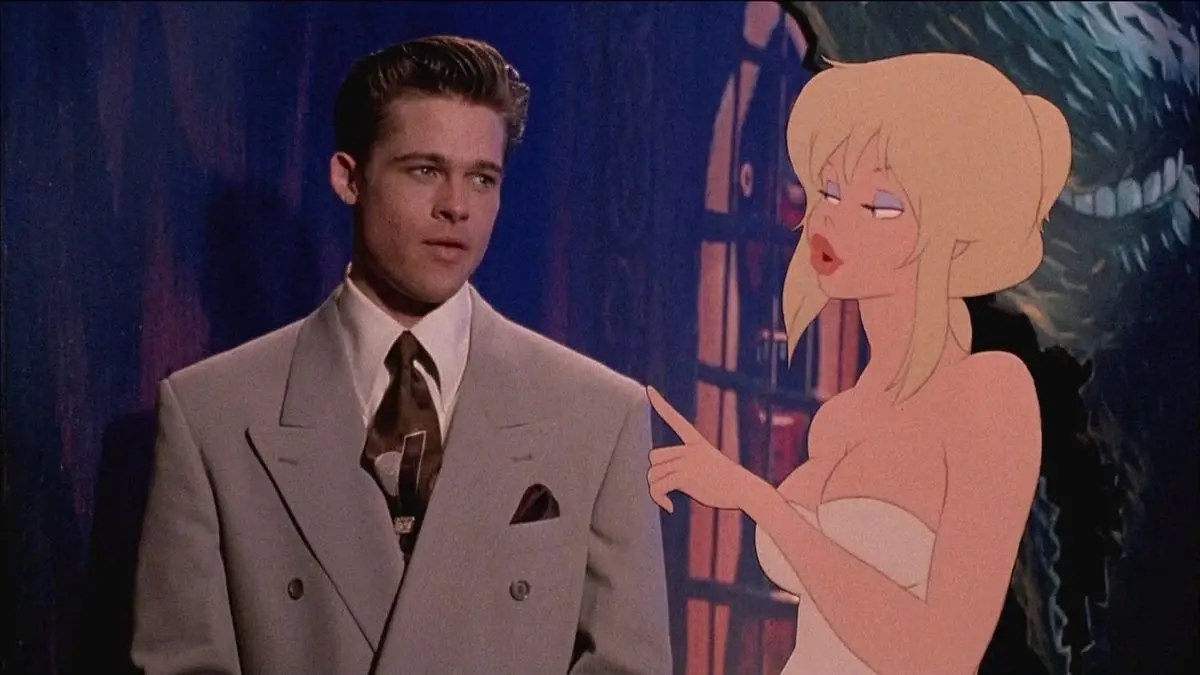
Earth and Cool World were never meant to interact, and Holli’s plan threatens to destabilize both dimensions. She is indifferent to the danger, which puts her at odds with Frank Harris (Brad Pitt), the only human resident of Cool World and one of its few police officers. Jack finds himself caught between the two.
A deliberate clash of animation styles
Bakshi told IGN in 2004 that Cool World originally began as a horror story about the child of a cartoonist and a cartoon who came into the real world to find and kill his father. Paramount bought the concept and hired Bakshi to direct, but on his first day on set, the producer handed him a new script only vaguely based on his own vision—transforming Cool World into a PG-13 action fantasy.
The resulting film reads as a tour through animation history, packed with deliberate stylistic clashes. Some characters resemble Disney knockoffs, others appear drawn in the style of Don Bluth, and many more seem lifted from Tex Avery’s work—all ricocheting off Byrne, Pitt, and one another. Except for Holli, none of Cool World’s doodles ever simply move when they could bounce, slither, or deform.
The surrounding city is split between infinite highways, dark ruins, and strange industrial landscapes, with the deliberate visual inconsistency conveying a sense of cheerful anarchy from the outset.
A film unlike anything else
Cool World has earned a reputation as a cheaper version of Who Framed Roger Rabbit, though the two films share little beyond their core concept. A closer comparison may be 1981’s Heavy Metal: both are early entries into adult animation as a genre and arguably precursors to what later became known as the New Weird.
Big animation studios established certain rules, which smaller productions like this proceeded to deliberately break. Modern viewers who grew up watching anime, SpongeBob SquarePants, and Rick & Morty will likely absorb everything in Cool World without hesitation—yet there was almost nothing else like it in 1992, and arguably still is today.























Rejoignez la conversation