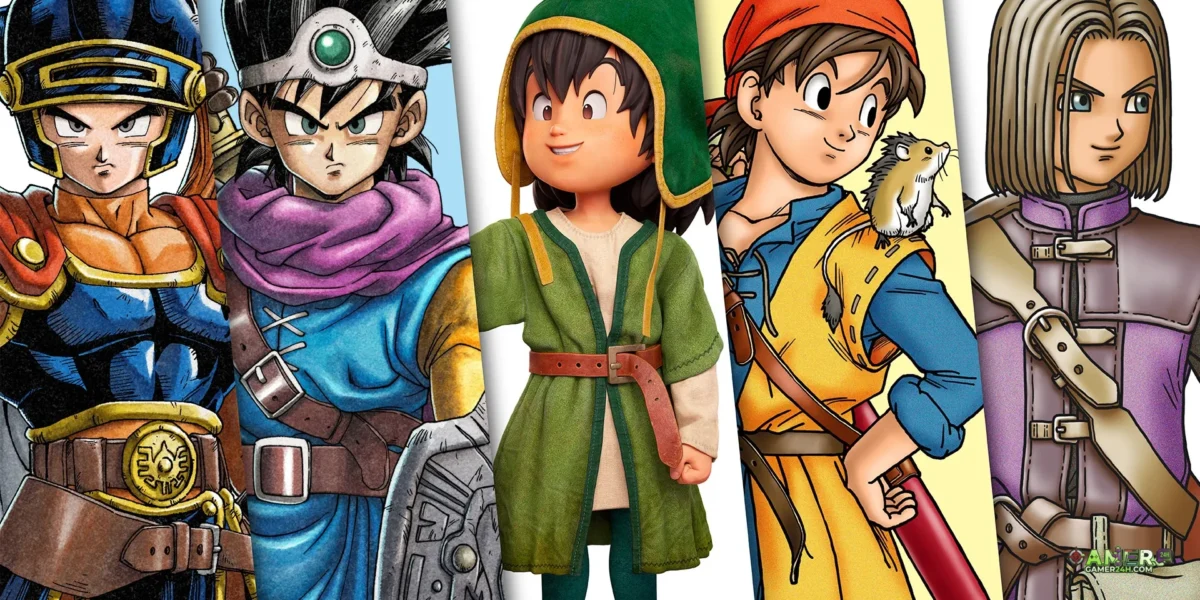
In a bold departure from its predecessors, the title introduces a groundbreaking “Fragments” mechanic that lets players traverse between past and present, gradually piecing together a world that had slipped into ruin. Alongside the series’ classic vocation system, gamers now gain the ability to transform into Monster vocations, adding a fresh layer of strategic depth.
Visually, the game marks the franchise’s inaugural leap into fully three‑dimensional maps, granting players the freedom to rotate the camera and survey their surroundings from every angle. This shift feels like a true evolutionary step into the PlayStation era, offering a more immersive exploration experience than ever before.
Platform: PlayStation 2 | Release Date: November 27th, 2004 (Japan) / November 15th, 2005 (US)
Built to harness the full power of the PlayStation 2, this entry stands as the series’ first fully 3D title. Every character, environment, and cutscene is rendered in stunning 3D, allowing players to wander through expansive vistas that feel truly boundless. The game also introduces core mechanics such as “Skill Points” for character development, cementing its role as a pivotal turning point for the franchise.
The storyline centers on an epic quest to lift the curse of the malevolent jester, Dhoulmagus. By laying the groundwork for future titles, it introduced now‑iconic systems like “Psyche Up,” “Skill Points,” and the “Alchemy Pot.” Coupled with cel‑shaded character animations, behind‑the‑scenes field camera work, and fluid real‑time cutscenes, the game delivers a cinematic, three‑dimensional adventure that perfectly encapsulates the spirit of the PS2 generation.
In commemoration of the Dragon Quest’s 30th anniversary, the game was developed as a tribute to the series’ roots and its grand finale. Steering away from the online realm of Dragon Quest X Online, this installment marked a triumphant return to the offline gaming experience, crafting an entirely new world brimming with nostalgic references to previous titles.
The game’s narrative, which delves into the profound question “What is a Hero?”, skillfully intertwines elements reminiscent of the legendary “Erdrick Trilogy.” The combat system incorporates the engaging “Pep” and “Pep Powers,” while character advancement leverages the customizable “Character Builder.” Additionally, it offers “Draconian Quest” modifiers for high-difficulty challenges, providing an extensive playground for gamers. With its stunning, high-definition world rendered by Unreal Engine 4, the inclusion of retro “Spell of Restoration” passwords, and numerous legacy callbacks, longtime fans were treated to a veritable feast.
The upcoming releases for PlayStation 5 and PlayStation 4 are slated for November 14th, 2024 (Japan & US) and August 24th, 2017 (Japan), respectively.
The 2024 PlayStation 5 release marks the grand culmination of the legendary “Erdrick Trilogy,” a saga that launched with the groundbreaking Dragon Quest and its sequel, Dragon Quest II: Luminaries of the Legendary Line. The original 1988 title ignited a cultural phenomenon in Japan, and the new remake takes that legacy forward by reimagining every visual element with the stunning “HD‑2D” style—a harmonious blend of classic pixel art and modern 3D graphics—while overhauling core gameplay mechanics for a contemporary audience.
Delving deeper into the Erdrick lore, the remake expands the narrative with new story arcs focused on Ortega, the protagonist’s father, and introduces the brand‑new “Monster Wrangler” vocation alongside an exhilarating “Monster Arena” tournament. These additions broaden gameplay variety and deepen the emotional resonance of the series’ mythos.
The HD‑2D aesthetic preserves the original’s charm while delivering a polished, modern visual experience. Fully voiced event scenes and an expansive orchestral soundtrack further immerse players in a world that feels both familiar and refreshingly new.
Historically, Dragon Quest debuted in 1986 as Japan’s first major home‑console RPG, followed by the smash sequel in 1987. This comprehensive remake packages both titles into a single, fully reworked experience, complete with fresh scenarios, new features, and the signature HD‑2D graphics. Players who have completed the chronological prologue of Dragon Quest III can now explore the interconnectedness of the trilogy at its finest.
Combat has been modernized to allow multi‑monster battles in DQ I, while DQ II supports a four‑member party and introduces a new princess from the Kingdom of Moonbrooke. Fresh mechanics such as “Scrolls” that grant specific skills and the integration of DQ II’s collectible “Sigils” into DQ I enrich the gameplay experience. The seamless fusion of pixel‑art characters with 3D backdrops in the HD‑2D style delivers a nostalgic yet innovative visual journey, complemented by fully voiced cutscenes and a majestic orchestral score that deepen immersion into the franchise’s roots.
News Source: PlayStation Blog





Comments
Be the first to comment.