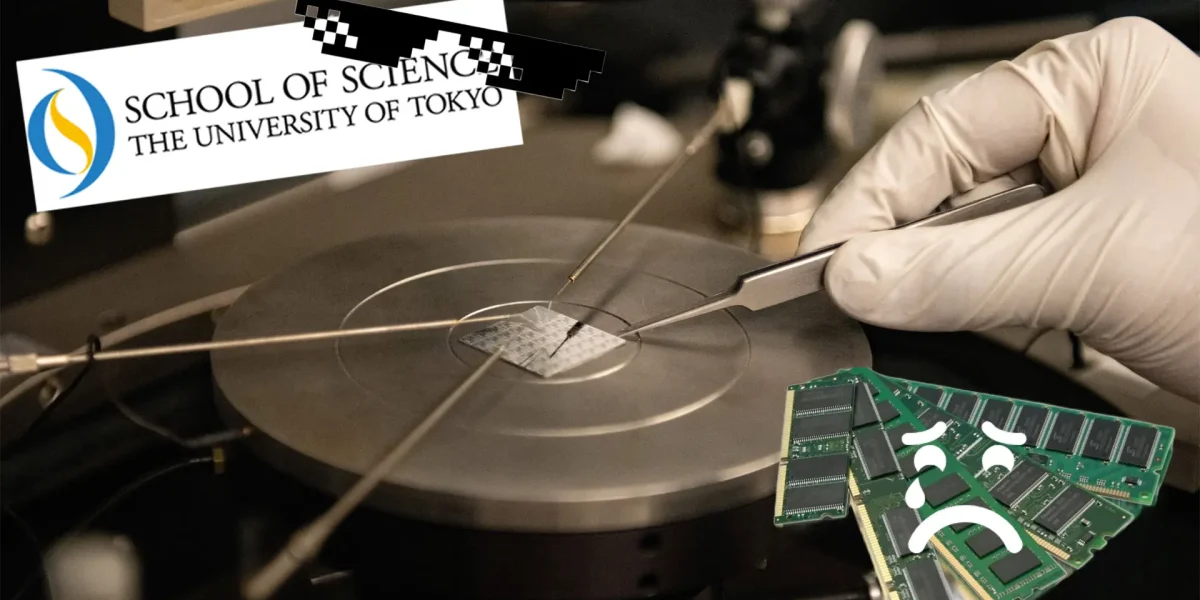
One of the most formidable barriers to contemporary technological progress is the speed ceiling imposed by device overheating. To break through this limitation, a research team from the University of Tokyo has engineered a groundbreaking magnetic memory module that can process data a thousand times faster than today’s standard DRAM technology.
Operating at a blistering 40‑picosecond response time, the new device offers a tangible pathway to building tomorrow’s hardware—delivering unprecedented speed without the usual thermal penalties that plague conventional memory systems.
The breakthrough was detailed in this week’s issue of the journal Science, building on a January 2025 study published in Nature. The paper presents a novel method for flipping a binary magnetic state in picoseconds, a dramatic improvement over the nanosecond switching rates that are the benchmark for modern processors.
Unlike other experimental approaches that push temperatures to dangerous levels in pursuit of speed, this component shines by consuming remarkably little power and generating virtually no heat. The scientists achieved this efficiency by employing a specialized material—manganese tin—and applying short electric pulses to permanently alter the magnetic structure of the chip, securely storing data even when power is completely cut.
The development of this type of technology directly tackles one of the biggest bottlenecks of the AI era: the colossal energy and cooling demands required to move and store data in massive data centers.
To grasp the significance of this breakthrough, it’s essential to understand how computers operate at their most fundamental level. Every time a user opens a browser tab, loads a file, or trains an AI model, the system executes billions of state changes. Transistors flip on and off, memories load and unload, and each transition consumes electrical power that inevitably turns into heat.
In the vast systems that bundle thousands of GPUs to run AI workloads, a large portion of the power draw comes not from performing mathematical calculations but from constantly shuttling and updating data across components. Current technologies simply cannot manage this process without costly side effects.
DRAM, the primary memory in PCs and servers, stores information as electrical charge. However, due to continual leakage, the system must refresh data thousands of times per second to prevent loss, burning energy and generating heat even when idle. In contrast, flash memory on storage drives retains files permanently when the device is powered off, but its slow, energy‑intensive write process makes it unsuitable as main memory.
For decades, the industry has chased a universal memory that blends the advantages of each format, yet attempts to achieve ultra‑fast speeds often relied on brute‑force heating of materials.
Japanese researchers have taken a bold step away from conventional charge‑based memory and ventured into the realm of “spintronics,” a cutting‑edge field that stores data in magnetic states rather than electrical charges. By replacing ordinary metals such as iron or cobalt with a specially engineered compound whose magnetic forces naturally counterbalance, the team achieved a dramatic increase in data‑write speed and a significant reduction in circuit footprint. When layers of this material were deposited on silicon, the scientists demonstrated that simple electrical pulses could instantly move the magnetic structure and lock in information—without the need for heating. Their simulations revealed that the process generates a mere 8 K (14.4 °F) temperature rise, a critical breakthrough that addresses the overheating issues plaguing earlier studies.
Beyond electrical stimulation, the team also harnessed light to reconfigure memory states. By directing a 60‑picosecond optical pulse from a laser onto the material, they could directly generate the electrical write commands required. This optical‑to‑electrical conversion is a pivotal development for data centers, where industry leaders are increasingly exploring photonic interconnects as a replacement for traditional copper cabling.
Should the technology reach commercial viability, it could give rise to computers that retain memory even in deep‑sleep mode, resume tasks instantly, and operate without generating heat. However, the researchers caution that the current prototypes are still small‑scale experiments that rely on external magnetic fields, a limitation that hinders immediate market deployment. Additional hurdles—such as cost, scalability, and compatibility with existing semiconductor manufacturing lines—remain to be overcome.
Even amid a landscape crowded with contenders that have yet to dethrone mainstream DRAM, this breakthrough underscores a fundamental shift: future performance gains will stem not merely from shrinking components but from dramatically reducing the energy required to process information.
News Source: Tarreo





This magnetic memory tech could be a game changer for next-gen consoles, enabling faster load times and smoother gameplay in titles like the upcoming AAA games, all while keeping temperatures in check.
this magnetic memory tech could be a game changer for next-gen consoles, imagine playing AAA titles with ultra-fast load times and no thermal throttling
This manetic memory tech could be a game changer for future gaming consoles, enabling ultra-fast load times and smoother gameplay. ganbatte
arigato! This magnetic memoory tech could be a game changer for next-gen consoles, imagine loading ino a AAA game like Cyberpunk 2077 in seconds
arigato! This magnetic memoory tech could be a game changer for next-gen consoles, imagine loading ino a AAA…
I agree, though I’m keeipng my expectations in check. The news for Magnetic Memory 1,000x Faster Than is promising, but the actual launch is what matters. Need a bit more info.
This magnetic memory tech could be a game canger for next-gen consoles, enabling faster load times and smoother gameplay.
this is so sugoi. This magnetic memory tech could be a game changer for next-gen consoles, imagine loading into a AAA game like Cyberpunk 2077 in seconds.
this is so sugoi. This magnetic memory tech could be a game changer for next-gen consoles, imagine loading…
i agree, though I’m keeping my expectations in chcek. The news for Magnetic Memory 1,000x Faster Than is promising, but the actual launch is what matters. Communiy feedback will show the truth. to be honest
ya habbii shukran. This magnetic memory tech could be a game changer for next-gen consoles, enabling faster load times and smoother gmeplay.
This magnetic memory tech could revolutionize gaming PCs and consoles with 1000x fastter speeds and minimal heat output, potentially enabling seamless gameply.
This magnetic memory tech could be a game changer for next-gen consoles, imagine loading into a AAA game like Cyberpunk 2077 in seconds.