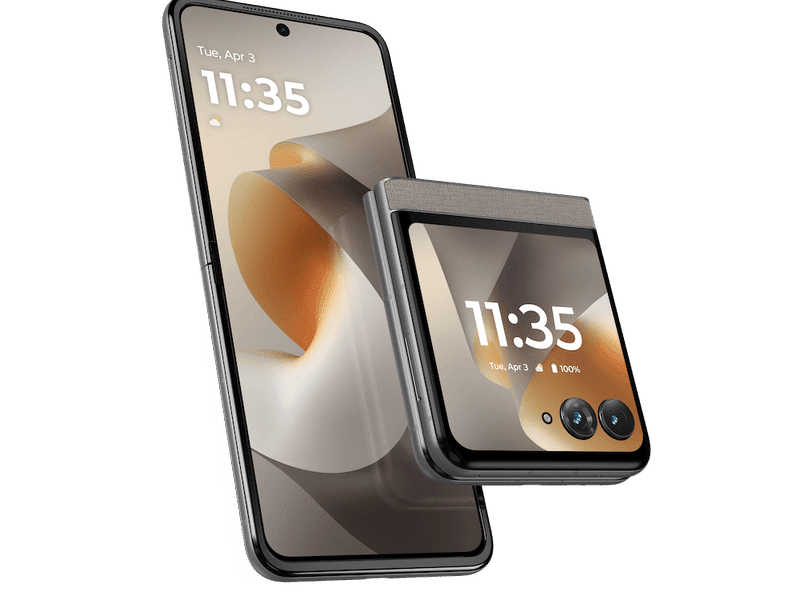
We tested the Motorola Razr 70, the smaller sibling of the Razr 70 Ultra that has already been evaluated by our team. We delve deeply into whether this base model lives up to expectations. Razr remains an iconic name. Back in the early 2000s, owning a Motorola Razr V3 was the ultimate status symbol. My wife still cherishes hers. Motorola took a bold gamble by resurrecting the brand in the foldable smartphone arena. Let’s see if they honor their legacy.
To position itself as a premium device, the Razr 70’s packaging is sleek and minimal. It closely follows the design philosophy of its rival, the so‑called “fruit of the forbidden” (Apple). Inside, you’ll find the phone and a USB‑C cable. The case protector, necessary for a foldable, is split into two rigid halves. The box also includes a 33W TurboPower charger and a SIM tray ejector pin. Notably, no earphones are bundled.
Motorola has been refining its foldable lineup for roughly six years. Each iteration has addressed early criticisms—screens that didn’t close fully, doubts about panel reliability, and battery life complaints.
The Razr 70 seems to have shed those flaws. Every component fits together flawlessly. The robust aluminum frame delivers exceptional rigidity and perceived quality. The rear is clad in Gorilla Glass Ceramic, one of the toughest materials available today.
On the closed front, the two primary cameras shine beside a 3.6‑inch external pOLED display. Though a touch smaller than the 4‑inch panel on the Ultra, it serves perfectly for glancing at the clock, checking the weather, or replying to a WhatsApp without opening the device. Fully folded, the unit remains impeccably sealed, a testament to Lenovo’s meticulous screen engineering. New stainless‑steel and titanium hinges guarantee greater overall durability, while the device retains IP48 protection—withstanding particles larger than 1 mm and water immersion up to 1.5 m for 30 minutes—a remarkable feat for a phone of this stature.
Holding it closed in the palm feels absolutely delightful. It becomes addictive, especially coming from devices whose average size exceeds 6 inches. It almost vanishes when tucked into a trouser pocket. Despite its remarkable compactness, the real magic unfolds when the phone opens, revealing a stunning 6.9‑inch AMOLED interior display that boasts a 120 Hz refresh rate, HDR10+ support, and a 1080 × 2460 pixel resolution. This delivers a 22:9 aspect ratio with a Mohs hardness of 4. The contrast ratio is superb, colors are vibrant, and while it doesn’t reach the 165 Hz of the Ultra, the 120 Hz ensures animations flow naturally, surpassing competitors’ averages.
Physically, the device mirrors the Ultra variant’s dimensions, measuring 171.5 × 74 × 7.2 mm when open, and tipping the scales at roughly 188 grams. The Razr 70’s fingerprint reader is ingeniously integrated into the side power button, delivering a fast, responsive, and highly accurate experience.
Unlike the flagship model, this Razr 70 is powered by a MediaTek‑signed processor: the Dimensity 7450X, featuring four Cortex‑A78 cores at 2.6 GHz and four Cortex‑A55 cores at 2.0 GHz. While it may not be the fastest chip on the market, its overall performance far exceeds expectations. The eight cores run alongside a stock Android 16 OS, and, as Motorola has shown, daily usage remains exceptionally smooth.
The device’s visual engine is powered by the Mali‑G615 MC2 GPU. While not the most cutting‑edge chip on the 2026 market, it delivers solid performance across a wide range of workloads. Coupled with a 120‑Hz display, the Razr 70 offers a visual experience that far exceeds the industry average.
In rigorous on‑the‑go testing, we pushed the device with titles such as Asphalt 9, Call of Duty Mobile, and PUBG, as well as lighter games like Fallout Shelter and the artistic Monument Valley 1 and 2. The Razr 70 maintained a steady frame rate well above 60 FPS, delivering a consistently fluid experience.
The Razr 70’s photography suite remains robust, featuring two 50‑megapixel main lenses—one standard and one ultra‑wide—both equipped with optical image stabilization. The front‑facing sensor is a 32‑megapixel Quad‑Bayer unit that outputs 8‑megapixel selfies, offering a balanced approach to self‑portraiture and video calls.
Captured images are sharp and true‑to‑life, thanks to well‑handled HDR and precise color balancing that avoids oversaturation. The ultra‑wide lens preserves fine detail and a wide dynamic range, ensuring that every shot looks natural.
At night, the main camera’s “Night Vision” mode delivers impeccably balanced chromatic tones and a dynamic range that mirrors real‑world perception, while the ultra‑wide counterpart also shines with remarkable clarity in low light.
The 32‑megapixel front sensor finds its niche in video calls, whereas the 3.6‑inch external display can be used as a mirror, allowing users to snap high‑resolution 50‑megapixel selfies with the main camera. This dual‑use approach gives the Razr 70 a versatile edge for both everyday photography and social media.
For videography, the Razr 70 records up to 4K at 30 fps with the primary lens and up to 1080p at 120 fps on the secondary lens. It defaults to the H.264 codec but can switch to the more efficient H.265 to conserve storage, all while retaining image stabilization and a handy horizon‑lock feature on the ultra‑wide camera.
Motorola equips the device with 256 GB of internal flash storage—ample for most everyday tasks. The downside is the absence of a microSD slot, meaning users cannot physically expand storage once the internal memory is exhausted.
Battery life stands out as a major strength, featuring a generous 4,800 mAh cell paired with a low‑power AMOLED display that delivers two full days of typical use. Continuous video playback pushes endurance to roughly 15 hours. The bundled 33‑W charger tops the phone from 0 % to 100 % in about 55 minutes, hitting 80 % in 40. Qi wireless charging up to 15 W lets you leave it on a dock overnight. Connectivity is current, offering Wi‑Fi 6E, Bluetooth 5.4, and NFC.
Purchasing a foldable is a statement of intent. Those drawn to the form factor seek either extreme portability or a bold, disruptive statement. The Razr 70 delivers on both fronts, backed by balanced hardware that, while not flagship‑level, is more than adequate.
Today the Razr 70 is available for 1,499,000 Argentine pesos on Motorola’s official website. While not a bargain, the price sits 700,000 pesos below the Ultra edition, creating a significant gap that makes this model highly appealing. Its portability, titanium‑reinforced build, and everyday performance earn it a well‑deserved Gold Medal from IRROMPIBLES.
❓ Frequently Asked Questions (FAQ)
Does the Motorola Razr 70 come with earphones in the box?
No, the Razr 70 does not include earphones; Motorola has opted for a minimalistic, eco‑friendly packaging approach, leaving out bundled earphones.
What kind of charger is included with the Razr 70?
The device ships with a 33W TurboPower USB‑C charger, providing fast charging capability for the foldable smartphone.
How does the Razr 70 improve upon earlier foldable models in terms of design and durability?
The Razr 70 features a robust aluminum frame, a split two‑half case protector, and a screen that closes fully without gaps, addressing previous criticisms of panel reliability and structural rigidity.
News Source: Irrompibles





Comments
Be the first to comment.