It has been a long time since a soulslike truly humbled me. After a decade of playing FromSoftware’s games and their flock of imitators, I thought I had mastered the genre’s intricacies. However, Guns of Eschaton arrived to remind me that there’s always more to learn.
A Unique Take on the Soulslike Formula
Guns of Eschaton isn’t your typical soulslike. It’s a first-person shooter set in an apocalyptic weird west, a setting that throws many familiar third-person melee strategies out the window. While it retains core soulslike elements – earning level-up currency from kills, losing it upon death, fighting for every inch of progress, and offering co-op support – its unique quirks make it feel like learning to walk all over again.
One of the biggest challenges is that most enemies wield ranged weapons. This means you’re constantly dealing with archers, just like in Anor Londo. During a recent two-hour demo, I suffered through dozens of deaths as I tried to understand Guns of Eschaton’s gunpowder-heavy approach to the soulslike genre.
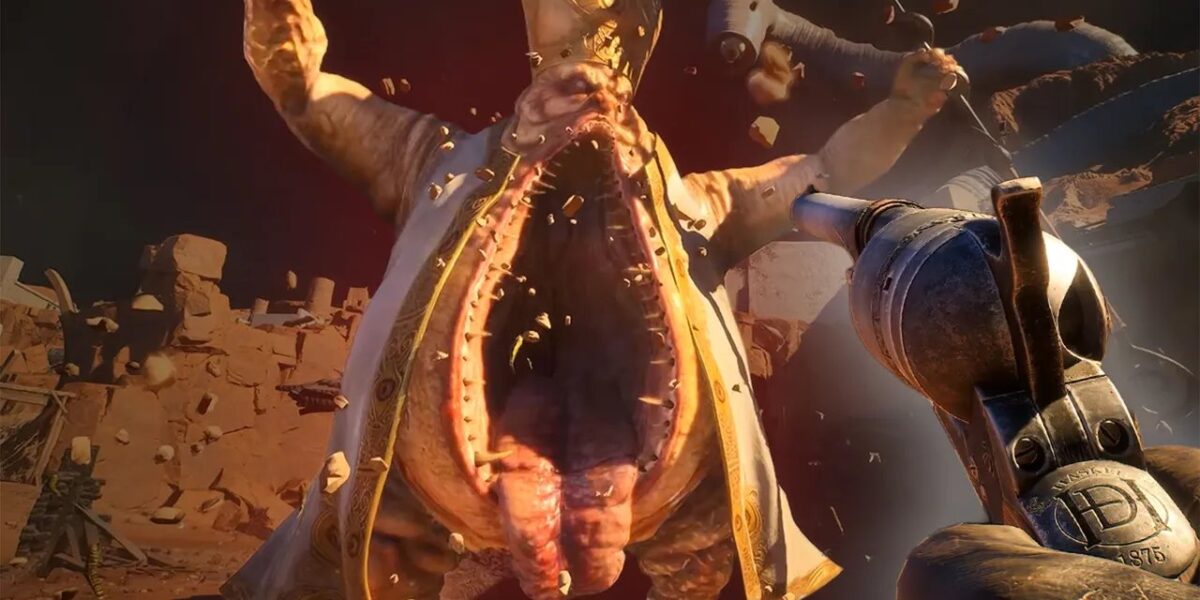
The most important aspect is your weapon. Developer Eschatology Entertainment has recreated authentic 19th-century firearms. In my demo, I used a six-shot single-action revolver. It’s an admirably fiddly piece of hardware; the hammer must be cocked before each pull of the trigger, and the empty shells must be ejected one-by-one before refilling the cylinder with fresh ammunition. Reloading is an excruciatingly lengthy ordeal, and getting caught in the open with six spent cartridges is a death sentence.
You can also manually rotate the cylinder to line up specific chambers, which becomes important when you acquire bullets with special properties, such as armor-piercing or cursed projectiles. While the demo didn’t allow me to tinker with this system in depth, I can already see the potential of arranging a full drum of different bullets, firing them off in sequence to cause maximum pain.
I also got a better handle on Guns of Eschaton’s shot sequence system. While you can dispatch enemies by simply pumping lead into them, you can achieve much more efficient kills by shooting them in particular patterns. For example, the Serviteur can be quickly eliminated by blasting its left and right leg in sequence. The Severed Lawman must be capped in the left leg, left arm, and then the head. Your gunslinger is equipped with a book, and pulling it out while looking at one of your foes will flick to the relevant page that reveals the correct sequence.
Having only played for a couple of hours, I’m yet to decide if this sequence system is a work of genius or simply too complicated. In general, I’m drawn to games that radically rethink genre conventions – I adore Doom Eternal’s lock-and-key approach, and there’s an echo of id Software’s divisive design in Guns of Eschaton. Repeating enemy types makes it easy to commit sequences to memory, and each new foe introduces a one-off scramble to do field research under fire. But even on its higher difficulty levels, Doom Eternal was never quite as punishing when it comes to progress lost, and the Doom Slayer didn’t have to reload any of his weapons, never mind feed in each cartridge one at a time. And yet, the approach ensures there’s purpose in each stand-off, so much so that even “cannon fodder” enemies are combat puzzles to solve. I admire Eschatology Entertainment’s dedication to making each and every enemy feel like a duel.
There is also a dedicated duel mechanic, which demands you stay perfectly still and only fire back after deflecting the enemy’s shot. However, this is how almost every face-to-face shootout functions, so at least at this early stage the dueling feels a bit redundant.
Guns of Eschaton wouldn’t be able to lay claim to the soulslike badge if it didn’t have a parry system. Enemy weapons emit a flash of light and make a mechanical “chambering” sound before firing, which is your cue to perform a parry. A pair of spectral arms shield your face, and perfect timing triggers a brief window of slow-motion within which you can fire off a damaged-buffed counter-attack. As with so many melee action games, it’s a source of deep satisfaction. However, there are some frustrations that come as a result of this being a shooter – often there are multiple enemies firing at you simultaneously, and parrying plus countering all incoming attacks is a difficult exercise. Additionally, I’d often be shot at by snipers I hadn’t yet seen, which blindsided me with crippling damage. It felt cheap in a way Dark Souls’ surprise hidden enemies typically don’t.
There are multiple other new ideas that I was only able to briefly touch. There’s a library of abilities to be acquired from the world’s NPCs, plus a magic system with both prayers and curses, but the thing that interests me most is the bandolier worn by your protagonist. Creative director Fuad Kuliev tells me it can eventually be filled with unique handguns, each equipped with its own custom-arranged cylinder of special bullets. With multiple guns ready to go, you can fire off every round in one and then pull out the next, allowing for uninterrupted battle. It’s an approach with exciting potential – I’d love to craft a bandolier tailored to each of the game’s boss fights.
While I didn’t face any of those bosses in the demo, the trailers suggest there’s an array of fantastic-looking horrors waiting in the decaying wastes of the west. That won’t come as a surprise to those who know the name Viktor Antonov, the art director of Dishonored, Half-Life 2, Wolfenstein: The New Order, and now Guns of Eschaton.
Antonov sadly passed away last year aged just 52, a tragic event that has somewhat uncomfortably become the focal point of Eschatology Entertainment’s promotional material. The Bulgarian artist’s distinct style is clear to see in Eschaton’s world, with his bold, brutalist line work now present in the frontier’s sheer cliffs and chunky details. So far I wouldn’t say it’s as striking as his work on Dishonored, in part due to the demo’s sparse desert area lacking the lived-in character that Dunwall communicates, but – as with the bosses – the trailers suggest there’s plenty of his magic in later environments.
Getting through Guns of Eschaton’s demo was arduous. Everytime I felt like I’d conquered a milestone – mastering the parry, nailing the sequence system, paying proper attention to how many shots were in my cylinder – I was knocked back down by a bleed-inflicting beartrap, a surprise stick of dynamite, or an encounter with the Glutton, a grotesque priest who relentlessly tracks you with a damaging energy ray. But while I left the preview session feeling dejected by my inability to truly connect with it, I can’t help but wish I was back in Guns of Eschaton’s world, tinkering with bullet arrangements and finding new solutions to the seemingly never-ending array of frustrating horrors. That’s the curse of being a soulslike fan – you really do become a masochist.
As with Bloodborne, my initial introduction to the genre, I’m entranced enough by the world and systems to want to endure the painful processes of “gitting gud.” And with any luck, the promising depths of Guns of Eschaton’s campaign will make it worth enduring.
Source: IGN




Comments
Be the first to comment.