

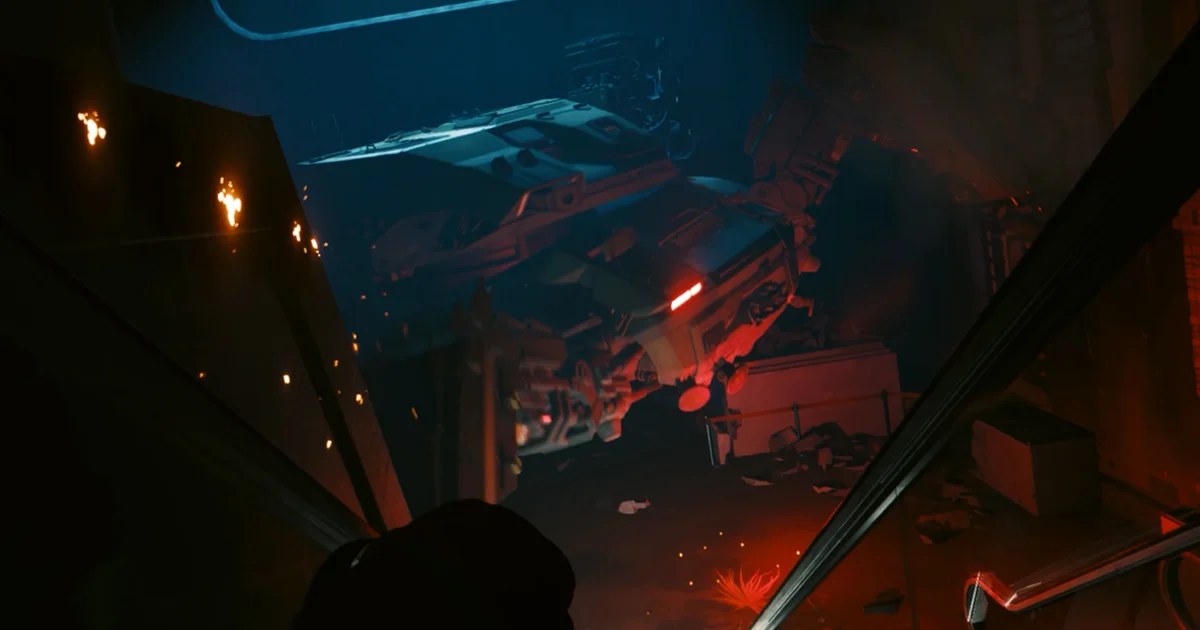
The Chimera tank boss fight in Cyberpunk 2077: Phantom Liberty was so ambitious in its design that it consumed two years of development and reportedly four full rebuilds before it felt right. The revelation comes from an interview with game director Gabe Amatangelo, creative director Igor Sarzyński, and art director Paweł Mielniczuk, who broke down the production challenges CD Projekt Red faced while crafting the set piece. The discussion surfaced on the latest episode of the AnsweRED Podcast, where the trio reflected on the specific hurdles the studio encountered during the game’s development.
For players who have faced the boss, the payoff may feel obvious in hindsight. The encounter opens with a Ghost in the Shell–esque chase sequence, a big, boisterous moment in which the armored tank pursues the player before ultimately hunkering down in a single spot, leaving it vulnerable for the kill. But that cinematic flourish belies the sheer labor behind it. As the developers explained, the Chimera was never simply a combat encounter—it was a convergence of multiple disciplines, which is precisely what made it so difficult to get right.
A Nexus of Gameplay, Narrative, Art and Worldbuilding
Amatangelo described the Chimera as a rare case where content sits at the intersection of several creative fields at once. “Sometimes we’re making content that’s a nexus point of different disciplines; the Chimera is a great example of that,” he said. The fight was simultaneously a gameplay challenge, a narrative beat, an art demonstration, and a piece of worldbuilding. To sell the military authenticity of the vehicle, Amatangelo and Mielniczuk reportedly exchanged YouTube videos of real-world mini-gun-equipped military equipment, using them as reference material to inform the design.
The goal was visceral impact. “When this chimera rises up, we just want it to terrify you with this overwhelming sound,” Amatangelo recalled. That terror factor, however, required relentless iteration. Mielniczuk, who hosted the interview, emphasized the scale of the effort: “We were iterating— I think it was two years to make this boss fight work. We were reiterating over and over.”
“It was about striking a balance and I think the three of us heavily got into it and went, ‘Okay beat by beat, let’s do this.'”
Gabe Amatangelo, Game Director
The process was iterative to an extreme degree. According to Mielniczuk, the team was “doing the tank I think four times, changing equipment, the weapons,” with Sarzyński adding that the finished asset represented “one of the most expensive art assets I think ever.” The combination of high production value and a multi-disciplinary brief meant the team had to constantly recalibrate the fight’s pacing, tone, and mechanical execution.
Community Reaction and the Wow-Factor Debate
Not everyone who has experienced the encounter has been convinced the effort translated into a fully satisfying payoff. Some players have noted that while the lead-up sequence is genuinely impressive to watch, it leans into a design sensibility reminiscent of the PS3 era—one built around spectacle rather than interactivity. In that framing, the elaborate chase and rising tank can feel like a “wow-factor” moment that players cannot meaningfully engage with during the sequence itself.
Once the fight proper begins, the action settles into a relatively open arena where the tank does not move much, which some have interpreted as a missed opportunity given the resources invested. Still, the developers’ willingness to spend years refining a single encounter speaks to a studio that values polish and ambition. Even for those who are not entirely won over by the final result, the Chimera stands as a case study in how much labor can go into a single moment of gameplay.
Looking Ahead
Phantom Liberty has since become one of the most acclaimed expansions in the Cyberpunk 2077 franchise, helping to redefine the game’s reputation following its troubled 2020 launch. The Chimera boss fight remains one of its most memorable set pieces, and the studio’s candid reflections on its development offer a rare glimpse into the meticulous process behind modern AAA design. As CD Projekt Red continues to support the game with updates and new content, the Chimera’s story serves as a reminder that the most expensive art assets are often the ones that demand the most patience to perfect.



1 comment