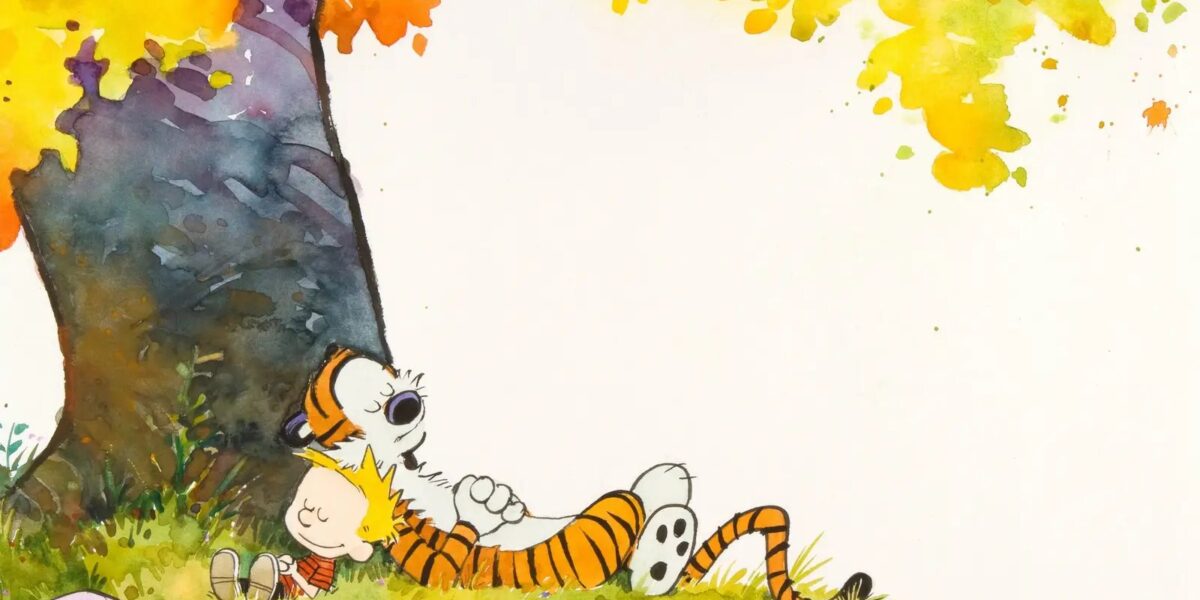
For those unfamiliar with Bill Watterson’s masterpiece, Calvin and Hobbes, it might come as a surprise just how profound this seemingly simple comic strip can be. Yes, it features a rambunctious young boy and his stuffed tiger, and yes, there are plenty of hilarious installments involving flying T-Rexes and massacred snowmen. But that’s only one facet of Calvin and Hobbes.
The Deeper Meaning
At its core, Calvin and Hobbes delves into surprisingly thoughtful themes. Calvin, despite his mischievous nature and aversion to homework, possesses a remarkable capacity for deep thought and profound ideas. One memorable strip features Calvin and Hobbes speeding down a hill on a sled when Calvin poses the question: “Hobbes, do you think human nature is good or evil? I mean, are people fundamentally good with bad tendencies, or fundamentally bad with a few good ones?” The comic doesn’t offer an answer, leaving the reader to ponder this complex question.
Beyond human nature, Calvin and Hobbes occasionally explores humanity’s place in the universe. In one strip, Calvin stands alone under a starry sky and exclaims, “I’m significant!” He pauses, then mutters to himself, “Screamed the dust speck.” This understated moment highlights our insignificance within the vastness of the cosmos while acknowledging our innate desire for significance.
Many Calvin and Hobbes strips are monologues where Calvin poses well-thought-out questions. However, this strip is more subtle, emphasizing humanity’s insignificance in the grand scheme of things, alongside our inherent yearning to feel significant. It’s a powerful combination of ideas packed into a single panel.
The Ends Justify the Means?
The comic also tackles complex ethical dilemmas, such as whether the ends justify the means. In one strip, Calvin rants about how “I don’t believe in ethics anymore,” arguing that “might makes right” and that “winners write the history books.” A moment later, Hobbes pushes Calvin into a puddle of mud, and Calvin angrily asks why. Hobbes replies, “You were in my way. Now you’re not. The ends justify the means.” This highlights the hypocrisy inherent in such justifications, as Calvin points out that Hobbes was only applying the principle to him, not universally.
Einstein, Relativity, and Broken Watches
The comic often plays with big ideas, but sometimes the humor comes from Calvin’s misunderstanding of them. In one memorable strip, Calvin attempts to test Einstein’s theory of relativity using his wagon. He believes that because time slows down as you travel faster, he can slow time itself by making his wagon go as fast as possible. Hobbes watches with a pocket watch, waiting for time to stop. When the wagon crashes, Hobbes declares that Einstein was right, pointing out that his watch isn’t working anymore – even though it’s simply broken.
A Call to Nature
Perhaps the most enduring theme in Calvin and Hobbes is nature. Watterson repeatedly returns to this subject, depicting Calvin wandering through the woods or sledding down snowy hills. His appreciation for nature is evident not only in the visuals but also in the dialogue, where Calvin laments deforestation or pollution.
Long before the phrase “touch grass” became a meme, Calvin and Hobbes advocated for it. The comic encourages us to connect with nature and appreciate its beauty. In one strip, Hobbes expresses his appreciation for the fall season, even though it makes Calvin melancholy.
The Timeless Wisdom
My favorite Calvin and Hobbes quote that inspires us to “touch grass” appeared on January 6, 1991. The strip begins with Calvin and Hobbes walking through the snow. Calvin says, “You know, Hobbes, it seems the only time most people go outside is to walk to their cars. We have houses, electricity, plumbing, heat… Maybe we’re so sheltered and comfortable that we’ve lost touch with the natural world and forgotten our place in it.”
Then Calvin delivers a profound observation: “Maybe we’ve lost our awe of nature.” This quote has resonated with me for years. It perfectly captures what’s wrong with our screen-obsessed world today. Instead of putting down our phones to connect with nature, we often stay indoors, ignoring the world around us and forgetting our place in it. While cell phones weren’t a huge deal back when Calvin and Hobbes was running, this quote is even more relevant now, in an age where many can’t look away from their devices – even when they are literally touching grass.
Source: Polygon




Comments
Be the first to comment.