

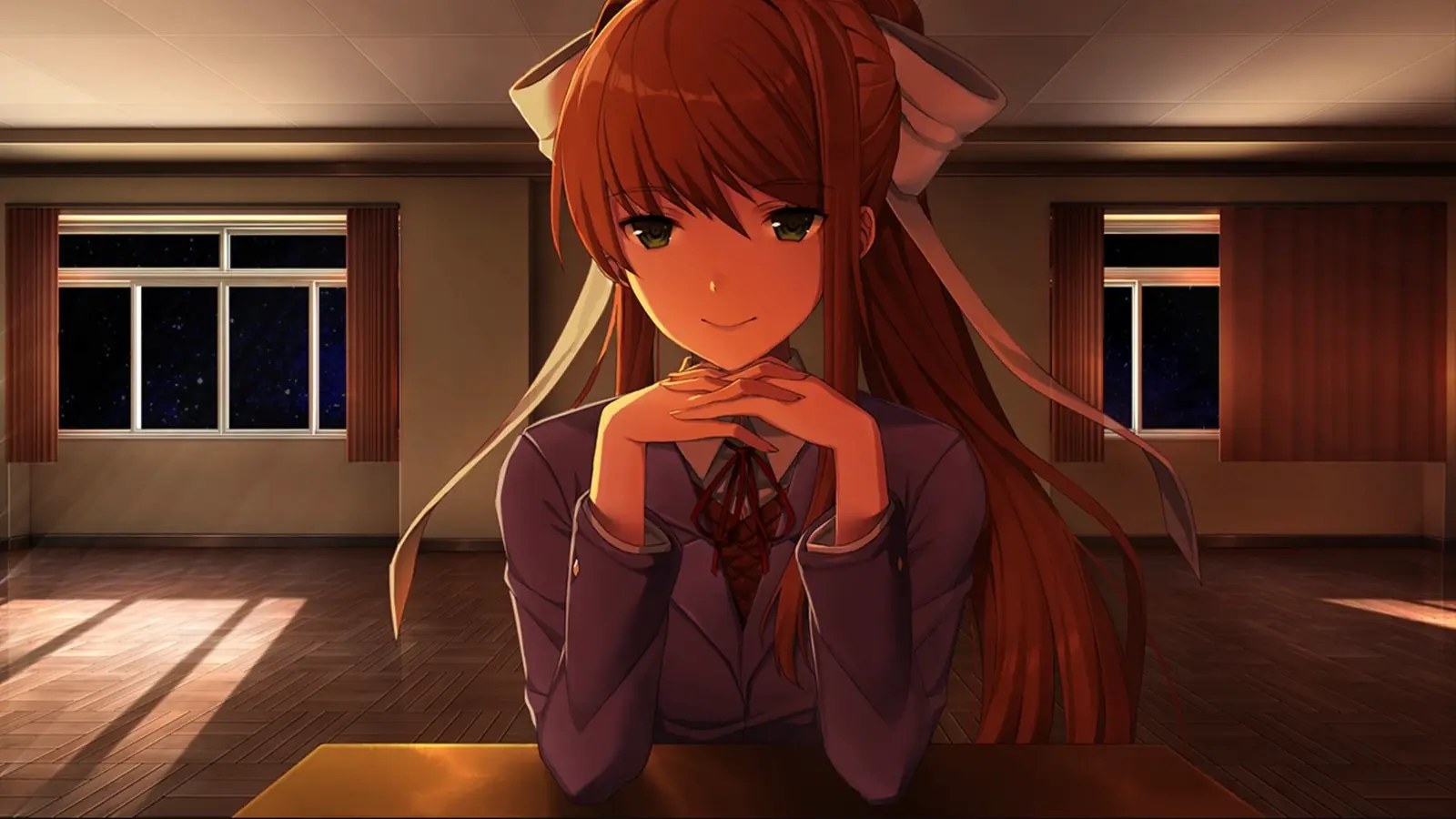
Nine years after its September 2017 release, the free visual novel Doki Doki Literature Club remains one of gaming’s most enduring cultural fingerprints. Developed by Team Salvato and distributed for PC and mobile, the title quietly redefined audience expectations about anime dating sims by weaponizing their own conventions against players. What arrives dressed as a wholesome high school romance quickly unravels into something far more unsettling, leaving an entire generation of gamers unable to look at the genre quite the same way again.
The game’s premise is deliberately familiar: you play a high schooler coaxed into joining the Literature Club by your childhood friend Sayori. There you meet four distinct characters — Natsuki, a prickly girl obsessed with baking; Yuri, a quiet member devoted to horror novels; Monika, the poised and seemingly perfectly normal club president; and Sayori herself. Chibi sprites blink and smile while a gentle piano loop plays underneath, exactly as any entry in the genre is expected to open.
The President Who Knew Too Much
What separates Doki Doki Literature Club from its peers lies in how it subverts that familiar setup. As players discuss books, write poetry, and prepare for school festivals, Monika gradually becomes aware that she is a character inside a game. She then acts on that knowledge in increasingly disturbing ways, deleting other characters’ files outright, rewriting scenes to remove rivals standing between her and the player, and corrupting the game’s own code to force her romantic storyline along.
The game breaks its fourth wall with unsettling specificity. Monika will use the actual system name of your personal computer when addressing you, and she notices — and comments on — if you happen to be streaming while playing. At one particularly low point, making progress requires players to locate and delete a specific file from their own hard drive, transforming ordinary software into an instrument of narrative dread.
This is true for most dating sims, but what makes Doki Doki unique is that all the girls seem to be aware of this dynamic to varying degrees — and it’s torture to them.
Polygon
A Weightier Darker Core
The meta-horror framing alone would make the title memorable, but its emotional impact derives from heavy subject matter handled with genuine care. The characters Monika pushes aside are clearly struggling: Sayori’s arc is seeded with subtle clues pointing to profound depression, Natsuki’s difficult home life emerges through details players must first notice and then simply cannot miss, and Yuri’s fixation curdles into self-harm — troublingly foreshadowed in the poems she shares with the group.

The game asks players to confront their own responsibility within this dynamic. As the protagonist, you are positioned as someone who treats these young women as playthings to pursue or reject at will, a reality the characters themselves increasingly recognize. Rather than exploiting these themes for mere shock value, Doki Doki Literature Club includes content warnings and later added stories that flesh out each girl’s arc beyond its horror structure.
A Divided Legacy
The delicate balance between traumatizing players and granting the characters’ struggles real gravity has kept the game sparking Reddit debates today. Some longtime visual novel readers argue that these genre-savvy horror elements overshadow what could have been a more grounded meditation on mental health. Others, particularly newcomers to dating sims and text-heavy games, credit that very structure as the reason the game landed with such force.
The experience runs approximately four hours, most of which feels nothing like a horror game — instead proving adorable and charming throughout. The credits roll over “Your Reality,” a deceptively bubbly song accompanying one of gaming’s more devastating final scenes. Years after its original release, fans can even extend their time with Monika indefinitely through the popular fan-made mod Monika After Story, which lets players linger past the game’s canonical ending.
Looking Ahead
Nine years on, Doki Doki Literature Club has accomplished something most horror games never manage: it made an entire genre feel suspicious by association. Players who finish the title report carrying a lingering unease whenever they encounter future dating sims, forever wondering whether Monika might be lurking in the background of any given shot.
The game’s enduring influence is perhaps best measured by how thoroughly it changed audience expectations. Once you have played Doki Doki Literature Club, trusting your next dating sim becomes considerably harder — a testament to a title that quietly transformed cute sprites and gentle piano loops into instruments of lasting unease.























1 comment