

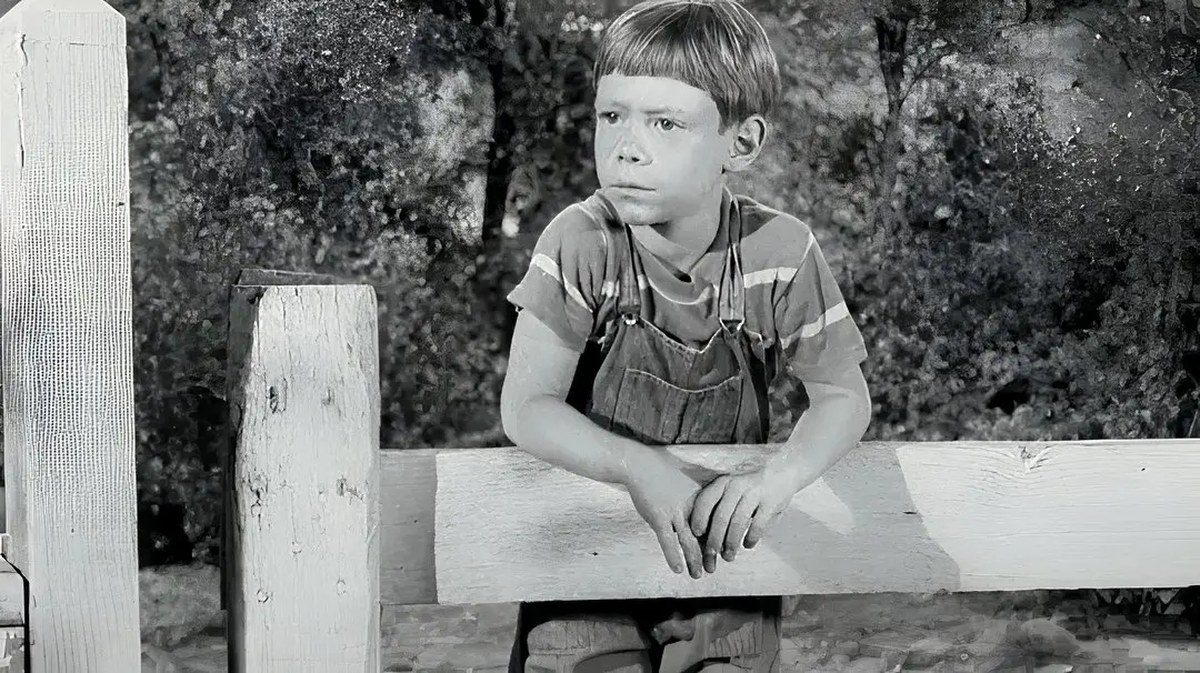
Some sixty-five years ago this week, Rod Serling’s acclaimed horror anthology series delivered what many consider its most unsettling entry: the Season 3 episode “It’s a Good Life,” which premiered on December 15, 1960. Rather than relying on conventional monsters or supernatural beasts, the two-part story channeled terror through the figure of Anthony Fremont, a six-year-old boy whose god-like mental powers have reduced an entire village to tyrannical submission. The episode remains a landmark of speculative fiction that slipped past 1960s television censorship by cloaking its commentary on authoritarianism in the language of the uncanny.
Aired as Episode 8 of Season 3, “It’s a Good Life” follows Serling’s tradition of stories that disturb and unsettle before delivering a twist laced with moral weight. Over five seasons, Serling served as both host and writer, examining science, superstition, prejudice, and identity through tales engineered to linger long after the credits rolled. While fans point to later standouts such as “Eye of the Beholder” and “Nightmare at 20,000 Feet,” this particular installment manages to burrow beneath the skin in ways that modern horror enthusiasts still find difficult to shake.
A Monster With a Little-Boy Face
The episode opens with one of Serling’s eeriest narrations. The creator introduces viewers to the village of Peaksville, now isolated after the rest of the world seemingly vanished. Though the residents cannot explain how this occurred, they know why. “A monster had arrived in the village,” Serling declares, noting that it simply used its mind to remove automobiles, electricity, and machines because they displeased it.
Just as audiences expect a traditional beast or futuristic alien to emerge, Serling delivers his ominous reveal:
“His name is Anthony Fremont. He’s six years old with a cute little-boy face and blue guileless eyes. But when those eyes look at you, you’d better start thinking happy thoughts. Because the mind behind them is absolutely in charge. This is the Twilight Zone.”
Rod Serling, “It’s a Good Life”
The child Anthony has used his powers to construct a tyrannical society stripped of any genuine freedom—not through malice, but because he was never disciplined and remains utterly clueless about morality or its consequences.
The Terror of Forced Compliance
Peaksville sits in technological darkness. Anthony has blocked television signals and dismantled automobiles, the food supply has dwindled, and adults must obey his every whim to avoid banishment to a place known only as “the cornfield.” Because he can read minds and punish anyone who challenges him, the villagers feign happiness at all times, forcing themselves to think happy thoughts and say happy things.

This fragile equilibrium collapses when a man named Dan Hollis (Don Keefer) drunkenly calls Anthony a monster and stirs others toward revolt. The episode examines the horror of forced compliance, portraying a society full of adults rendered helpless against a child who does not grasp his own cruelty—a suffocating meditation on the loss of autonomy under authoritarian rule.
An Allegory for State Surveillance
Although Serling penned the screenplay, “It’s a Good Life” is based on Jerome Bixby’s 1953 short story of the same name. Some of its most unnerving sequences carry over from the source material, including a scene in which Aunt Amy (Alice Frost) remarks that it is “a terribly hot day” while receiving groceries from Bill (Tom Hatcher). As soon as she speaks, Bill pushes back urgently:
“Oh, I wouldn’t say that, Aunt Amy… No sir, I wouldn’t say that at all. It’s fine. It’s just fine. It’s a real good day.”
Bill, “It’s a Good Life”
He hastily tries to convince both himself and the watching child that everything is perfectly fine.
This constant undercurrent of terror functions as a compelling allegory for state surveillance and the limited options available to a helpless populace living under an authoritarian regime. Peaksville is entirely cut off from the outside world, making rescue impossible, while Anthony’s unpredictable powers mean no one can safely revolt—he can doom everyone without thinking things through, exactly as he does when Dan challenges him during a drunken fit of anger.
A Bleak Ending That Lingers
Even setting aside its allegorical themes about dissent and the abuse of power, “It’s a Good Life” stands as an excellent episode. Serling makes both his opening and closing narrations count, adding urgent, anxiety-inducing context to a story that can never offer a happy ending. Anthony’s petulant nature proves genuinely terrifying, since the rules of human civilization no longer apply to Peaksville under his rule—a lose-lose scenario engineered to leave audiences with an uncomfortable pit in their stomachs within just twenty-five minutes.
The Twilight Zone can be streamed on Pluto TV and Prime Video.























Join the conversation