

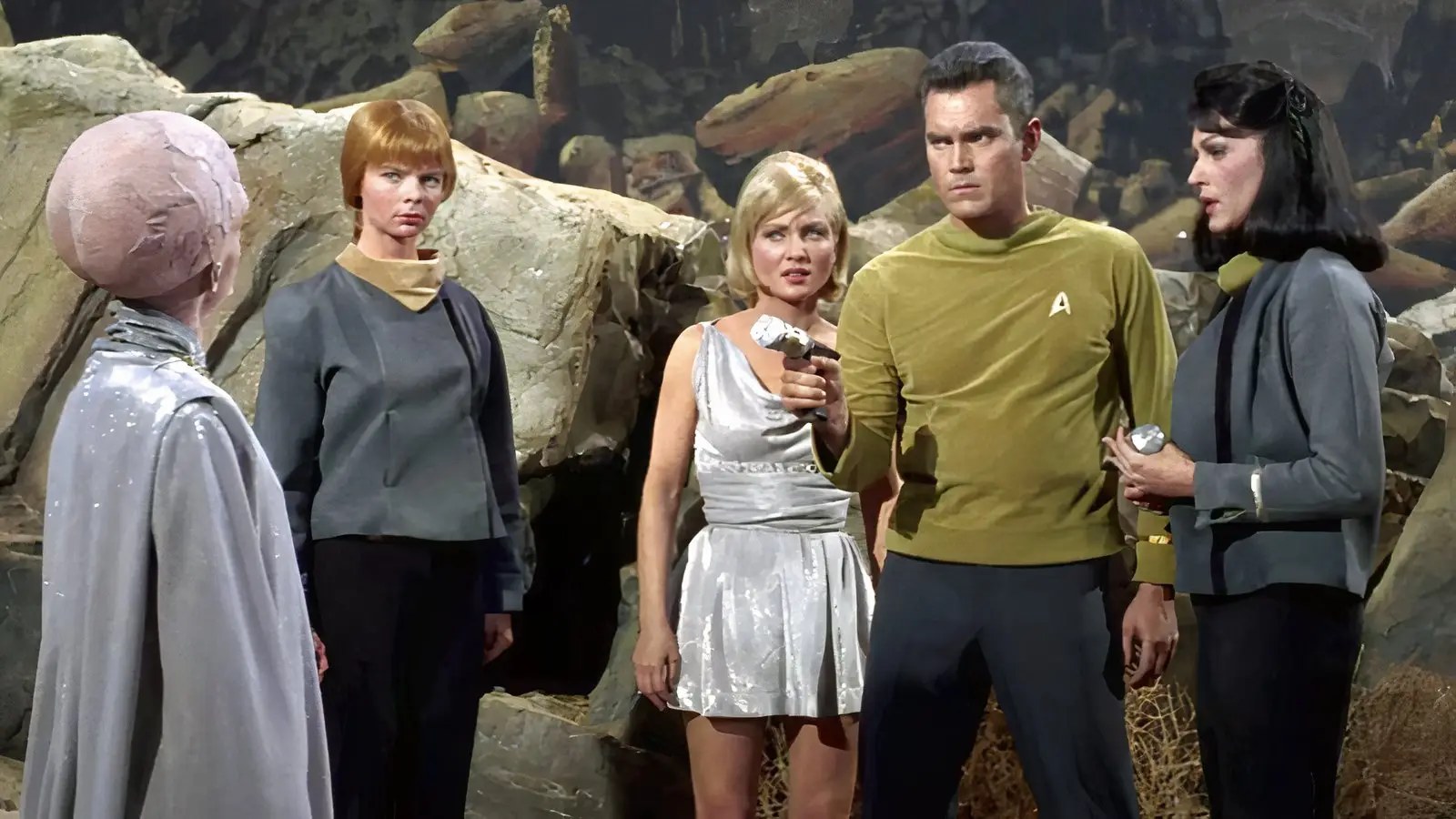
When NBC rejected Gene Roddenberry’s original “Star Trek” pilot, “The Cage,” in 1965, few could have predicted that this single act of network rejection would reshape television history. The station passed on the Jeffrey Hunter-starring episode as Captain Christopher Pike, citing concerns that it was too cerebral for a mainstream audience—a judgment now regarded with dark irony given how thoroughly the franchise built an entire cultural phenomenon around intellectual ambition.
The story begins and ends with failure. “The Cage” premiered nowhere; NBC declined to air it in 1965. Yet rather than abandoning Roddenberry’s vision entirely, the network made the highly unusual decision to grant him a second chance. That single act of corporate reconsideration set into motion everything that followed: William Shatner as Captain Kirk, Leonard Nimoy’s enduring Spock, and six decades of science fiction television.
Star Trek Exists Because “The Cage” Failed
To be fair, “The Cage” doesn’t quite feel like the original series that immediately followed it. The episode runs slower and more somber, its captain downright miserable at times. When we first truly come to know Pike, he tells the ship’s doctor that he is tired of being responsible for 203 lives and considers walking away from Starfleet entirely—a far cry from the swaggering introduction Kirk would eventually receive.
The story surrounding Pike already feels remarkably familiar. After being captured by the Talosians on the episode’s first away mission, Pike discovers they can create completely convincing illusions. They aren’t interested in conquering the Enterprise or blowing up Earth; instead, they study him, probing his desires and offering him the life he thinks he wants.
This transforms “The Cage” into a story about something much bigger than escaping aliens with enormous heads. Pike must decide whether happiness means anything if none of it is real. The Talosians, meanwhile, have become so dependent on their illusions that they’ve lost the ability to sustain their own civilization, entertaining themselves into extinction.
This is where NBC’s “too cerebral” criticism becomes so ironic. Aliens who challenge humanity intellectually rather than physically in a story questioning reality and free will sounds extremely Star Trek in retrospect. The franchise would spend the next six decades returning to variations of these same ideas.
Spock Is the Evolutionary Link
If Pike feels slightly unfamiliar in “The Cage,” Spock can feel like somebody doing an impression of Spock after receiving bad instructions. Leonard Nimoy was the only cast member to survive the transition from “The Cage” to the second pilot, but his character remained very much a work in progress.
Most famously, Spock actually smiles while examining some singing plants on Talos IV. He’s also noticeably more emotional than the cool, relentlessly logical Vulcan who would become one of television’s most recognizable characters. Part of the reason may simply be that the familiar Spock didn’t entirely exist yet; Majel Barrett’s Number One was actually the colder, more analytical presence aboard Pike’s Enterprise.

Once that character disappeared, Spock inevitably took on some of those same qualities and responsibilities. Whether that was intentional or simply the result of Roddenberry and Nimoy continuing to figure out the character, the Spock who emerged was considerably different from the one wandering around Talos IV.
“That makes watching ‘The Cage’ particularly fascinating. Almost everything around Spock would change—his captain, much of the crew, and even parts of his personality—yet he remained. Roddenberry was still figuring out what he wanted Star Trek to be.
Gamer24h Editorial
Pike Went From Discarded to One of Star Trek’s Central Characters
Spock survived “The Cage.” Christopher Pike did not. Jeffrey Hunter was gone by the second pilot, but the franchise never completely let him disappear. Footage from “The Cage” was repurposed for the two-part episode “The Menagerie,” which established Pike as Kirk’s predecessor and gave the rejected pilot a place in Star Trek canon.
This also gave Pike a tragic future: He was horribly injured in an accident and rendered unable to communicate beyond flashing a light on his wheelchair. He was ultimately returned to Talos IV, where the Talosians gave him the illusion of the healthy life he had lost.
For decades, that was essentially Pike’s place in Star Trek history—an intriguing glimpse at the version of Star Trek that might have existed if NBC had said yes the first time. Then Star Trek started going backward. Bruce Greenwood played Pike in J.J. Abrams’ 2009 reboot, giving audiences a version of the character who served as Kirk’s mentor.
Anson Mount then took over the role in Star Trek: Discovery before becoming the captain of his own series, Star Trek: Strange New Worlds.
Looking Ahead
Suddenly, the guy Star Trek left behind was sitting in the Enterprise’s center seat once again. There’s something wonderfully fitting about that. Strange New Worlds is filled with philosophical dilemmas, strange aliens, and stories that frequently ask its characters to confront difficult questions about themselves.
Pike is once again a captain wrestling with his own future, although now he knows exactly what awaits him. In other words, nearly 60 years later, Star Trek returned to both the character and many of the ideas that were there at the very beginning. Star Trek had to leave Christopher Pike behind to make it happen.
Eventually, after several decades, it became big enough to come back for him—because Starfleet never leaves a man behind.























Join the conversation