

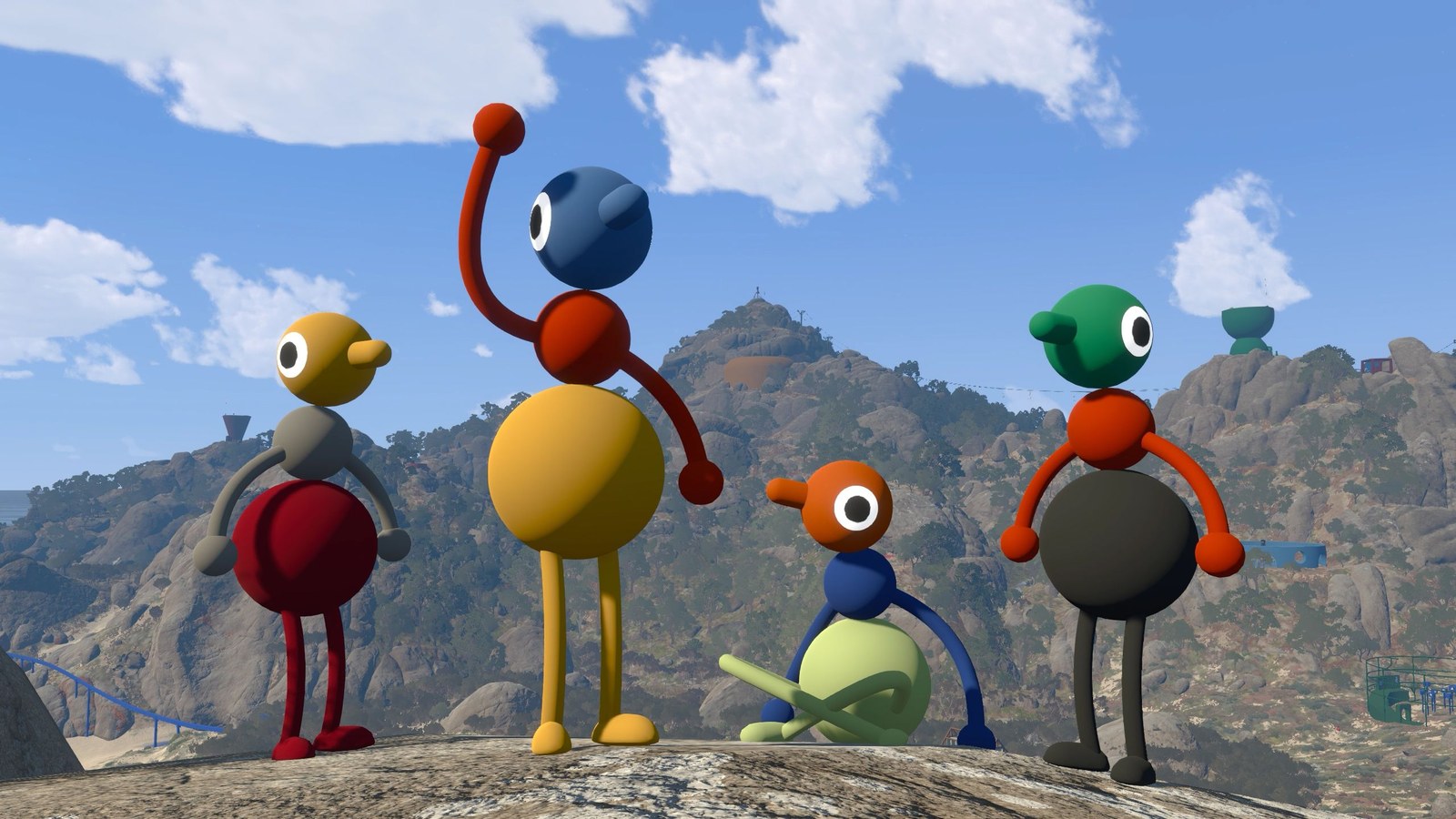
In 2026, a new generation of developers is turning the most basic human action—simply walking—into the centerpiece of their games, prompting what many observers are already describing as a revolutionary shift in how players move through virtual worlds. From the traversal puzzles of Cairn and the meticulous balance physics of Baby Steps to Big Walk, an entire game built around trotting across a vast map from point A to B, studios on PC gaming’s Steam platform are increasingly prioritizing granular, grounded motion over the power fantasies that defined earlier decades.
The trend marks a notable departure from the era when movement was designed primarily as a vehicle for spectacle: wall-running onto a mech in Titanfall 2, lining up a perfect shot across an open field in Doom Eternal, or mastering the sim-style tactical physicality of ARMA 3. Those titles set a high ceiling for what skilled players could achieve through their controls. Today’s experiments instead chase movements that carry no power fantasy at all—walking slowly, mantling awkwardly over a surface, losing your footing on a small hill and taking the long way around.
The appeal of the mundane
A lot of 3D games widely regarded as touchstones of thoughtful movement are now a decade or more old. Mirror’s Edge, Titanfall 2, Dishonored 2, Doom Eternal and ARMA 3 remain reference points for anyone who has studied in-game locomotion closely, each offering a distinct power fantasy to master. Yet the newest wave of titles is chasing something different: the fun hidden inside actions that would once have sounded too dull to advertise on a game’s back cover.
This impulse reaches back as far as PC gaming itself, where simulation-focused “boring” games have always had an audience. What distinguishes this newer crop is how deeply they tap into something more universal and compelling, with several of them emerging as Game of the Year frontrunners. The appeal lies in finding meaning in tasks as simple as balancing a load of packages or escaping the sucking mud of a traversed landscape.
A lineage of movement mastery
The conversation gained particular traction following 2025’s Baby Steps, whose central premise—that merely walking without toppling over could constitute an entire game—drew widespread attention. While that idea alone was not revolutionary, critics noted its high-end execution as the distinguishing factor, breaking down a normally functional act into its constituent parts and rebuilding it with care.
The irony is that this beloved title was inspired by one of the most unambiguous power fantasies in gaming: a gruelling custom Mirror’s Edge mod. That experience forced players to rethink everything about their character’s moveset and experiment with level geometry to solve each obstacle.

“It was the stuff that was ambiguous as to whether or not you could do it, stuff that you could puzzle over and push you into trying new ways of moving.”
Gabe Cuzillo, Baby Steps designer, at GDC 2026
Several of this year’s most acclaimed titles are distinguished precisely because of how they deploy movement. Cairn transforms climbing a mountain into a series of precise navigation puzzles layered with resource management, while Control Resonant pairs a familiar superhero-style moveset with gravity-defying switches in physics. Big Walk strips the concept down to its essence—an entire journey across a large map—yet even mantling over a knee-high surface proves surprisingly challenging.
Why now?
The designers behind these experiments insist they are not deliberately forming a movement, but analysts point to two converging forces. The first is simply the natural outcome of how long 3D games have existed; with a game available for nearly every conceivable fantasy, creators are free to explore previously uncharted corners of interaction.
The second theory frames these titles as a reaction against control being stripped from players during the rise of big-budget blockbusters in the late 2000s and 2010s. As multiplatform pushes drove PC games toward console norms, movement became increasingly trivialized—third-person climbers like Assassin’s Creed required little input to scale rooftops, while series such as Uncharted sanded away the sharp edges of ’90s platforming in order to reach millions of players.
The result is a design philosophy now widely seen as falling out of fashion. Games like Cairn, Baby Steps and Big Walk connect precisely because they refuse to trivialize movement this way, asking subversive questions such as what it truly takes to place one foot in front of another, or how the body repositions when weight presses against a cliff face.
Looking Ahead
With GDC 2026 already providing a stage for developers to discuss























1 comment