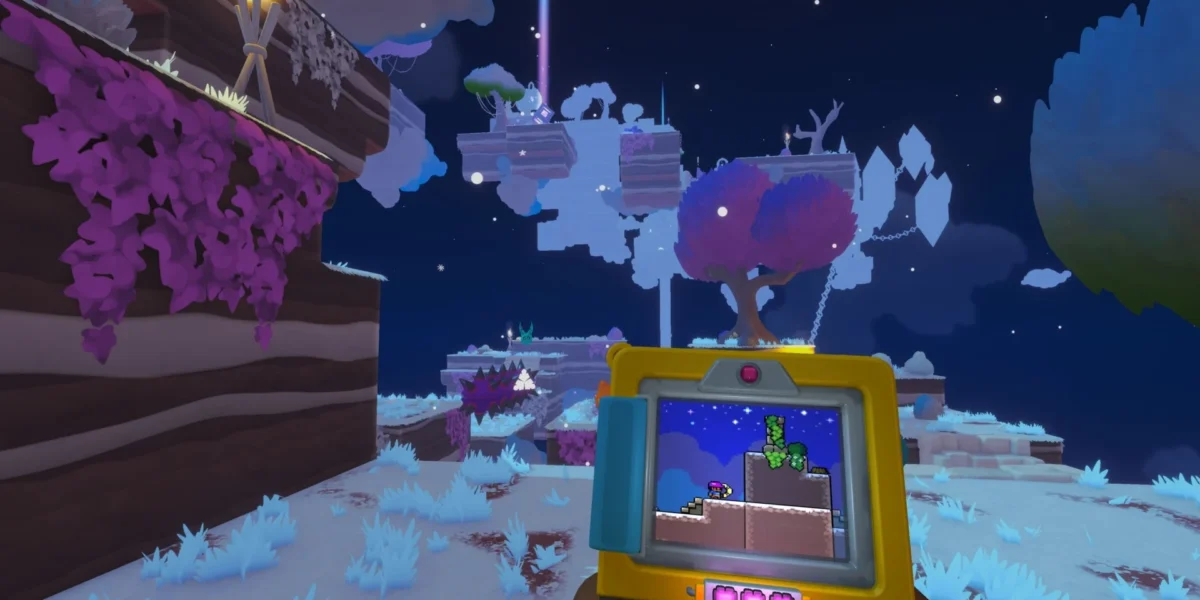
At this year’s Summer Game Fest, Crescent Moon Games unveiled Screenbound, a groundbreaking “5D” platformer that fuses first‑person 3D exploration with a side‑scrolling 2D layer. Players must navigate both perspectives in tandem, a mechanic that has already sparked widespread curiosity and viral clips across TikTok, X, and other social channels since the 2024 reveal.
The idea is hard to explain in words but instantly clear when you watch it in action. The visual novelty of simultaneously traversing a 3D world while consulting a 2D handheld view has earned the title millions of views, proving that the concept resonates with both casual viewers and hardcore gamers.
During the demo, I encountered a classic “look where you’re not looking” moment: a floating balloon above a chasm appears only on the handheld’s 2D screen. By leaping, holding my breath, and trusting the handheld’s perspective, I could grab the balloon’s string and glide safely across the void—illustrating how the dual views unlock otherwise invisible pathways.
Three indie developers are steering this ambitious project, blending 3D and 2D gameplay into a single, cohesive experience that challenges conventional platforming norms.
Even when the core idea clicks, players still face the practical hurdle of constantly switching between the richly detailed 3D world and the compact 2D interface on their handheld device. Certain solutions or obstacles only reveal themselves in one dimension, forcing gamers to rely on the alternate view to progress.
Game director Josh Presseisen told Kotaku that Screenbound began as a series of experimental prototypes blending 2D and 3D gameplay, but the final vision crystallized when he imagined the handheld as a true second screen. He experimented with side‑scrolling 2.5‑D platformers that transitioned into third‑person ship sequences—think a Star Fox‑style flight—yet the breakthrough came after spotting someone using a handheld. That moment sparked the idea of a linked 2D display that directly influences the 3D environment, a concept that immediately captured the interest of the community.
Every level in the game must communicate its objectives clearly in both 2D and 3D, so moments of discovery arise when players notice how a single action translates across the two visual styles. They must remain vigilant of both perspectives, as certain solutions or hazards may only appear on one screen.
ScreenBound pioneers a fresh genre by blending first‑person 3D exploration with classic 2‑D platforming, all on a handheld device. Players control a character in a side‑scroller view while simultaneously navigating a 3‑D world from a first‑person perspective, creating a truly immersive and unconventional gameplay experience.
“The moment everything clicked was when you’re floating on a balloon in 2‑D, yet your character in the 3‑D first‑person view can drift freely through the air,” explains lead designer Presseisen. “That sensation is unlike anything else in the market. Watching the 3‑D environment while your 2‑D avatar remains stationary adds another layer of intrigue. Turning these ideas into a complete game was a monumental challenge, demanding a clear vision of how the worlds interconnect and what’s possible within that framework.”
Designing a title that simultaneously renders and traverses both 2‑D and 3‑D spaces essentially means building two games in tandem—a daunting technical undertaking. To tackle this, ScreenBound partnered with Southfield studio Radical Forge and crafted a bespoke level editor from scratch. This tool streamlines the duplication of levels across dimensions, allowing designers to draft a 2‑D tile map that automatically generates the corresponding 3‑D layout.
In a revealing interview, the lead developer explained that the game’s terrain is first laid out using 2D tile maps, with prefab objects placed atop them. Once the basic structure is in place, additional 3D details are layered on through custom prefabs, a meticulous process that the team considers one of Screenbound’s most distinctive features. “I’m thrilled with how the world turned out,” he added, underscoring the blend of technical precision and artistic vision that defines the title.
Presseisen publicly praised Radical Forge for their pivotal role in bringing Screenbound’s multi‑dimensional design to life, noting that Crescent Moon Games “would not be where we are now without them.”
While the idea of a game that simultaneously functions as a 3D platformer and a 2D sidescroller is ambitious in itself, Screenbound promises even more innovative gameplay twists that have yet to be disclosed. Players will encounter a second cartridge for their “not‑Game Boy” that reshapes the experience as they advance.
“It’s been a bit hush‑hush as it’s been worked on behind the scenes for quite awhile,” Presseisen says. “The idea is that when you complete the first cartridge you are given access to another one which is an entirely different style of gameplay—a nod to early adventure games on home console systems. Without going into too much detail, or revealing too much, this world that you adventure around in will give you access to different weapons and tools that you would see in those retro games. It adds another dimension in Screenbound – a top‑down view. Similar to retro RPGs you might have played.”
❓ Frequently Asked Questions (FAQ)
What makes Screenbound a "5D" platformer and how does its hybrid gameplay work?
Screenbound blends first‑person 3D exploration with a side‑scrolling 2D handheld view, creating a "5D" experience where players must navigate both perspectives simultaneously. The 3D world provides depth and spatial awareness, while the 2D layer offers a simplified, handheld view that reveals hidden objects, pathways, and enemies not visible in the main view. Players switch between or combine these views to solve puzzles, avoid hazards, and progress through the level.
How has Screenbound been received on social media and what impact could it have on the indie platformer market?
Since its 2024 reveal at Summer Game Fest, Screenbound has gone viral on TikTok, X, and other platforms, amassing millions of views. The hybrid design taps into a growing appetite for innovative gameplay, positioning Crescent Moon Games as a potential disruptor in the indie platformer scene. Its success could encourage more developers to experiment with multi‑dimensional mechanics, pushing the genre toward more immersive, hybrid experiences.
What unique gameplay mechanic was highlighted during the demo and how does it illustrate the dual‑view system?
During the demo, a floating balloon above a chasm was only visible on the handheld 2D screen. Players had to leap, hold their breath, and trust the 2D perspective to grab the balloon’s string and glide across the void. This moment showcases how the dual views unlock otherwise invisible pathways, demonstrating the necessity of coordinating both perspectives to navigate the game world.
News Source: Kotaku



Comments
Be the first to comment.