

 •
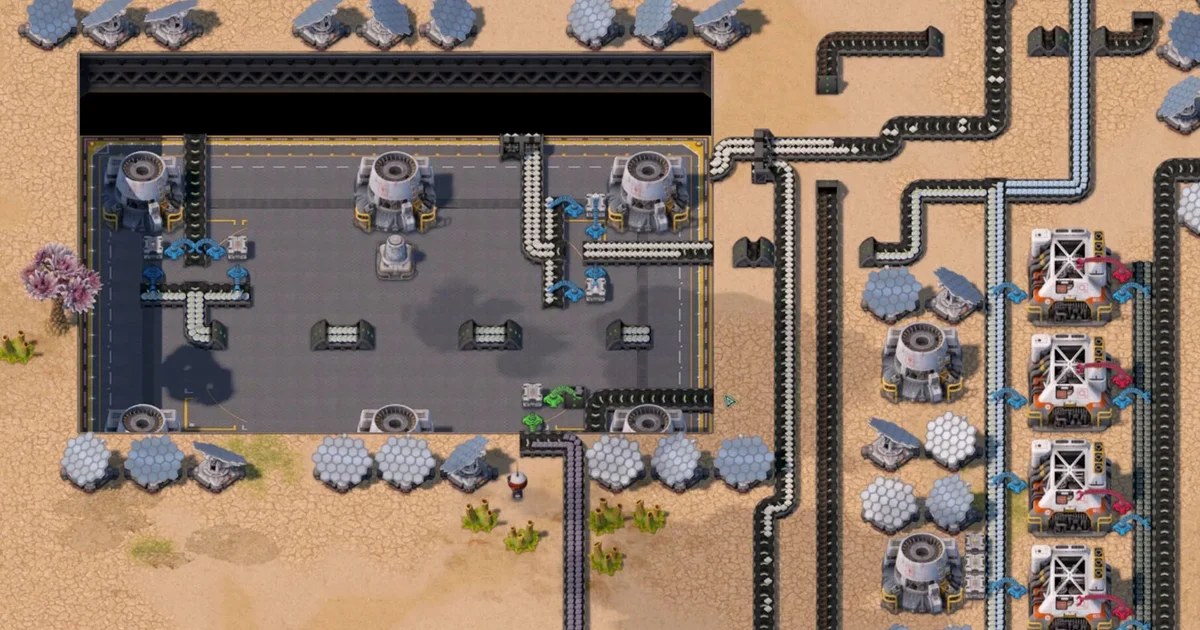
•Substructure is a new automation game from Dubious Designs that begins in familiar fashion—landing on an alien world with little more than your UI tools and a tech tree to build up a sprawling—but vertically layered—factory.
According to a report by Rock Paper Shotgun, the game looks much like Factorio at first: you claw resources from the planet’s surface and transform them into components. But it also hints at something new.

The world extends far below its surface. Build drilling equipment and elevators and you can carve through topsoil down to caverns—and even deeper still. In those depths, new resources await transformation into more advanced equipment.
One major change between the surface and the first sublayer is light—or its absence. While lights are needed on the surface at night, outside of elevator shafts there is total darkness. Players must find ways to build lamps and power them if they want to explore.
In that dark lie rewards: fauna that can’t grow on the surface, and minerals found only at great depths. Deeper still are toxic spores that will kill you but also have a catalysing effect on certain plants. In one example shown by the developers, a shrub that cannot spawn on the poison level still benefits hugely from the toxic fumes, quadrupling its growth rate.
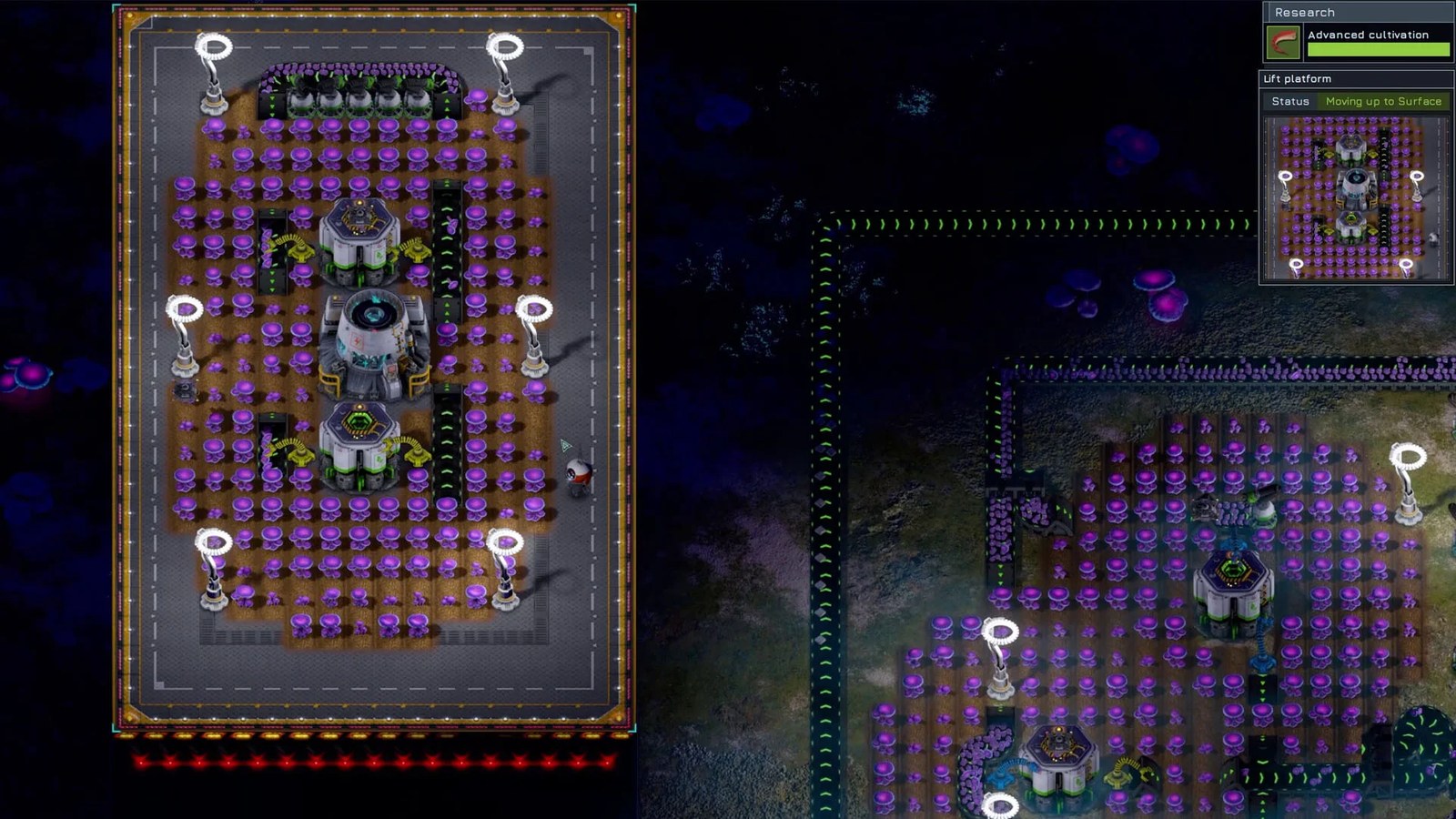
Spoilers aside, the solution involves lifts—platforms acting as go-betweens between levels of the planet. These are little patches of land you can litter with machines and stockpiles so they slot into whatever operation you have on each level. As one demonstration showed, a farm on the surface empties its resources onto belts carrying them to waiting machines on a platform; when it hits a certain quantity—using logic rules set by the player—the lift descends, aligning with belts on the level below.
While Substructure looks similar to Factorio, this interplay between levels offers something new. Dubious Designs’ CTO Stu Taylor, who created the fiendishly difficult Ultracube mod for Factorio, says the lifts are one of the ideas that convinced him to create Substructure—”It’s a big scheduling and constraints puzzle that would not have been possible in the Factorio engine.“
Making a new game rather than modding an existing one also lets Taylor explore puzzles for players who aren’t already attuned to the complexities of Factorio. “With the Ultracube mod, I was trying to make a factory game that was much more about constraints and puzzles than never-ending scale increases,” Taylor explains. “I was able to do it but it was a very hardcore mod. It wasn’t something you could just sell to the general public, it would be too hard for lots of players. So with our engine, it’s really about finding features to allow that kind of gameplay, but in a way that is approachable. Things like the platforms are a big example of that.“
But along with these new toys lie teases of something unsettling. Concealed in the dark of lower levels are signs of what lived on the planet before—patches of organic matter, remnants of flesh spreading into the blackness like fields of skin. Construct a miner on top of these ‘behemoth patches’ and the machine will spit out organic matter and bones.
“The surface is going to be calming and safe and inviting,” Dubious Designs’ CEO Michael Donoghue tells Rock Paper Shotgun. “The deeper surfaces will not be.” The team were influenced by survival games to treat the surface as a “safe homestead”, but one that will coax players into the depths, where exploration presents new challenges like dealing with toxic fumes.
Yet what sticks is how Donoghue describes the “emotive” elements of factory builders. “The emotion for us when we play automation games and factory games is really around this sense of accomplishment and the pride you have based on the things that you produce,” Donoghue says. The team noted it was something they often felt playing systems-driven, grand systems games—”games that deliver that sense of accomplishment through indirect guidance.”
In Substructure’s early production they researched what created that sense of fulfillment and how it can apply to their factory game. “It turns out indirect guidance is the highest return rate on that,” Donoghue says, explaining how that’s led them to a very “light touch” in prescribing your early hours.
When you first land, the ground around you will be wild and untouched. There are minerals to mine and land to till, but mining and farming operations will initially be inefficient. While you could conceivably amass many resources by hand to carve through the surface and build the elevator needed to access the level below, it would be an extremely arduous task—and complicated electronics can’t be assembled without a machine’s help. It’s a soft puzzle for you to solve.
The guidance Dubious provide is your tech tree and descriptions of items around you. One example: crops planted in a farm need light to grow, so can you use lamps to keep their growth rate steady through the night? If you do, you’ll need power—and solar panels won’t produce electricity once the sun goes down. That puzzle then evolves below the surface, where there’s no natural light.
Donoghue doesn’t suggest Substructure is the first game to do any of this—”That sense of accomplishment that comes from building something you are proud of is extremely prevalent in these types of games”—but it’s something they aim to capture. “You should feel like the time you spent in our game is additive to your quality of life.“
Beyond lifts and sublevels, there are other differences between Substructure and its main influence, Factorio. An intriguing one that has already divided beta testers is decentralised power. In many automation games, you place a generator and link it to buildings with power lines. In Substructure, each generator has a limited range around which it can connect to buildings.
“Some people like it, some people are annoyed by it,” Taylor admits, but it’s a feature he feels strongly about. “It makes sense to have centralised power but in terms of game mechanics, it ends up just becoming busy work.” He compares it to the messy canopy of woven power cables that can cover Satisfactory saves—”There’s not really any meaningful decisions there,” he continues. “We want to avoid including things just because they’re common in other games if there’s not some interesting puzzle or decision involved with them.”
Taylor says decentralised power adds many more decisions when it comes to factory design, especially given stark differences between the layers. A solar panel is great, accessible power—but as noted above, it’s useless if powering grow lamps on a farm. “You’re going to end up using different ones on different layers of the planet, or in different contexts.”
The reporter didn’t get to play Substructure—only given a tour of its early moments before hopping between levels. Taylor was operating the game at lightning speed with seemingly unlimited resources, dropping down factory machinery with a practiced hand.
Still, the fly-by tour leaves intrigue. And as much as there’s appeal in building a new factory on a new world—something still not tired of, despite the proliferation of automation games—what matters most is exploring Substructure’s depths and finding out what waits in its shadows.
Travel and accommodation to Gamescom was provided by the conference organisers. Satisfactory























1 comment