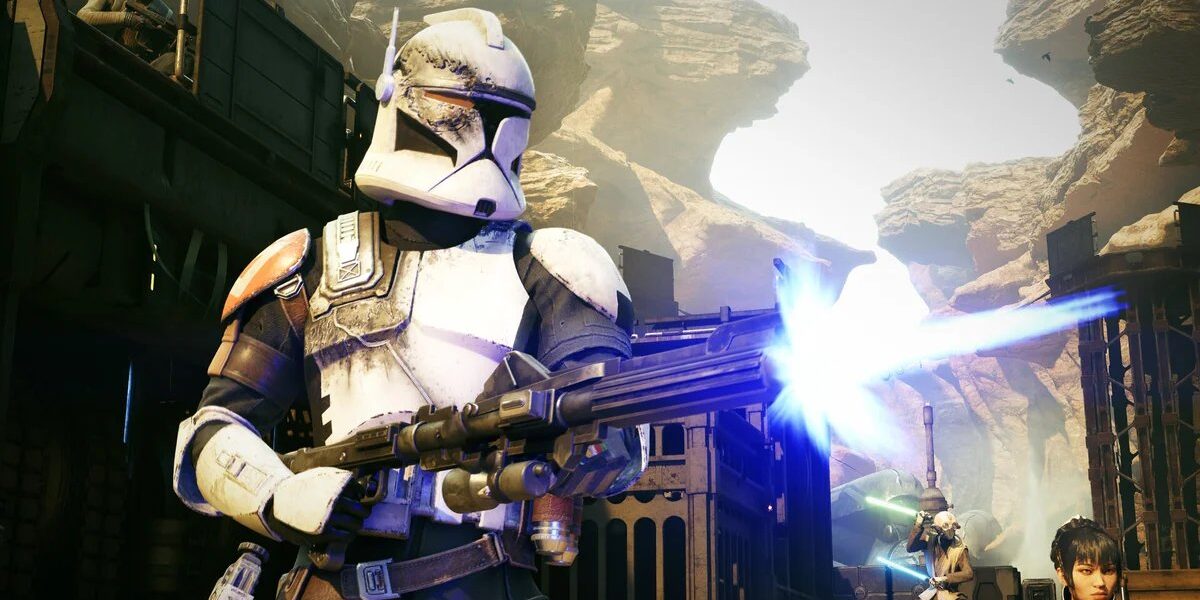
I’m still early days on Star Wars: Zero Company, but I think I’m in love. And this is kind of expected and also kind of strange. It’s kind of expected because this is XCOM: Star Wars at first glance, and jeepers I love XCOM. I love moving my little units around, pondering when to advance and when to hang back, and I even love missing a shot that surely was almost a dead cert.
A Familiar Framework, A Fresh Perspective
Crucially, I also love the way that every new XCOM game messes with that beautiful two-action-points-per-turn formula. I loved Enemy Within’s mechs and Meld crates that made the game into American Football. And I really loved the breaching mechanics and interleaved unit turns of Chimera Squad. When it comes to XCOM I am happy to experiment, to put Shreddies in with my Coco Pops, just to see what happens. Zero Company, then, is another blessed chance to see what’s new and what’s been fiddled with. Three action points rather than two? A little cone for the hands-on directing of Overwatch attentions? Advantage Points?
By gosh, this is interesting: let’s see what I make of it all.
More Than Just a Game: It’s a Toy Box
But as for Star Wars? I tell myself that I am at best a lapsed fan. I was born in 1978, so Star Wars belonged to my older brothers. I will watch Harrison Ford in absolutely anything (along with Scott Bakula, I swear he is the eternal father figure of the divorced-parents-early-90s-kid) and the music still stirs me, along with that magical shot of a Star Destroyer in all its stark, stately glory, ghosting overhead. I’ve watched the original films, but not the prequels, the sequels, the side stories, the TV shows.
All of which should leave Zero Company as an 85 percent chance of hitting, in other words: target within range but partially obscured by cover (cover in this scenario is the fact that I often find myself humming the doomy Vader music, but I don’t know what Coruscant is). And yet here I am, barely out of the tutorial and it’s love. What happened?
A lot of things, certainly. A lot of neat little ideas and clever bits of world building, and that eternal back-and-forth between a hub that you build out and street-by-street missions that may kill all your favourite units. But a lot of this stuff that I love, I think, can be wrapped up in one big idea. And look at that, I’ve already spoiled it in the headline: Zero Company understands that Star Wars games should feel more like the toys than the games.
The Magic of Play
Star Wars toys: now we are talking. It is impossible, I think, to understand quite the impact these things had on people of my age back in the early 1980s. They were everywhere: they were a language that my brothers and everyone my brothers knew spoke beautifully. I can remember the figures hanging in racks in supermarkets and I can remember the squeal of pulling the plastic carton off the cardboard and freeing any bonus weapons from that little bit of tape that held them back.
But I can also remember playing with these things. And it’s always seemed that playing with Star Wars toys was a creative endeavour on several fronts. For one thing, the toys just sat there. You had to decide how to animate them. You had to decide whether you were going to repose the legs as they walked, or whether they would just pogo around a bit like Muppets. You had to decide how they were going to interact, and, if you were playing with other kids, you had to decide how you were going to handle sound effects and who was going to win in a fight between cherished favourites.
You also – this is an aside, but I am old so let me have it – had to populate the wider Star Wars world, which meant coming up with solutions for spacecraft and bases given that the official spacecrafts were really expensive. In our family, this meant that our Star Wars heroes knocked around in egg boxes. They had seats in them by design, kind of, and you could fit a bundle of figures into each box. They were easy to come by – eggs were cheap back then! – and the cardboard egg boxes often had this kind of utilitarian ruggedness to the external design that chimed well with the kit-bashed Star Wars space vehicles from the movies.
Zero Company: A Return to Childhood
It’s all of this – Egg Box Star Wars – that comes back when I play Zero Company. And I think the reason why is that the structure and pacing of a turn-based combat game is suited to creating a toylike feel to proceedings.
I’ve thought this before with XCOM, which is a bit like taking chunky action figures out to a promisingly sculpted part of a public park to play with for a few minutes, while the HQ waiting for you between missions is basically a perfect doll’s house. But with Zero Company I see that there’s something more that makes the magic work. The focus on small battles and skirmishes that tactics games thrive on is perfect for recreating an afternoon with a friend where you both bought a pocketfull of figures over.
Elsewhere, the reliance on cover and slow progress ties in neatly to the fact that posing figures to move is a pain and that they often fall over if you don’t lean them against something. And there’s something about the turns – my action points, your action points – that clicks with the democratic way that the best childhood games unfolded. Turn-based games move at a pace that suits action figures very well indeed.
A lot of this comes down to scarcity, I now see. You often had a few action figures but not the complete sweep. One of you might have a proper Millennium Falcon or Tie-Fighter, but they were too delicate to use in any really entertaining stagings of warfare. So toys kept the scale intimate, and the intimate scale allowed individual figures to become gigantic, to shine with a special splendour in your imagination.
More Than Just a Game
This is why I think Zero Company is more toy-like than the Battlefront games, which, on paper at least, are all about playing with Star Wars toys. Battlefront games are great, but whoever had this many figures? And the pace is so fast that the individual specialness of the figures gets lost. Battlefront’s a sport. Zero Company is somewhere between a board game and a chance to really appreciate the cool detailing of each individual action figure.
Well. This was more than I expected to write about toys, a part of my life that feels so distant that, when clearing out a parent’s house a few years ago and coming across a drawer of old figures, I realised that I had lost the imaginative power to animate them at all. I could no longer make them come to life.
And maybe that’s why I need games like Zero Company, to keep this child-like part of the old imagination alive. Just as I once propped Han Solo, Hoth Outfit Edition, against the corner of a bookshelf so he wouldn’t face-plant during a laser battle, now I prop myself up on the rules and animations of a game made by a team that, between them, has made some of the best turn-based games and some of the best Star Wars games ever. Obviously I still faceplant a little. But that’s the fun of losing yourself in something I guess?
Source: Eurogamer




Comments
Be the first to comment.