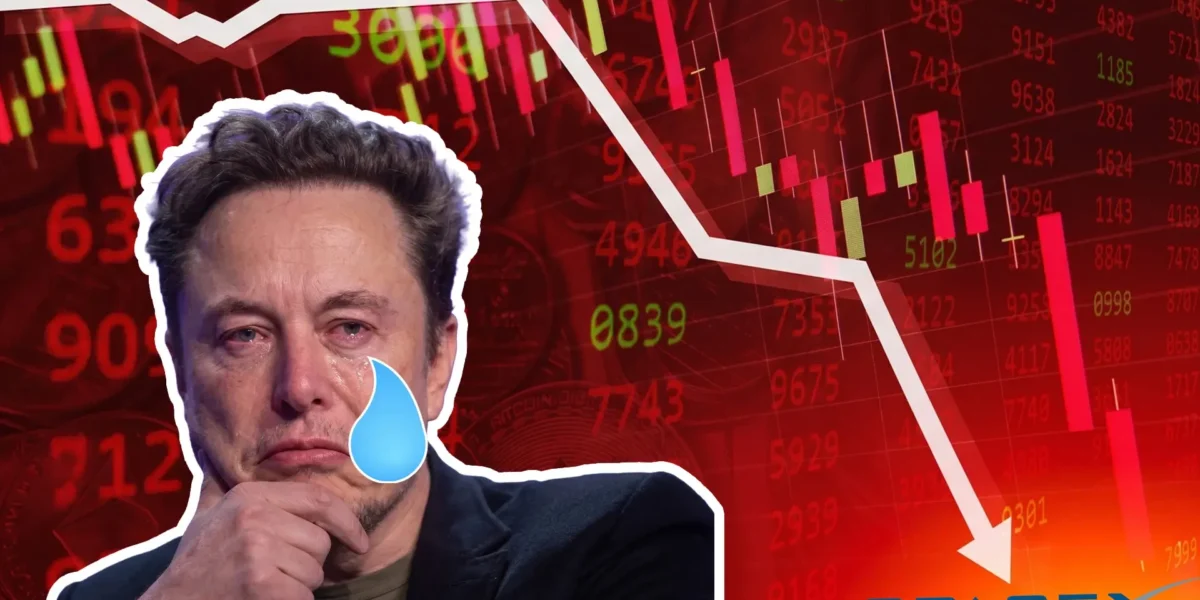
SpaceX’s debut on the stock market has taken an unexpected and dramatic turn over the past few days, erasing the initial surge that once sent the company’s shares soaring. The shares have slid back to the $150 price point that marked the company’s opening, a fall that has sent shockwaves through Wall Street and left investors who purchased the stock at its public launch staring at the looming threat of significant financial loss.
The aerospace titan went public on June 12, a move driven by the need to raise substantial capital to sustain its ambitious long‑term projects. On the day of the IPO, the company set a base price of $135 per share, but the intense demand from buyers pushed the price quickly up to $150. This sharp uptick catapulted SpaceX’s valuation to new heights, inflating Elon Musk’s net worth to record levels and, according to several analysts, positioning him as the world’s first trillionaire.
However, the narrative shifted dramatically when SpaceX’s shares, trading under the ticker SPCX, fell below the $150 threshold, erasing more than $400 billion in market value in a single trading session. Although the stock had surged over 40% in its early days—temporarily outpacing the valuations of tech giants like Amazon and Microsoft—it collapsed to a concerning low of $146.88 before managing a modest rebound, marking a painful streak of four consecutive down days.
The recent surge in share sales is not an isolated issue for the aerospace firm; it reflects a broader downturn that is severely impacting the entire technology sector. According to outlets such as CNBC and MarketWatch, this widespread slide stems from the forthcoming monetary measures the Federal Reserve plans to enact under the leadership of Chairman Kevin Warsh.
In plain terms, these tightening policies involve the central bank raising interest rates and making borrowing more expensive across the economy. The tech industry feels the sting most acutely, as the market valuations of these companies are highly sensitive to rate changes.
Despite the unsettling volatility in the markets, SpaceX has recently confirmed that it remains in a robust financial position, holding just over $100.8 billion in cash and cash equivalents. The company also announced a bond sale, a strategy that involves borrowing from large investors to settle its debts.
Financial experts at Quartz note that these price fluctuations are crucial to monitor, as SpaceX’s commercial performance acts as a barometer for current market sentiment. Simply put, the stock market’s behavior is being viewed as a clear indicator of how major capital will react to the upcoming public offerings of AI-centric companies such as Anthropic and OpenAI.
To anticipate what lies ahead, analysts caution that the scarcity of shares available on the market, combined with SpaceX’s long‑term project portfolio, could sustain sharp price fluctuations for an extended period.
In short, while the stock has rallied to roughly $164—still a modest gain over its $135 IPO price—this uneven debut underscores that investing in SpaceX’s shares will require patience and prudence from future buyers.
❓ Frequently Asked Questions (FAQ)
What caused SpaceX's shares to fall below the 10‑day IPO price?
The sharp reversal was driven by a combination of market volatility, profit‑taking by early investors, and a broader sell‑off in high‑growth tech stocks that led to a rapid decline in the share price from its peak of $150 back to $146.88, below the 10‑day average.
How much market value did SpaceX lose in the two days after its IPO?
SpaceX erased more than $400 billion in market value in a single trading session, with the drop from $150 to $146.88 translating into a loss of roughly $400 billion in market capitalization.
What impact did the share price drop have on Elon Musk's net worth and the company's valuation?
The decline pulled back the inflated valuation that had temporarily positioned Musk as a potential trillionaire, reducing his net worth by several billions and bringing SpaceX's market cap closer to its pre‑IPO levels.
News Source: Tarreo





Comments
Be the first to comment.