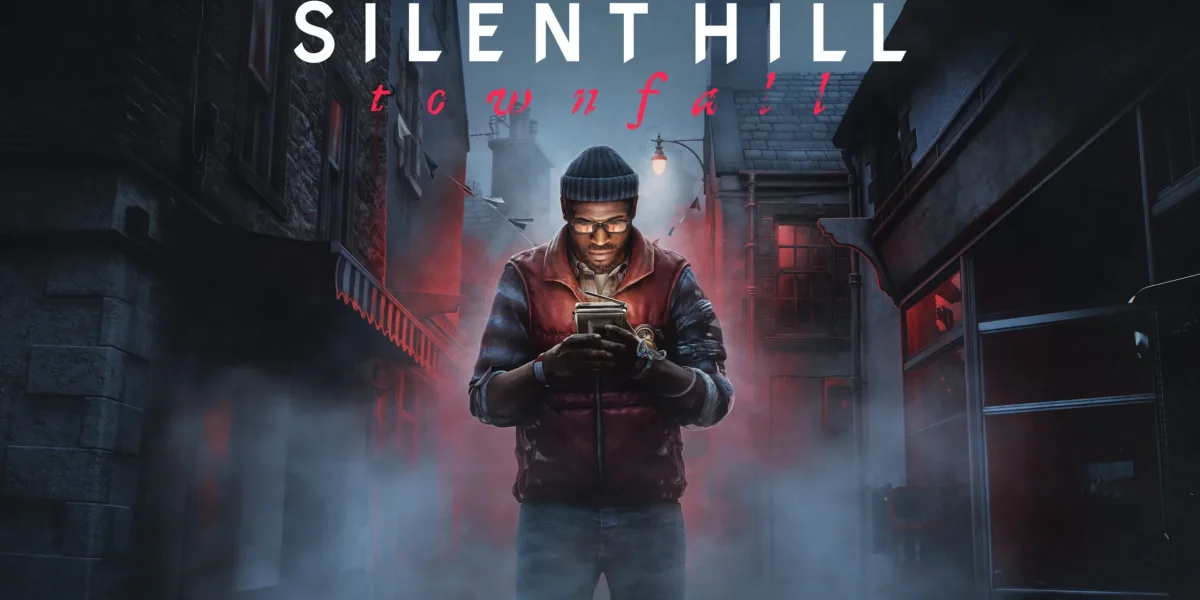
The boundary between supernatural dread and the inner turmoil of its characters has always been a hallmark of the Silent Hill series, yet it has never been as indistinct as it is in Silent Hill: Townfall. I spent roughly four hours immersed in this first‑person survival horror, following protagonist Simon as he navigates a mist‑laden Scottish town that feels both eerily familiar and wholly alien, leaving players to question what is tangible and what is merely a product of a fractured mind.
My exploration kicked off with Simon receiving a mysterious letter urging him back to the enigmatic town of St. Amelia. In a surreal sequence, he appears to drift toward a dock aboard a boat, only to abruptly emerge from the water and haul himself onto shore as if he had been awakened in a dream. The filmic presentation of Simon’s arrival is deliberately opaque, hinting at deeper layers of unreality.
Once inside St. Amelia, Simon sets out to uncover the town’s secrets, only to find it eerily deserted. As he wanders the cobblestone streets, distant shouting and fleeting flashes suggest a protest or riot, yet the town square remains starkly empty, amplifying the sense of isolation.
Is Simon merely hallucinating, or are unseen forces manipulating his path through St. Amelia? The ambiguity deepens when he answers a ringing payphone and is met with a cryptic voice urging him to find a woman named Zoe. Suddenly, he is thrust into a subterranean chamber bathed in red light, a hallmark of Silent Hill’s Otherworld—a twisted, alternate dimension that blurs the line between reality and nightmare.
While navigating the labyrinthine layout, Simon unexpectedly stumbles upon an apartment that houses the pivotal handheld television of Townfall. By adjusting its channels, players receive cryptic clues that unlock puzzles, and the device is essential for reaching an elevator that transports you back to the bustling streets of St. Amelia.
Writer‑director Jon McKellen reveals that each puzzle doubles as a narrative breadcrumb. The signals flickering on the CRT television are intimately tied to the histories of St. Amelia and Zoe, offering players insights into her identity and possible whereabouts.
Exploring Zoe’s vacant flat confirms her profession as a nurse, guiding players to the clinic where she once practiced. Inside the clinic, three scales await items that once held deep personal meaning for her, yet she associated them with failure, prompting her abrupt departure from the workforce.
Within Zoe’s home, players uncover her identification badge, and a nearby pharmacy holds a prescription she mistakenly filled with an incorrect dosage. Continuing the investigation, the story leads to a colleague’s apartment where a medical bag containing a broken stethoscope is found—an emblem of the nurse’s perceived inability to truly listen to her patients.
In Townfall, Zoe’s narrative is inseparably bound to the town’s mysterious medical crisis, and it also draws Simon into a web of intrigue—despite his lack of knowledge about her identity.
Marking a pivotal shift, Townfall is the first Silent Hill title to thrust players into first‑person combat. This change strips away the safety net of a third‑person view, forcing you to confront threats head‑on or flee, thereby amplifying the game’s already tense atmosphere.
As Simon follows Zoe’s trail, he discovers that St. Amelia is far from deserted; the streets are overrun by faceless, writhing monsters, bound in industrial straps and sporting axe‑shaped faces.
Players can occasionally scavenge wooden planks to fashion crude clubs, though such resources are scarce and must be used judiciously.
Combat is swift and relentless: when a monster attacks, you can block its ferocious charges by holding L2 and counterattack with R2 when an opening appears. However, enemies are resilient, and the makeshift club’s durability is limited to only a few encounters.
❓ Frequently Asked Questions (FAQ)
What is Silent Hill: Townfall and how does it differ from previous Silent Hill games?
Silent Hill: Townfall is a first‑person survival horror that places a heavier emphasis on psychological ambiguity than earlier entries. While classic Silent Hill titles often blended tangible supernatural threats with personal trauma, Townfall blurs the line even further, presenting a mist‑laden Scottish town where the boundary between reality and fractured mind is indistinct. This narrative experiment aims to broaden the series’ appeal beyond traditional horror fans by focusing on internal dread and ambiguous storytelling.
Who is the protagonist and what is the main plot of Townfall?
The protagonist is Simon, who receives a mysterious letter urging him back to the enigmatic town of St. Amelia. Upon arrival—depicted in a surreal, dream‑like sequence—Simon finds the town deserted, with distant shouting and flashes hinting at unrest. He must navigate the cobblestone streets, uncover the town’s secrets, and confront whether his experiences are hallucinations or the result of unseen forces manipulating his path.
How does the game handle psychological horror and what can players expect in terms of gameplay experience?
Townfall foregrounds psychological ambiguity, using opaque filmic presentation and atmospheric tension to keep players questioning what is real. Gameplay focuses on exploration, puzzle‑solving, and survival mechanics, with an emphasis on mood and narrative over explicit gore. Players can expect a haunting, introspective experience that challenges their perception of reality and invites them to piece together the mystery of St. Amelia.
News Source: PlayStation Blog





Comments
Be the first to comment.