

Decades after Gary Larson’s comic strip The Far Side conquered newspapers around the globe, a handful of his music-themed panels are quietly losing their punchline. As readers return to the beloved one-panel series that ran from 1980 through 1995, several jokes built on pop-culture references from the late 1980s and early 1990s now demand a footnote—turning what once landed instantly into puzzles for younger audiences who have never heard of Madonna’s cone bra or Fats Domino’s Blueberry Hill.
The Far Side is widely regarded as timeless. With its endless parade of cows, cavemen, and existential dinosaurs, much of Larson’s output feels just as sharp today as it did when it appeared in print editions worldwide throughout the 1980s and 1990s. But not every gag survives the test of time, and his music jokes are among the most vulnerable to obsolescence. Where some panels rely on universal human absurdity, others hinge entirely on a specific song, album, or celebrity moment that has since faded from mainstream memory.
A Cartoonist With Strong Opinions On Sound
Larson clearly harbored plenty of views about music, and they frequently surfaced in his work. Accordions and banjos seemed especially prone to becoming the butt of his jokes, while classical music’s stuffiness offered fertile ground for subversion. Jazz, by contrast, usually earned a flattering portrayal, whereas rock and pop would occasionally draw his razor-sharp wit—though pinning down exactly what he was mocking has grown difficult across the decades.
The result is a set of panels that reward deep knowledge of 20th-century popular music while leaving casual readers baffled. Here are seven thoroughly dated Far Side comics and the references they depend upon, drawn from the strip’s original run in newspapers worldwide.
Madonna And The Life Raft
The most immediately recognizable reference belongs to a 1992 panel centered on Madonna, still alive and still making music but no longer as dominant a cultural force as she was at the time. The joke pivots entirely on her infamous cone bra, which she debuted during her “Blond Ambition” tour in 1990. Intended by its creator as a symbol of female empowerment and a jab at conservative critics, the garment became such an iconic image that Larson simply imagined how disastrous it would look on an inflatable life raft.

The cone bra was intended as a symbol of female empowerment and a way for Madonna to skewer her conservative critics—but for Gary Larson, the extra-pointy attire just seemed like a really bad thing to wear on an inflatable life raft.
[Reference explanation for The Far Side panel]
Songs That Predate Their Own Jokes
Some panels are dated not because the reference is obscure, but because the underlying song is ancient. “Mack the Knife,” a 1928 number from Kurt Weill and Bertolt Brecht’s musical The Threepenny Opera about a murderous antihero, had already been revived by Louis Armstrong, Ella Fitzgerald, and Bobby Darin before Larson published his surreal take on it in 1987—meaning the strip was nearly three decades old even when it debuted.
“Blueberry Hill” works similarly but demands more. The 1940 song became a massive hit after versions by Elvis Presley and Louis Armstrong, with Fats Domino’s 1956 recording cementing its fame. The joke requires not just knowledge of the tune but its lyrics: since it opens “I found my thrill on Blueberry Hill,” Larson simply swapped “thrill” for “drill,” reframing the romantic line around a man mourning his missing power tool.
The Lyric-Headed Gags
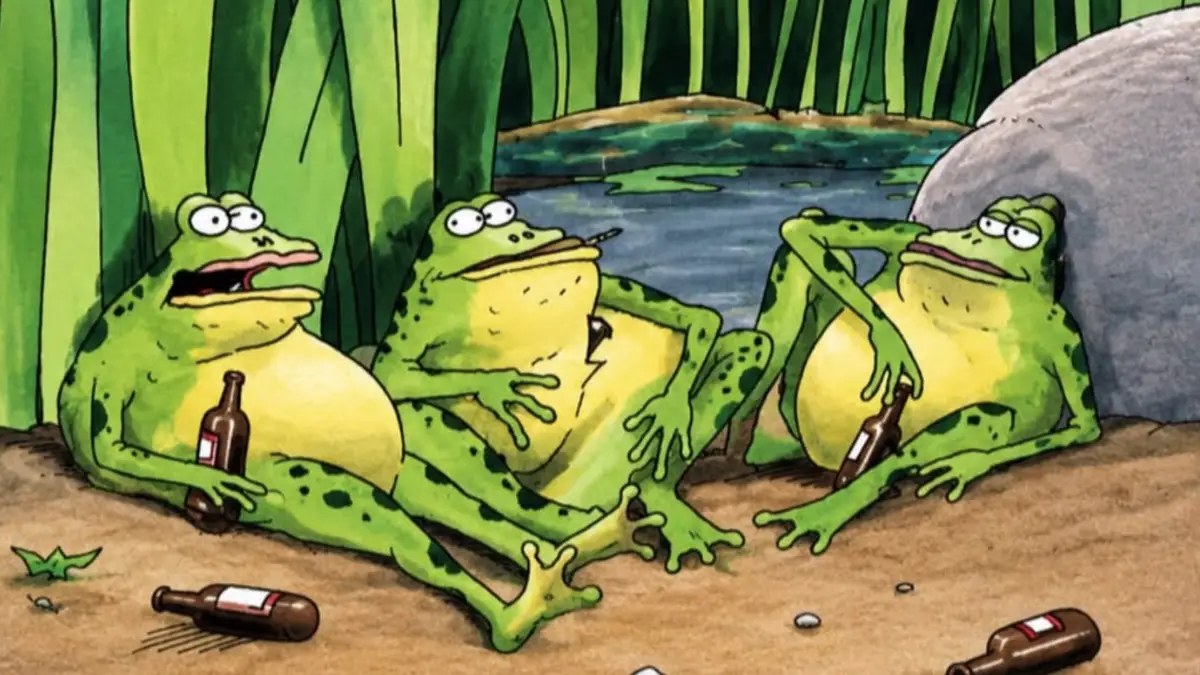
A cluster of panels only lands if you know the words being parodied. Three Dog Night’s 1969 hit “Joy to the World” featured deliberately nonsensical lyrics, opening with a verse about Jeremiah, a bullfrog and a good friend who “always had some mighty fine wine.” Larson took that imagery literally, placing a group of frolicking bullfrogs simply enjoying their drink. Likewise, his panel on Chubby Checker’s 1961 “Let’s Twist Again”—a spiritual sequel to the 1960 dance-craze single The Twist—sets animals singing the unchanged lyric while giving the lead snake Checker’s signature pompadour hair and bow tie.
The strip also occasionally abandoned its usual single-big-joke format. A 1992 panel captioned “Albums to avoid” packed several mini-gags into one frame, imagining how dreadful duets might sound if crooner Frank Sinatra shared a microphone with pop star Prince. Meanwhile, a Jaws–themed panel narrowly escaped becoming dated: had Steven Spielberg’s 1975 blockbuster failed to remain one of the most enduring films ever made, its reference would have aged just like the rest.
Looking Ahead
As The Far Side continues to find new readers through reprints and digital archives, these seven panels offer a fascinating window into how comedy ages. They remind audiences that even timeless cartoonists are products of their moment—capturing the songs, stars, and sensations of a specific era in a way that rewards those who remember, while inviting others to learn the story behind the laugh.























Join the conversation