

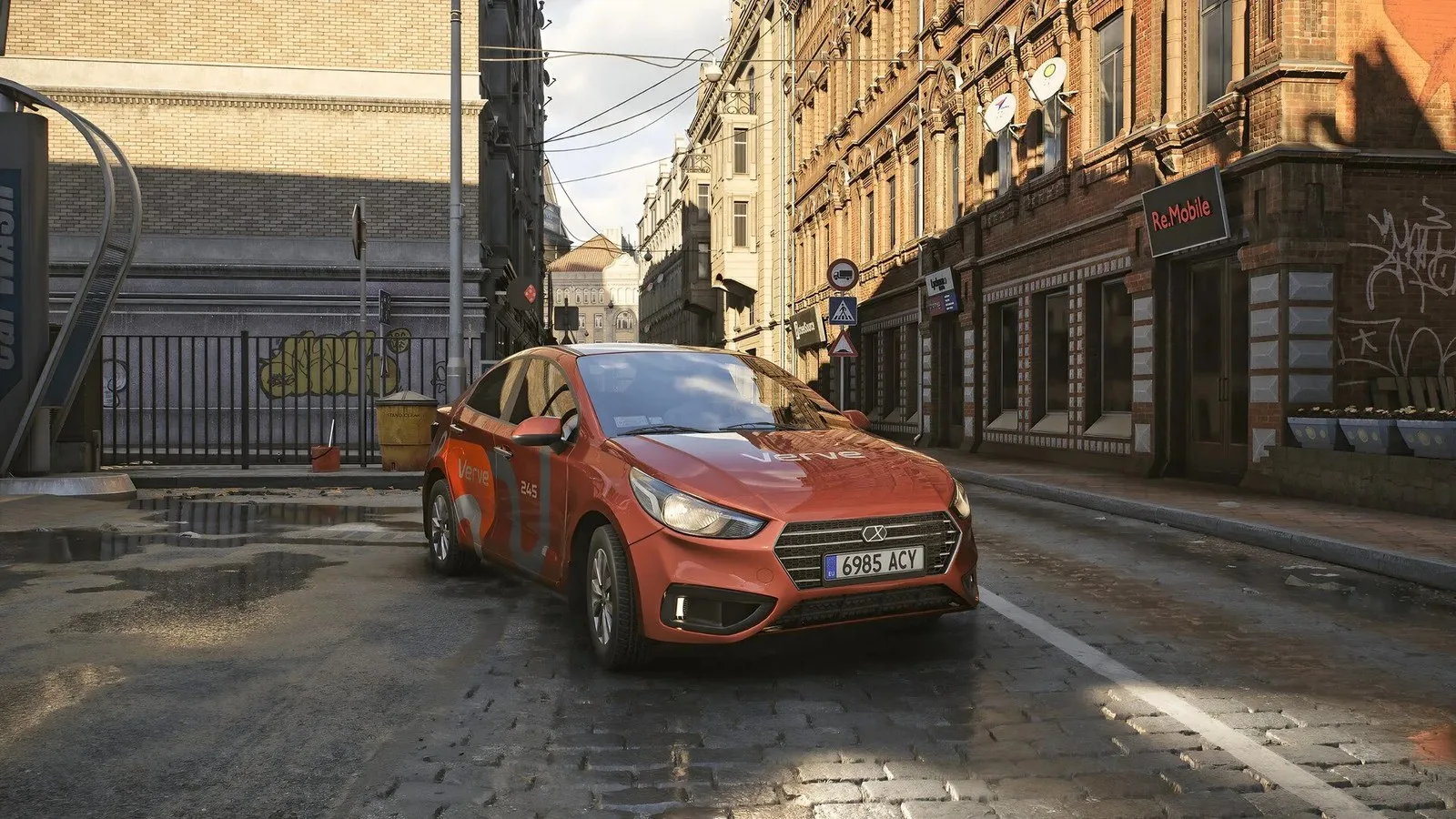
Saber Interactive’s driving game Rideshare Stimulator has already made headlines for all the wrong reasons. But while its use of AI and the allegations from a former writer have attracted plenty of attention, Rideshare Stimulator has a far more fundamental problem to overcome: being an enjoyable game to play.

You’re put in the driver’s seat of a rideshare business that you co-own with your buddy, Tim. You’ll have to pick up a variety of passengers, navigate traffic (and adhere to the usual rules of the road) and earn enough money to keep the business running. It has the potential to be a pretty fun gameplay loop, especially when there’s an ongoing side mission to restore an old sports car housed in your garage. Unfortunately, the more Rideshare Stimulator attempts to simulate the realities of the job, the less appealing it becomes.
After Rideshare Stimulator was announced, it almost immediately began drawing criticism after former lead writer Stella Sacco alleged that Saber Interactive had replaced her with AI-generated writing midway through development. Stacco claimed that she was removed from the project and that AI was used to write the remaining text, including material intended for future updates.
The dispute escalated when Saber CEO Matthew Karch responded publicly to Sacco’s claims. His comments included a personal attack on the former writer, suggesting that he would have been happy to replace her with AI in retrospect.
Speaking to GameSpot at Gamescom in August, Saber’s chief creative officer Tim Willits addressed the controversy, pushing back against the idea that the company was replacing employees with generative AI. “I promise you we have never let anyone go and replaced them with AI. I hire people all the time,” Willits said. He described the technology as something the company was experimenting with, rather than a replacement for its workforce. Rideshare Stimulator’s AI disclosure outlines uses for voice generation, localization, passenger missions, and music.

Obey the rules of the road in Rideshare Stimulator.
Indeed, in-game when choosing from radio stations, they’re clearly marked as AI, and much of the voice acting is certainly AI-generated, and leaves a lot to be desired—it highlights the cases where AI can and cannot be useful, and on this occasion it should have been left to the humans. Regardless, as a simulation game, Rideshare Stimulator has to stand on its own merits. It fails to do so.
There are occasions where simulation games can make the mundane surprisingly entertaining. There’s a reason that people spend thousands of dollars to build huge rigs so they can drive trucks across Europe for hours. On the lower end, there are players who gladly while away their time managing supermarkets or farms, or operating machinery. The trick is turning routine tasks into satisfying gameplay loops with a clear sense of progression.
Rideshare Stimulator seems determined to make its players really work for their enjoyment. Keeping a car in good condition is part of the job, so dealing with practical responsibilities such as refueling and cleaning the vehicle between rides is to be expected. You can’t expect your passengers to be happy if the car is filthy or breaks down because there’s no gas.
However, the rate at which the car guzzles fuel and gets dirty detracts from the activity that should be the main focus. If the process of maintaining your vehicle becomes an obligation that interrupts the fun too often, it’s immersion-shattering. There’s a balance to be struck between realism and entertainment—games like PowerWash Simulator show that something as simple as cleaning can be deeply satisfying, but Rideshare Stimulator hasn’t got the balance right yet.
The same applies to its driving systems. You’re expected to follow traffic rules, avoid pedestrians, and manage the condition of the vehicle while keeping your passengers happy. One mission, where a tow truck driver doesn’t know the location of the vehicle he’s recovering, tasks you with tracking down a car in a pretty wide area of the map. The game hints that you should listen to your passenger for clues, but said passenger remains mercilessly silent throughout, leaving you scouring the streets for his stranded car until you’re pretty much next to it on the street. At this point he exclaims, “Hey, I think that’s the truck!” Yeah, thanks buddy. Really helpful.
I don’t want Rideshare Stimulator to be Crazy Taxi, but I do want it to make the process of getting from one destination to another enjoyable enough that I want to keep doing it.
There’s an understandable temptation to make Rideshare Stimulator’s use of AI the defining problem surrounding the game, especially considering Sacco’s allegations and Karch’s less-than-professional response. They’re legitimate concerns, and transparency about AI-generated content matters. However, the game’s underlying design deserves scrutiny, too.
Rideshare Stimulator wants to be a realistic driving simulation and a business management game with interesting passenger stories and a side project of restoring a sports car. Each of those ideas can form the basis of an engaging game, but there are too many pain points in each one for me to recommend Rideshare Stimulator in its current state.
Using AI in the Free Ride mode could provide unpredictable encounters based on current events, but unfortunately I couldn’t test that out since it’s not included in the demo. Endless content can’t always be engaging, and an infinite supply of passengers isn’t worth much when the act of driving them around is frustrating and repetitive.
Have thoughts, questions, or benchmarks on this topic? Join the discussion on our forums.
Join Discussion ➔






















Bli med i samtalen