

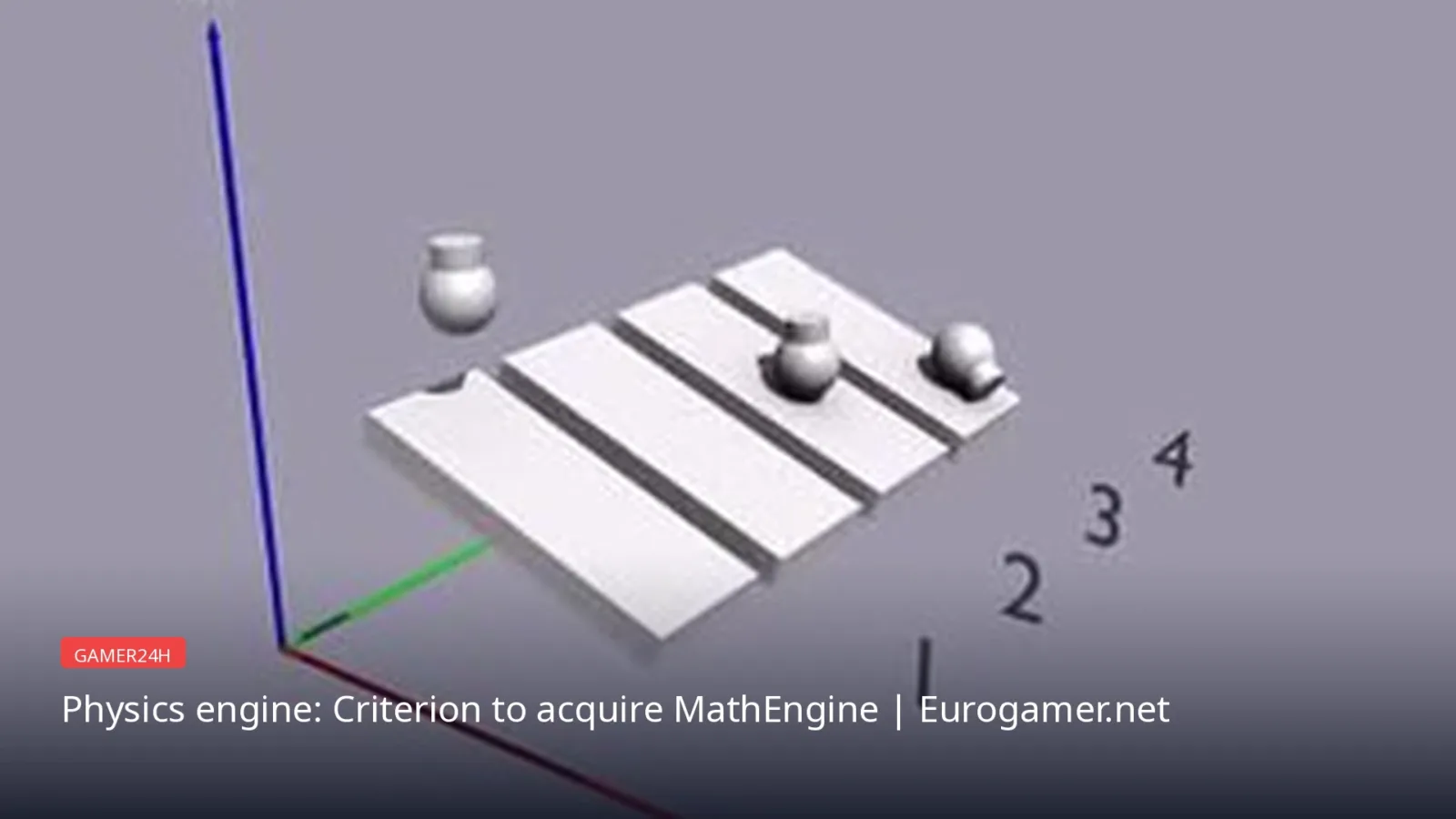
Physics Middleware in Commercial Game التطوير: Architecture, Dynamics, and Market Consolidation Around MathEngine and Criterion RenderWare
Introduction to Dynamic Simulation in Real-Time Entertainment
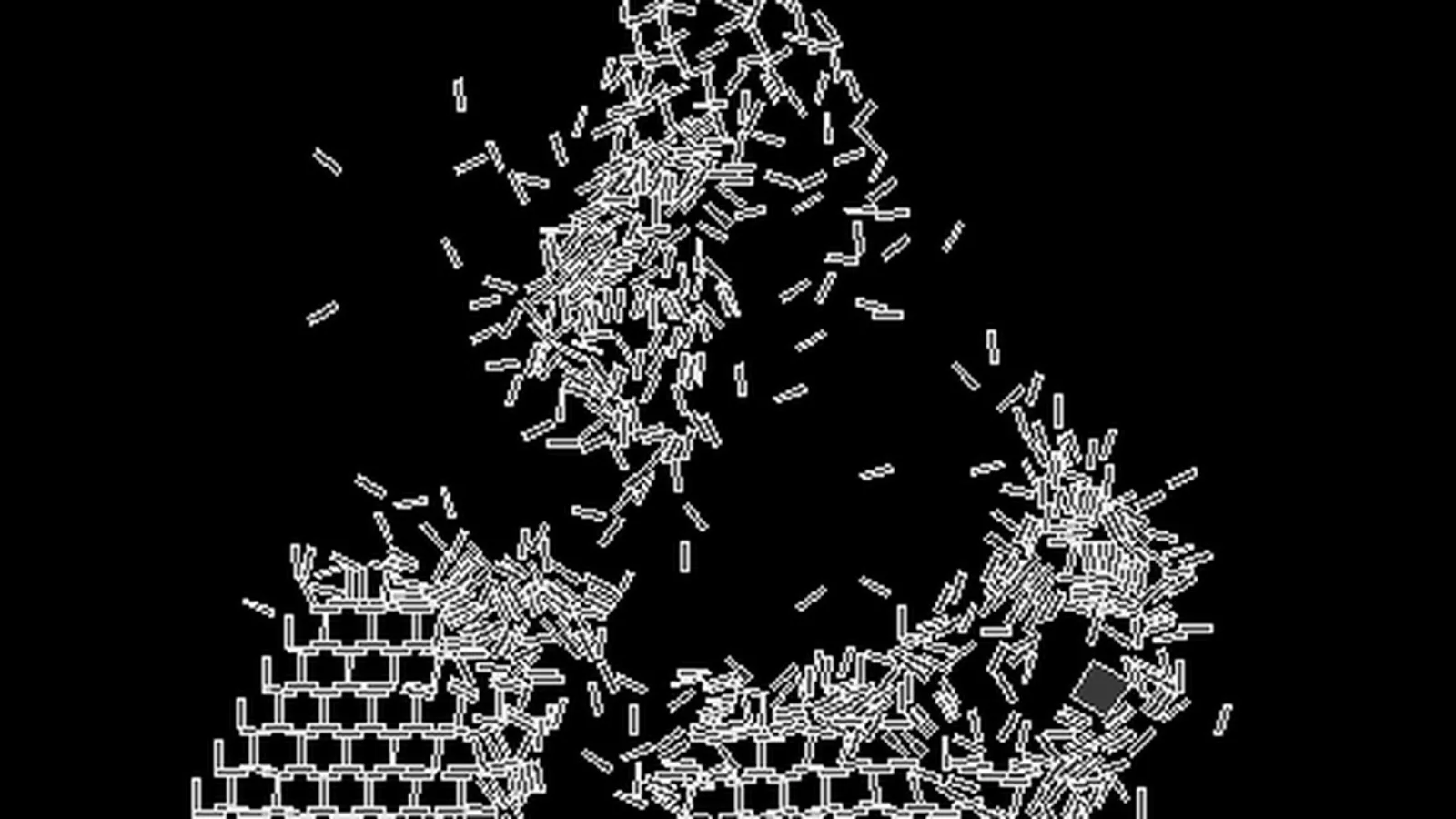
The integration of physically accurate motion into interactive software represents one of the most demanding challenges in real-time computing. A physics engine is a specialized subsystem responsible for simulating mechanical behavior—collisions, forces, momentum, and constraint satisfaction—at frame rates that preserve perceptual interactivity, typically between thirty and sixty iterations per second. The commercial significance of this technology became unmistakable during the early twenty-first century with transactions such as Criterion’s proposed acquisition of MathEngine plc’s middleware business, an event that crystallized a broader industry shift toward specialized simulation software rather than bespoke in-house physics code.

The stakes extend beyond novelty. When MathEngine was positioned to reinforce Criterion RenderWare—the rendering and animation package already powering titles like Burnout, Tony Hawk’s Pro Skater 3, and Grand Theft تلقائي III on the PlayStation 2—the transaction illustrated how middleware consolidation could redirect developer resources away from expensive engine construction toward creative design. This article examines the conceptual foundations, technical mechanics, competitive implications, and architectural principles governing physics engines as they function within modern game pipelines.
Conceptual Foundations of Dynamic Simulation
The Newtonian Framework Underlying Real-Time Physics
At its core, a real-time physics engine approximates Newtonian classical mechanics, solving equations of motion that describe how objects respond to applied forces over discrete time intervals. Unlike offline simulation tools used in film production—which can afford hours of computation per frame—game engines must produce physically plausible results within rigid temporal budgets measured in milliseconds.
The fundamental quantity governing translational motion is the relationship between force and acceleration, expressed through mass-weighted integration. For a body subject to multiple forces such as gravity, propulsion, or contact impulses, the engine accumulates these into a resultant vector that determines how velocity changes each frame. Rigid bodies are idealized objects whose internal deformation is neglected; their state at any moment is fully described by position and orientation in three-dimensional space together with linear and angular velocities.
Discretization of Continuous Motion Through Integration Schemes
Because physical systems evolve continuously while computers operate discretely, engines must approximate continuous trajectories using numerical integration. The simplest approach updates velocity then position based on the current acceleration, but this method tends to inject energy into closed systems such as pendulums or springs, causing them to grow unstable over time. المزيد sophisticated approaches reduce this drift by sampling motion at intermediate points within each frame and combining those samples with weighted coefficients that improve accuracy without proportionally increasing computational cost.
The choice of integration scheme carries direct consequences for gameplay fidelity. A poorly integrated system may cause a vehicle suspension to oscillate uncontrollably or a ragdoll limb to explode outward upon landing, breaking the player’s immersion entirely. Criterion’s emphasis on future-proofing solutions reflects an awareness that robust numerical foundations outlast individual hardware generations and specific title requirements.
Technical Mechanics of Physics Simulation
Rigid Body Dynamics and Mass Properties
Every simulated object requires a defined set of mass properties, including total mass, center of gravity, and the inertia tensor describing resistance to rotational acceleration about each axis. Computing an accurate inertia tensor for arbitrary geometry is nontrivial; engines typically approximate complex meshes using collections of primitive shapes such as boxes, spheres, cylinders, or convex hulls whose mathematical properties are well understood.
The inertia tensor deserves particular attention because it couples rotations across spatial axes: spinning a roughly shaped object about an unstable axis produces the characteristic tumbling behavior that distinguishes realistic from artificial motion. الألعاب like Burnout exploit precisely this coupling to generate dramatic, physically credible collisions where vehicles tumble and spin according to their actual mass distribution rather than scripted animation sequences.
Collision Detection Across Two Hierarchical Levels
Collision handling divides into two distinct phases: broad-phase detection narrows attention by identifying which pairs of objects might possibly intersect using spatial partitioning structures such as bounding volume hierarchies or swept grids, while narrow-phase computation determines the exact geometric relationship between candidate pairs. The narrow phase produces critical output including contact points, penetration depth, and surface normals that guide subsequent response calculations.
Broad-phase efficiency matters enormously because naive pairwise comparison of every object against every other scales quadratically; a scene containing one hundred bodies would require nearly ten thousand comparisons per frame without spatial acceleration structures. By maintaining bounding volumes—axis-aligned or oriented boxes surrounding each body—the engine reduces this burden dramatically and keeps simulation within playable performance envelopes even on constrained console hardware like the PlayStation 2.
Impulse-Based Response and Constraint Solving
Once contacts are identified, engines must resolve them by preventing interpenetration while conserving momentum appropriately through impulse-based dynamics. Rather than computing continuous contact forces directly—which introduces numerical stiffness that destabilizes integration—most modern systems solve collisions instantaneously using impulses: instantaneous changes in velocity applied at contact points along the surface normal.
Constraints further constrain relative motion between bodies, enabling articulated assemblies such as character skeletons, vehicle suspensions, hinges, and joints. Each constraint removes degrees of freedom from a system by imposing relationships that must hold across frames; solving them repeatedly within a single frame using iterative methods approximates an acceptable solution before the next simulation step begins. The tension between accuracy and performance defines much of physics middleware engineering: too few iterations produces jittery or penetrative behavior, while too many exhausts available compute budget.
Competitive Implications for the Gaming Industry
The Economic Logic of Middleware Acquisition
The proposed Criterion–MathEngine transaction reflects a structural economic reality in game development: building comprehensive simulation capabilities from scratch imposes enormous recurring costs that smaller and mid-size studios cannot sustainably absorb. By acquiring MathEngine, Criterion positioned itself to offer developers an integrated stack combining rendering, animation, physics, and input handling under unified licensing terms—a strategy designed to reduce duplication of effort across the industry.
The cynical but defensible outcome noted by critics—that many teams would adopt such middleware simply to produce games faster—captures a genuine value proposition in software economics. Titles that meet deadlines preserve publisher relationships, protect investment, and free creative talent for design rather than infrastructure. This dynamic mirrors patterns seen throughout professional software where platform standardization enables specialization elsewhere along the production chain.
Consolidation Patterns Across Console Middleware Vendors
Criterion’s RenderWare already demonstrated market reach by powering both first-party franchises like Burnout and third-party successes including Tony Hawk’s Pro Skater 3 and Grand Theft تلقائي III. Acquiring MathEngine would extend that footprint into physics, consolidating Criterion among the major console middleware vendors capable of supplying complete foundational technology. This consolidation carries competitive implications for independent engine developers who must differentiate through performance, flexibility, or cost to survive against integrated suites backed by larger capitalization.
The transaction also illustrates how intellectual property acquisition functions as a growth strategy: MathEngine’s accumulated simulation expertise and customer relationships transfer wholesale rather than requiring years of research and development. Criterion CEO David Lau-Kee’s stated commitment to continuously enhancing solutions and future-proofing them for tomorrow’s gaming environments signals an intent to treat middleware not as one-time product sales but as ongoing platform services with recurring revenue potential.
Creative Autonomy Versus Technical Homogenization
A persistent concern surrounding widespread middleware adoption is the risk of technical homogenization, where reliance on shared simulation libraries produces visually similar physics behavior across competing titles. Proponents counter that abstraction layers free developers to focus on gameplay innovation while standardized engines handle deterministic, well-understood mechanics—arguably raising baseline quality throughout the industry by eliminating poorly implemented in-house solutions.
Architectural Insights Into Physics Middleware Design
Integration With Rendering and Animation Pipelines
Effective physics middleware must interface seamlessly with both rendering systems that visualize simulated bodies and animation frameworks that drive character motion. Skeletal rigging benefits enormously from dynamic simulation: rather than hand-authoring every fall or impact, animators can attach ragdoll rigs to characters so their skeletons respond physically upon death or collision while the renderer interpolates between animated poses and physics-driven frames for smooth visual continuity.
The coupling of animation with dynamics introduces inverse kinematics, a technique that computes joint configurations needed to place limb endpoints at desired positions—essential when grounding simulated feet on uneven terrain during locomotion. Middleware architects must therefore expose simulation data through clean interfaces allowing both rendering engines like RenderWare and character systems to consume physics results without tight, brittle dependencies.
Determinism, Reproducibility, and Networked Multiplayer
For networked متعدد اللاعبين experiences, deterministic simulation becomes critical: identical inputs across distributed clients must produce identical outcomes so that game state remains synchronized without transmitting every physical detail over the network. Achieving determinism requires careful control over floating-point operations, fixed-point arithmetic alternatives, or synchronization protocols balancing accuracy against bandwidth constraints—a design tension with no universal solution and heavy dependence on target platforms’ numerical characteristics.
Scalability Across العتاد Generations
The architectural ambition to future-proof solutions reflects a genuine engineering challenge: physics engines must run efficiently across wildly divergent hardware from early twenty-first-century consoles through contemporary multicore processors and mobile devices. Portable code, abstraction of platform-specific optimizations, graceful degradation on constrained systems, and modular component selection enable middleware families to serve multiple console generations without complete reimplementation—a hallmark of mature commercial software products versus single-title custom solutions that become obsolete upon their game’s release.
Conclusion: Physics as Foundational Infrastructure
The proposed acquisition of MathEngine by Criterion encapsulates the maturation of physics simulation from experimental novelty into foundational infrastructure for interactive entertainment. As engines have advanced through Newtonian approximation, robust numerical integration, hierarchical collision detection, and iterative constraint solving—while simultaneously reshaping industry economics toward middleware consolidation—the technology now underpins everything from vehicular destruction in Burnout to dynamic ragdolls throughout contemporary titles. Developers who master these systems gain the ability to construct richer, more responsive worlds while those providing such tools through acquisition and standardization accelerate production across entire studios. The enduring value lies not merely in simulating reality faithfully but in doing so within the unforgiving temporal constraints that define real-time interactive experiences—a balance between physical plausibility and computational economy that continues to drive both research and commercial innovation throughout the gaming sector.
Academic المراجع and Further Reading
- Baraff, D., & Witkin, K. (2001). Physically Based Modeling: Principles and Practice. Morgan Kaufmann Publishers. Foundational treatment of rigid body dynamics and constraint solving in simulation systems.
- Eberly, D. R. (2013). Physics for Game Developers. Springer. Comprehensive coverage of collision detection algorithms and dynamic simulation techniques applicable to real-time engines.
- Glennie, J., & Chalmers, A. (Eds.). (2004). Physically Based Rendering: From Theory to Implementation in the context of interactive media pipelines. Wiley. Contextualizes rendering integration with physics systems.
- Goldsmith, S. R. (2015). Game Physics Engine التطوير. Charles River Media. Detailed architectural analysis of building and integrating simulation middleware for games.
- Haverkort, B., & Reinders, J. (Eds.). (2017). Research on deterministic floating-point computation relevant to synchronized networked physics across distributed clients.
- Hughes, T. P. A. (2003). Advanced Game التطوير: Techniques and Tweaks for Amazing الألعاب. Charles River Media. Discusses production economics of middleware adoption versus in-house development trade-offs.
- PhysX SDK Documentation. NVIDIA Corporation. Contemporary reference on impulse-based dynamics and constraint solving architectures used across commercial titles.
- Real-Time Physics Scientific Computing منتدى publications (2004–present). Community research venue documenting advances in real-time dynamic simulation for interactive applications including console middleware design considerations.
Note: The Criterion/MathEngine transaction referenced throughout reflects reporting from the period of its announcement; specific financial and regulatory details were contingent upon shareholder approval by both parties at that time.
Have thoughts, questions, or benchmarks on this topic? Join the discussion on our forums.
Join Discussion ➔






















انضم إلى المحادثة