

Path Tracing Architecture: The Real-Time Clair Sampling Revolution Behind Next-Gen Jeux PC
Introduction: Beyond Rasterization — The Holy Grail of Real-Time Graphics
For more than three decades, video game graphics have relied almost exclusively on rasterization—a collection of clever mathematical approximations, pre-baked shadow maps, and screen-space tricks designed to simulate lighting without actually tracing physical photons. While rasterization made high framerates possible on consumer silicon, it fundamentally struggles with complex multi-bounce indirect illumination, realistic contact shadows, and physically accurate mirrors.

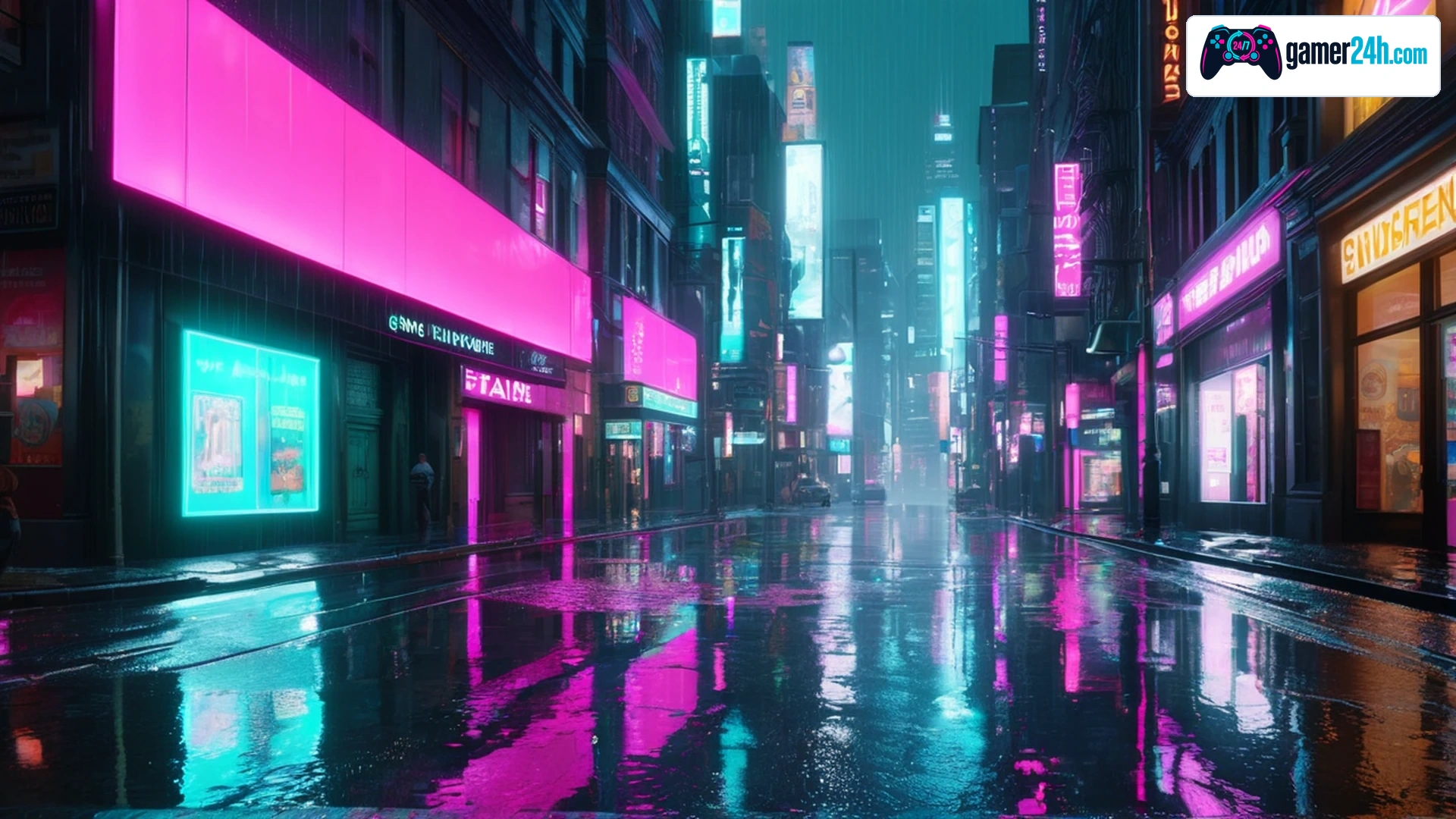
Path tracing (often referred to as “Full Ray Tracing”) changes this paradigm fundamentally. Rather than faking reflections and shadows with separate screen-space shaders, path tracing simulates the true physics of light transport by calculating rays as they bounce dynamically between physical surfaces, absorb color pigments, refract through translucent media, and enter the virtual camera lens. The result is the visual fidelity benchmark seen in cutting-edge PC releases like Cyberpunk 2077: Ray Tracing Overdrive and Alan Wake 2.
Core Mathematics: Solving the Rendering Equation in Real Time
At the mathematical heart of every path tracer lies the famous Kajiya Rendering Equation. In physical terms, the total light leaving any given point on a surface is the sum of the light emitted by that surface plus all the incoming light arriving from every possible direction over the hemisphere, multiplied by the surface material’s reflectance properties (the Bidirectional Reflectance Distribution Function, or BRDF) and the angle of incidence.
Because calculating infinite rays across an entire spherical hemisphere is computationally impossible for sixty frames per second, engines utilize Monte Carlo integration. Instead of evaluating every possible angle, the GPU shoots stochastic (randomly sampled) rays through the scene to estimate the true global illumination.
The Monte Carlo Variance Challenge
In standard Monte Carlo sampling, error and noise decrease with the square root of sample count: Error ∝ 1 / √N. This means that reducing visual grain by half requires four times as many ray calculations per pixel. For a competitive AAA game targeting 60 to 144 FPS, shooting thousands of rays per pixel is impossible—which is where advanced importance sampling enters the architecture.
Importance Sampling: Eliminating Noise Without Crushing Framerates
If a graphics engine shot rays completely randomly across a hemisphere, the vast majority of samples would hit dark walls or obscure corners, contributing virtually zero light while burning precious GPU cycles. Importance sampling solves this by biasing the direction of rays toward known high-intensity light emitters and dominant specular reflection angles.

- Cosine-Weighted Distribution: Rather than sampling flat angles near the horizon that contribute minimal energy, ray density is mathematically concentrated along the surface normal vector.
- Multiple Importance Sampling (MIS): Pioneered by Eric Veach, MIS intelligently blends material-driven sampling with direct light-source sampling, preventing catastrophic noise when glossy surfaces interact with small, intense light sources.
- Reservoir-Based Spatio-Temporal Importance Resampling (ReSTIR): The breakthrough algorithm that enabled real-time path tracing on consumer GeForce RTX GPUs by reusing light samples across neighboring pixels and preceding frames.

Matériel Acceleration: Bounding Volume Hierarchy and Dedicated RT Silicon
Executing path tracing in real time requires tracking billions of ray-triangle intersection tests every second. Modern graphics architectures (such as NVIDIA Ada Lovelace / Blackwell and AMD RDNA) offload this workload from general shader cores to dedicated Ray Tracing hardware accelerators (RT Cores).
These specialized ASICs accelerate Bounding Volume Hierarchy (BVH) traversal—a tree structure that groups 3D polygon meshes into nested bounding boxes. Instead of testing whether a ray intersects millions of individual geometry triangles, the hardware discards entire chunks of the scene in a few clock cycles, exponentially accelerating the path-tracing pipeline.
The AI Frontier: Neural Reconstruction and Temporal Denoisers
Even with advanced importance sampling and dedicated RT silicon, current GPUs can typically afford only 1 to 3 rays per pixel in real-time workloads. A raw 1-spp image looks like a heavily distorted television snowstorm. The true catalyst that pushed path tracing into playable reality is neural reconstruction.
Technologies like NVIDIA DLSS 3.5 Ray Reconstruction replace handcrafted heuristic denoisers with deep neural networks trained on supercomputers with ground-truth offline renders. By analyzing temporal motion vectors, surface depth, and material roughness over time, AI reconstructs crisp specular highlights and sharp reflections from sparse ray data—achieving photographic realism at fluid, competitive framerates.
Technical Synthesis and Academic Bibliography
Path tracing represents the permanent convergence of real-time video games with Hollywood CGI rendering techniques. Through the marriage of Monte Carlo importance sampling, dedicated BVH hardware accelerators, and neural super-resolution, developers are finally shedding the architectural limitations of rasterization to deliver true photorealistic interactive worlds.
Foundational Literature & Références:
– Kajiya, J. T. (1986). The Rendering Equation. ACM SIGGRAPH Computer Graphics, 20(4), 143–150.
– Veach, E. (1997). Robust Monte Carlo Methods for Clair Transport Simulation. Stanford University.
– Pharr, M., Jakob, W., & Humphreys, G. (2023). Physically Based Rendering: From Theory to Implementation (4th ed.). MIT Press.
– Bitterli, B., et al. (2020). Spatiotemporal reservoir resampling for real-time ray tracing with dynamic direct lighting. ACM Transactions on Graphics (TOG).
Technical Key Concepts: Path Tracing, Monte Carlo Integration, Rendering Equation, Importance Sampling, Bounding Volume Hierarchy (BVH), ReSTIR, Neural Ray Reconstruction, DLSS 3.5, Global Illumination.























Rejoignez la conversation