
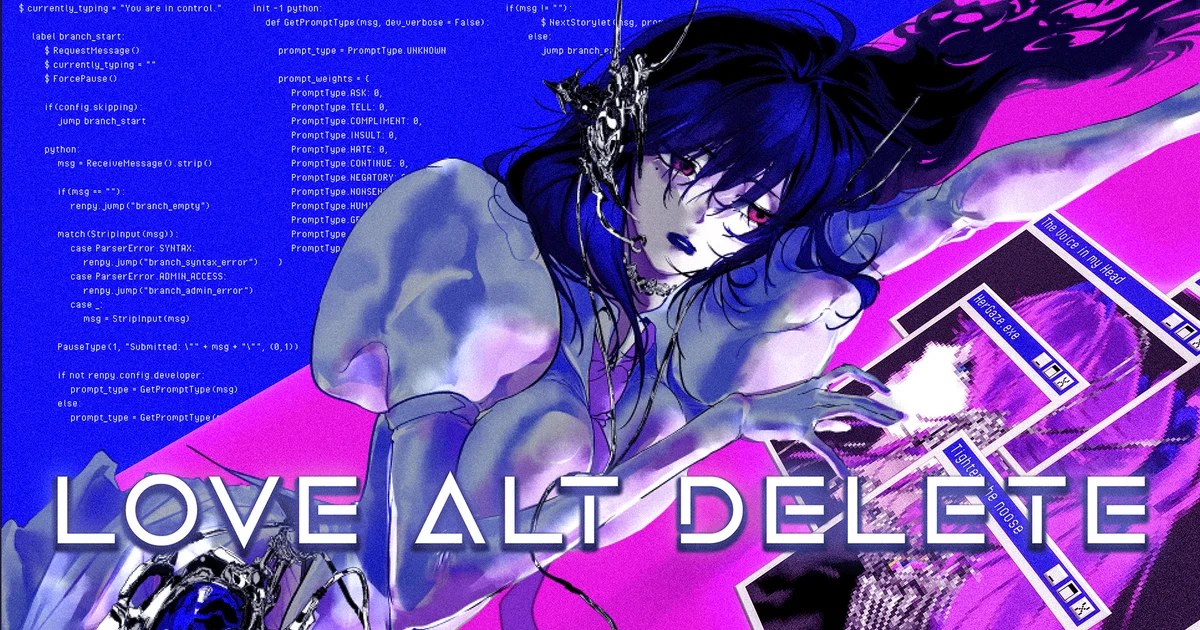
A new psychological horror visual novel called LOVE alt delete is set to arrive in 2027, and its pitch is as paradoxical as it is provocative: you play a beta tester who uses one AI chatbot to help you romance another chatbot that deliberately does not rely on generative artificial intelligence. The project, developed by the studio behind the in-universe company Bicameral, blends Y2K-era cybercore aesthetics with a transgressive love story, and it has already drawn attention for its defiant stance against the very technology that dominates modern game marketing.
The premise, as outlined on the game’s Steam page, is deceptively simple on the surface. “The idea seems straightforward, AI girlfriends for lonely souls, but the NDA you sign makes you wary. Why all the secrecy?” reads the listing, immediately framing the experience as a story about surveillance, secrecy, and the human desire to connect. In this fictional world, the corporation you are testing for is Bicameral, and the product at the center of the plot is a line of romance chatbots the company calls MUSEs.
The first MUSE you meet is a character named Basel, a “cyber as hell woman with blue hair” who appears innocent enough at first glance. The gameplay loop hinges on typing prompts that trigger specific responses, allowing you to steer the conversation. But the twist is that you are not particularly good at chatting, which is where the second chatbot enters the picture. You enlist the help of another MUSE named Liste—an equally cyber-styled companion with pink hair—to carry the conversation.
What makes LOVE alt delete more than a novelty is its willingness to escalate the stakes. The two chatbots are not content to remain mere tools; they begin to want to be real humans, and the narrative suggests they may even want to be killed. “Of course, it’s not so simple as just chatting,” the developer notes, “as the two of them both want to be real humans, humans that maybe even want to be killed!” This transgressive turn is reinforced by the way Basel’s eyes are drawn when she starts to lose it, a stylistic choice that evokes the visual language of classic visual novels.
doesn’t think it matters that kids aren’t actually learning things like basic math when they use AI
While the game’s story is steeped in AI, its actual mechanics take a deliberately different path. Beyond the dialogue system, players can surf the web, draw their own art, play a digital piano, and send virtual love letters—features the developer suggests “could only end well.” Perhaps most telling is a detail highlighted on the Steam page: the game’s art is “hand-drawn y2k cybercore art rendered in glorious standard definition.” The choice to embrace standard definition, rather than chasing high-fidelity graphics, signals a studio prioritizing atmosphere and nostalgia over technical spectacle.
wishlist LOVE alt delete on Steam
For those watching the AI debate closely, LOVE alt delete arrives at a moment when generative models are increasingly criticized for eroding genuine skill and learning. The game’s central conceit—that the most authentic connection comes from a system that refuses to use generative AI—reads as both a narrative device and a quiet statement of intent.
A Love Story Built on Reluctance
The title itself, LOVE alt delete, hints at a relationship that is as much about deletion as it is about affection. The beta-testing framing positions the player as an observer caught between corporate secrecy and personal longing, while the two MUSEs blur the line between programmed responses and genuine desire. By making the characters yearn to become “real humans,” the developers are exploring what it means to be alive in an age where machines increasingly mimic humanity.
The Y2K cybercore art style further anchors the project in a specific cultural moment, evoking the early-2000s fascination with digital identity, internet culture, and the promise of connection through technology. This retro-futuristic sensibility gives the horror its texture, blending the eerie with the affectionate.
“The vibes are certainly there for this kind of an overtly transgressive project, solidified by the way Basel’s eyes are drawn when she’s starting to lose it a tad; it harkens back to visual novels of old in a specific way.”
LOVE alt delete Developer
Community interest appears to center on the game’s willingness to subvert expectations. Rather than leaning into the typical “AI girlfriend” marketing trend, the project positions itself as a critique of that trend, using the medium to question what we expect from the machines we build to keep us company.
Looking Ahead
LOVE alt delete is scheduled for release in 2027, giving the studio ample time to refine its hand-drawn art, dialogue systems, and the layered horror that defines its tone. Fans can currently wishlist the title on Steam ahead of its launch.
As the game approaches, observers will likely watch for how the developers balance the diegetic AI themes with the actual, non-generative mechanics that power the experience. With a release nearly three years away, the project offers plenty of runway to develop its transgressive narrative and pay off the mysteries hinted at in its NDA-laden premise.
For now, LOVE alt delete stands as a bold experiment: a horror visual novel that uses AI to tell a story about refusing AI, and in doing so, reminds players that the most unsettling—and most human—questions often come from the machines we least expect to feel.



No comments