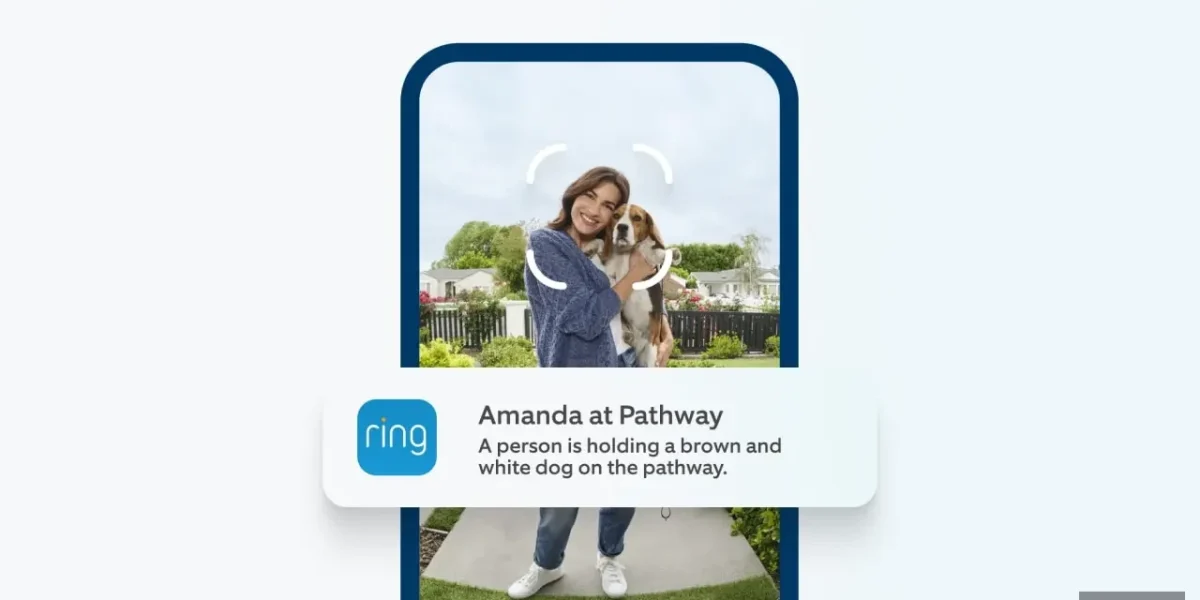
In a significant turn of events, Virginia resident Charles Sigwalt has taken Amazon, the parent company of Ring, to court over privacy concerns related to the tech giant’s “Familiar Faces” feature. The lawsuit, filed in the Seattle federal court, alleges that the AI-powered facial recognition system infringes upon user privacy.
For those uninitiated, “Familiar Faces” is an advanced AI feature designed to identify specific visitors and send personalized alerts instead of the generic “Person at Front Door” notification. Once a face is detected by the system, homeowners can assign names to these profiles within the Ring app, enabling the device to recognize frequent guests more accurately.
The system’s effectiveness varies depending on factors such as distance (optimal range being 9 to 13 feet for higher-resolution 2K and 4K cameras), lighting conditions, face masks, or high mounting angles. These elements can potentially impact the system’s accuracy.
Sigwalt’s lawsuit alleges that millions of Americans, including delivery drivers, neighbors, mail carriers, and pedestrians, have had their facial recognition information collected without their consent as they pass by a camera. This raises serious concerns about the potential misuse of personal data in an increasingly connected world.
Ring, the tech company behind popular doorbell cameras, has assured that the collected face data remains encrypted and is automatically deleted after a period of inactivity. Unidentified faces are erased within 30 days of no recognition, while labeled profiles disappear after 180 days of non-recognition. Notably, Ring has restricted the use of its facial recognition feature in areas with stringent biometric privacy laws, such as Illinois, Texas, Portland, and Quebec.
Stepping beyond human surveillance, Ring cameras are also equipped to capture animal biometrics. During the 2026 Super Bowl (Super Bowl LX), the company faced a wave of criticism for an advertisement promoting “Search Party,” an AI feature designed to help users locate lost pets by scanning neighborhood camera networks. This advertising campaign sparked controversy, as it promoted the use of advanced technology in a manner that some found intrusive.
Ring’s history is marked by legal battles over customer privacy concerns. In 2019, a significant lawsuit was filed against the company when hackers gained control of Ring cameras and used their two-way speakers to harass families, make racist comments, demand Bitcoin ransoms, and even communicate with young children directly. Four years later, in 2023, Ring found itself back in court due to a lawsuit filed by the Federal Trade Commission (FTC) over the company’s failure to restrict its employees and contractors from accessing customers’ private video feeds, potentially allowing them to invade users’ privacy in intimate settings.
News Source: Neowin






Comments
Be the first to comment.