

In the realm of historical fiction, where narratives often tread familiar ground, certain works stand out for their ability to transport us to different eras and cultures. While masterpieces like Takehiko Inoue’s “Vagabond” and Fuyumi Soryo’s “Cesare” remain unadapted for anime, other historical manga have found their way to the screen, offering glimpses into richly detailed worlds. Among these is Science Saru’s “Jaadugar: A Witch in Mongolia,” a promising addition that delves into 13th-century Persia with nuance and sensitivity.
A Glimpse into 13th Century Persia
Based on Tomato Soup’s “A Witch’s Life in Mongol,” the ongoing anime series, which premiered on July 4, paints a vivid picture of life in Tus, a bustling city on the cusp of change. While rooted in a story of resilience and wartime horror, “Jaadugar” revels in the everyday beauty and richness of its setting. The animation is breathtaking, seamlessly blending slice-of-life elements with a sweet, cartoonish aesthetic that’s both comforting and disorienting.
The year is 1213. Sitara, an orphaned child, is sold into slavery to the widowed Fatima. In this era of the Islamic Golden Age, Fatima decides to educate Sitara, but the young girl initially resists, yearning for her mother. Fatima gently reminds her that she has no home and that a slave’s worth lies in her value as “property.” This stark reality is juxtaposed with Fatima’s tenderness towards Sitara, who soon realizes the power of knowledge. Fatima’s son, Muhammad, encourages Sitara to embrace learning, igniting a passion for mathematics and astrology. However, this period of bliss is shattered eight years later when the Mongols invade Tus.

What sets “Jaadugar” apart is its commitment to historical and cultural accuracy. The series meticulously recreates the sights, sounds, and customs of 13th-century Persia, from the vibrant bazaars brimming with goods to the beautifully decorated homes that line the streets. Science Saru’s fluid, picturebook-esque color palette infuses these mundane moments with a sense of beauty, but this appreciation never feels superficial or exploitative.
The cultural richness of Tus is deeply intertwined with daily life. The Adhan (the Islamic call to prayer) and the practice of Iddah are integral parts of the community, and the Quran’s emphasis on knowledge is a guiding principle. When the Mongol invasion disrupts this harmony, the rhythm of normalcy shatters, highlighting the fear and alienation that accompany a violent intrusion. When Tolui, one of Khan’s sons, robs Sitara’s family library, it underscores how war strips communities of their cultural heritage.
In one poignant scene, Sitara emerges from her home to witness the devastation wrought upon Tus. The once-bustling bazaar is now a wasteland of ashes, a stark contrast that emphasizes Khan’s senseless brutality. While “Jaadugar” doesn’s shy away from these painful realities, it remains rooted in Sitara’s story, and the path ahead leads inexorably towards revenge.
Dragged to the Mongolian court by Tolui, Sitara must navigate a hostile environment where she is constantly demonized for her education and outspokenness. Despite being labeled a “witch” for defying traditional norms, she engages in subtle political maneuvering while concealing her rage. However, her relationship with the Mongols is complex. While they represent brutal colonizers who inflict unimaginable trauma, she must also understand their culture to exploit their vulnerabilities. This requires forging strategic alliances, cultivating an interest in their customs, and isolating individual motivations from the larger context of the Mongol invasion.
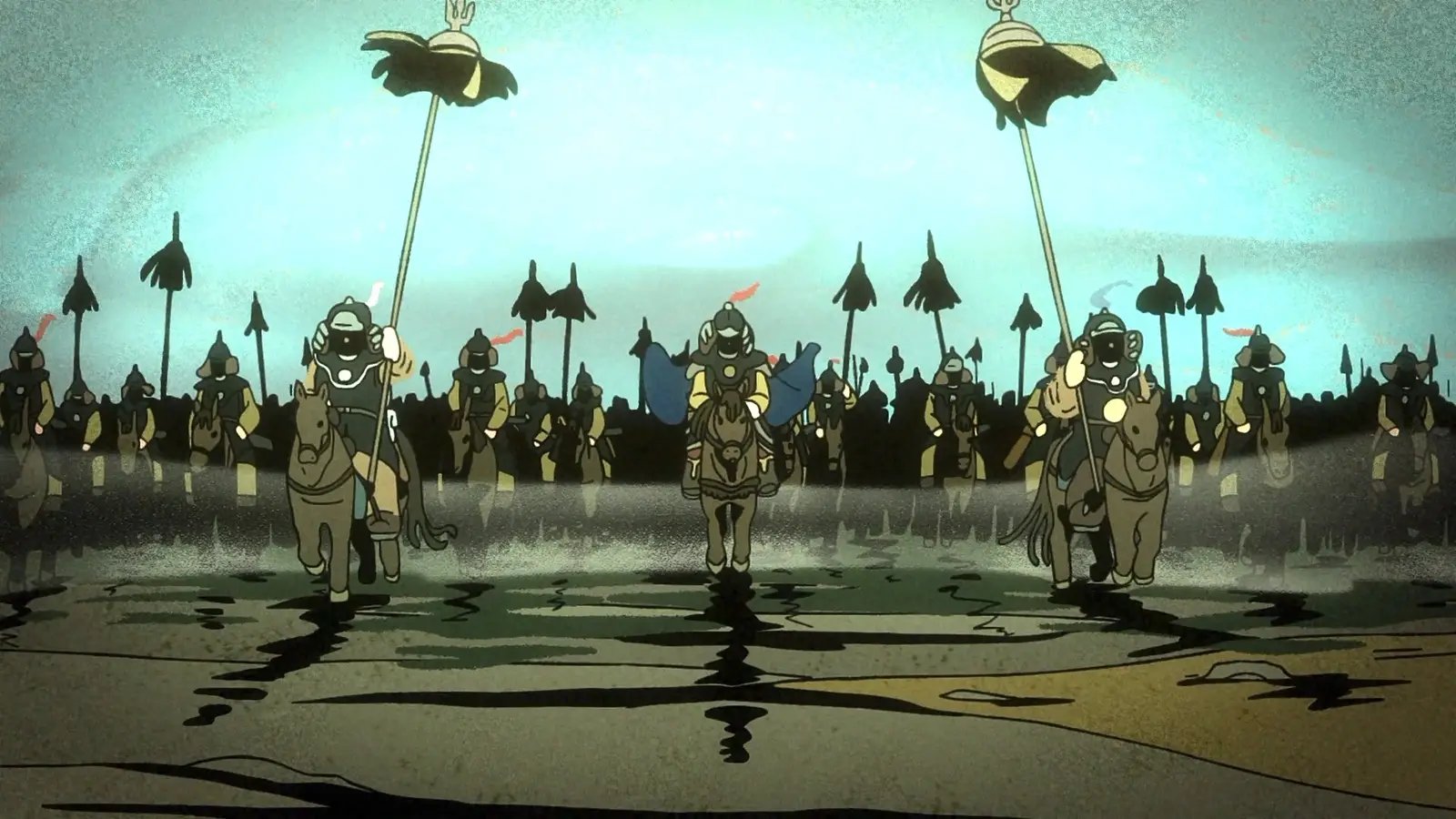
“Jaadugar” defies conventional anime tropes. Despite its gritty realism, it employs an expressionistic art style that offers a whimsical window into this historical fiction. Shifting color tones create contrast between the safety of the court and the unpredictability of the battlefield, building tension throughout the episodes. This masterful blend of visual storytelling and thematic depth is what makes “Jaadugar” so compelling.
While “Jaadugar: A Witch in Mongolia” has yet to reach its full potential, this well-received adaptation has already established itself as a spectacular historical anime that pays meticulous attention to detail. It’s a must-watch for anyone who appreciates a culturally rich tale rooted in real history, where characters are afforded multidimensionality at every turn. This compelling revenge story explores how knowledge can be used as a concealed weapon to dismantle one of the most formidable empires from within.
“Jaadugar: A Witch in Mongolia” is available to stream on Crunchyroll.
Source: Polygon























Join the conversation