

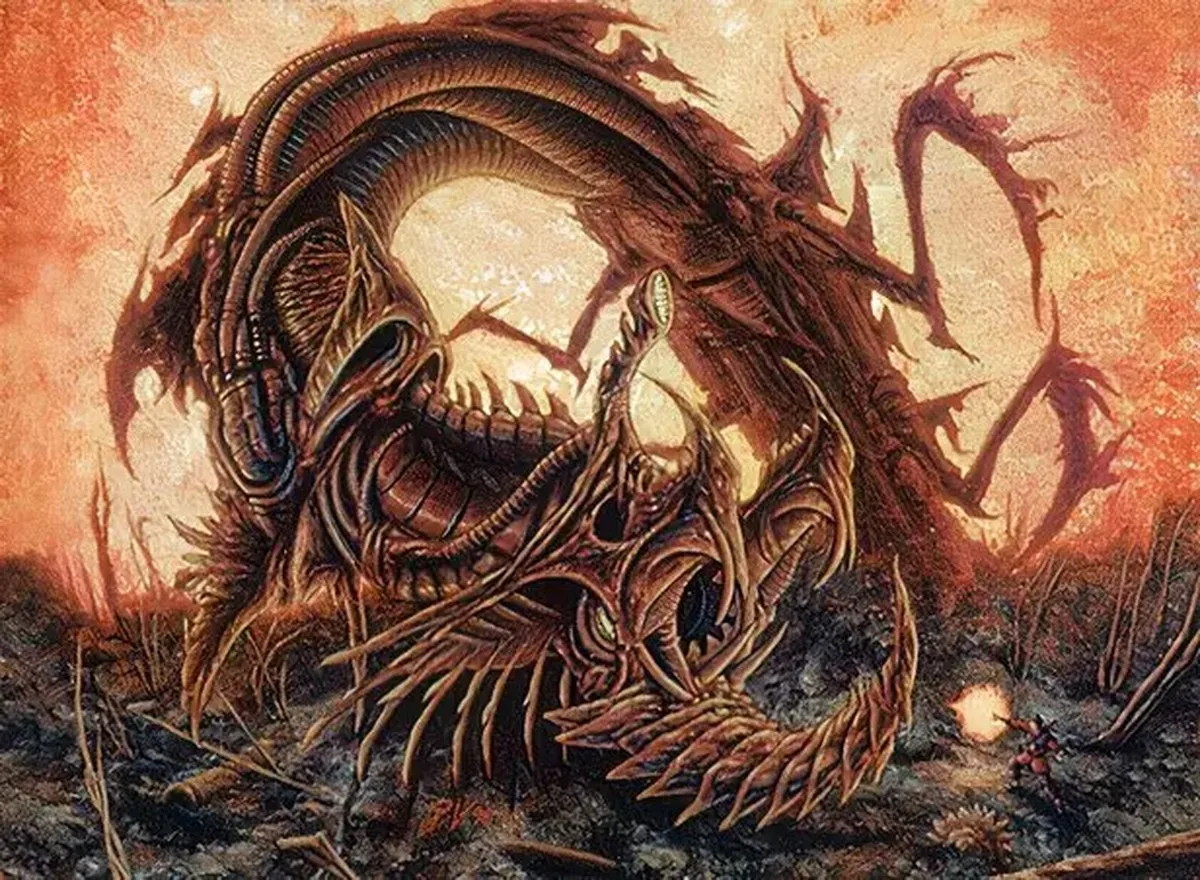
Spend enough time in Magic: The Gathering Online‘s Premodern best-of-three queue and, sooner or later, you’ll encounter something like this: Your opponent plays a turn-one Island and passes. You think, “Control deck. Got it.” You lead with a Forest and play a Birds of Paradise. Next turn comes, and there’s another Island on your foe’s side — followed by Phyrexian Dreadnought and an immediate Stifle to counter the Dreadnought’s triggered ability. Boom: There’s a 12/12 trampler staring you down on turn two. Welcome to Premodern. You’ve just met Phyrexian Dreadnought and “Stiflenought,” the powerhouse combo-control deck built around abusing one of the most ridiculous creatures in Magic history.

Magic: The Gathering‘s Mirage turned 30 in October 2026, and perhaps no card from the landmark expansion has enjoyed a stranger afterlife than Phyrexian Dreadnought. The one-mana 12/12 artifact creature has gone from an oddball relic of early Magic design to one of the defining threats of Premodern, the fan-created eternal format built around cards from the game’s first decade.
Add Polygon.com on Google
Add as Preferred Source
Follow on Google Discover
Mirage, Magic‘s ninth expansion, introduced a wealth of memorable cards, mechanics, and characters, including the first appearances of iconic time wizard Teferi and the verdant jungle continent of Jamuraa on the plane of Dominaria. Plenty of its cards remain desirable — and valuable — pieces of vintage cardboard three decades later. But few have become quite as emblematic of how old Magic can find new life as Phyrexian Dreadnought, a card whose absurd stats, tortured rules history, distinctive Pete Venters artwork, and interactions with other cards transformed it into something far more important than its designers could have ever anticipated.
The story behind Phyrexian Dreadnought’s design and art
Phyrexian Dreadnought was the first 12/12 creature in Magic history, but it didn’t appear out of nowhere. Head designer Mark Rosewater previously explained that the card grew out of a running game among early Magic designers to keep one-upping the largest creature ever printed. Alpha had introduced the 8/8 Force of Nature, followed by Antiquities‘ 9/9 Colossus of Sardia, The داكن‘s 10/10 Leviathan, and Ice Age‘s 11/11 Polar Kraken. When Rosewater pushed for a 12/12 in Mirage, lead designer Bill Rose told him it would need to be interesting enough to justify the size. Rosewater came back with his audacious answer: a 12/12 trampler for one single mana.
The card’s built-in drawback, of course, was supposed to make that absurd rate remotely fair. Naturally, players have spent much of the past three decades figuring out how not to pay it.
If Rosewater helped give Dreadnought its bizarre mechanical identity, Pete Venters provided everything else. One of the most prolific illustrators in Magic history, Venters has contributed hundreds of illustrations to the game while also shaping its early worlds, characters, card names, flavor text, and visual identity as a member of Wizards’ Continuity team. His lengthy résumé includes some of the finest Magic cards ever made.
I’m fairly confident I’m responsible for naming it.
Venters typically only got involved once the design team had already established a card’s mechanics and title, but in Dreadnought’s case, he was unusually close to the process from almost the beginning.
“I actually heard about the card about two weeks prior to receiving the file, when Mark Rosewater stopped me in the hallway to tell me there was going to be a 12/12 in the set,” Venters tells Polygon. “Since I was pushing to get Phyrexia back into Magic, and it was an artifact creature, I’m fairly confident I’m responsible for naming it.”
Venters was also asked to illustrate it. His resulting creation became one of early Magic‘s most immediately imposing pieces of art, depicting a gargantuan, almost serpentine biomechanical beast twisting through the frame.
“The Dreadnought is essentially a wyrm, and I used that long, sinuous form to have the Dreadnought double back on itself,” Venters says. “That coiling conveys the length of the beast but also allows the head to occupy the majority of the image space.”
With relatively little established Phyrexian imagery to draw from (the term “Phyrexian” had appeared as early as 1994’s Antiquities, but Phyrexia’s lore and visual identity as Magic‘s chief antagonists wouldn’t be fully developed until the sprawling Weatherlight Saga began in 1997), Venters took inspiration from Sandra Everingham’s striking Yawgmoth Demon illustration (above) and “[H.R.] Giger’s biomechanoid brilliance.” He says he eventually entered something of an artistic trance while sketching it, only to snap out of it an hour or two later with roughly 60% of the creature already drawn.
“I wasn’t aware it was taking on full mascot status.”
The card’s best visual trick, however, is easy to miss at Magic card size. Look closely at the bottom-right corner, and there’s a tiny figure: Taysir, one of Magic‘s earliest planeswalkers.
“The intent is that you see the creature and then later, when you see the human, you finally realize how big it is,” Venters says.
The Dreadnought has even followed Venters into later work. When he illustrated the borderless Phyrexian Altar for Double Masters 2022, he placed Yawgmoth’s floating altar inside the decapitated head of a Dreadnought.
While the creature’s immense scale and tremendous power are apparent at a glance, Premodern players looked upon this gargantuan biomechanical monstrosity and affectionately dubbed it the “Shrimp.”
“I’d heard the Dreadnought called ‘Shrimp’ — which I think is hilarious — but I wasn’t aware it was taking on full mascot status,” Venters says.
How rules changes unleashed Phyrexian Dreadnought
The Phyrexian Dreadnought terrorizing Premodern today may be printed on the same pieces of cardboard that came out of Mirage booster packs in 1996, but it has not always functioned the same way. That distinction is essential to understanding Stiflenought.
The instant Vision Charm arrived just one expansion later in 1997’s Visions, complete with the ability to phase an artifact out. Under Magic‘s rules at the time, however, players couldn’t use it to dodge Dreadnought’s drawback the way they can today.
Wizards responded by changing Dreadnought’s Oracle wording. Oracle is Magic‘s official, up-to-date rules text for every card, and it governs how a card functions even when it differs from the words actually printed on an older copy. Rather than allowing Dreadnought to enter play and then forcing its controller to make the sacrifice, the revised wording effectively prevented it from entering at all unless the price had already been paid.
Wizards later categorized that treatment as power-level errata, or a post-printing rules change made not to fix a typo or ambiguity, but to keep a card functioning at its intended power level.
Stifle subsequently arrived in 2003’s Scourge. Its wonderfully succinct purpose (“counter target activated or triggered ability”) seems tailor-made for Dreadnought, but the famous combo still wasn’t actually available because Dreadnought’s sacrifice requirement was no longer a triggered ability.
That finally changed in 2007. With the Tenth Edition Oracle update and Wizards’ broader effort to eliminate power-level errata, Dreadnought once again entered the battlefield before its sacrifice trigger resolved. Players could finally respond to that trigger — including by pointing Stifle directly at it.
It’s certainly made my signing events extra-busy.
Vision Charm achieves much the same result by phasing the Dreadnought out while its ability is still on the stack, waiting to resolve. The sacrifice trigger comes and goes without claiming the temporarily absent creature, which then phases back in on the player’s next turn, ready to start removing enormous chunks from an opponent’s life total.
Two cards printed only months apart had, thanks to years of rules changes that followed, eventually become a combo they were never able to perform when they were first released.
That kind of transformation is hardly unique in a game with more than three decades of accumulated rules, formats, and interactions. Venters has watched it happen repeatedly to cards bearing his artwork.
He points to Arcum Dagsson and Zur the Enchanter, two Coldsnap cards whose artist proofs — special card-stock copies given to illustrators, typically without a printed back — suddenly became much more sought after once the Commander format’s popularity took off. Premodern has had an even more pronounced effect on his older work.
“Premodern has certainly turned that up to 11 for me, as the legal sets for the format are a snapshot of my most prolific time in Magic,” Venters says. “It’s certainly made my signing events extra-busy.”
Stiflenought is much harder than it looks
All this historical weirdness eventually produces a strategy that sounds almost insultingly simple: Play Dreadnought. Stop its drawback. Attack twice with a 12/12. GG.
Andrea Piemonti, better known in the Premodern community as PieGonti and one of the format’s foremost Stiflenought specialists, knows better. As the author of one of the most extensive modern guides on the archetype, he has spent years playing the deck competitively and studying the countless little decisions that separate a turn-two Dreadnought from a turn-two disaster.
“The complexity of Stiflenought comes from the fragility of the strategy — the two-for-one problem,” PieGonti tells Polygon. “When you’re building a Phyrexian Dreadnought, you’re always two-for-one-ing yourself.”
Every successful Dreadnought generally requires casting the creature itself, alongside Stifle or Vision Charm. If an opponent answers that 12/12 anyway, the Stiflenought player can lose two cards, as well as a tremendous amount of tempo, in one fell swoop.
In other words, the two cards overlap without being redundant. Stifle offers broader interaction, while Vision Charm can protect Dreadnought in a different way and occasionally unlock stranger corner-case plays — exactly the kind of small decision that makes the deck much harder to pilot than its basic combo suggests.
An excellent Stiflenought player is like an encyclopedia of what can go wrong.
There’s one more complication: The dream hand isn’t especially common. By PieGonti’s calculations, players have a 24.37% chance of opening both Dreadnought and either Stifle or Vision Charm. While a roughly one-in-four chance isn’t that bad by Magic standards, it’s far from a given.
With that in mind, PieGonti asks: “How do we play the game in the other spots? How hard should we mulligan? What cantrips can we trust? This reasoning is a mixture of skill and gut feelings.”
That helps explain why Stiflenought is a combo deck in only the loosest sense. Its mountain of cantrips, free interaction, and counterspells can force players to consider possibilities far removed from merely protecting their beloved 12/12.
“An excellent Stiflenought player is like an encyclopedia of what can go wrong,” PieGonti says.
He recalls beating a mono-red aggro opponent by employing the alternate casting cost on two copies of card-drawing instant spell Gush during his own main phase, returning all four of his Islands to his hand before going for the Dreadnought and Stifle combo.
Such a seemingly counter-intuitive play had a very specific purpose: Mogg Salvage is a red artifact-destruction spell that can be cast for free if its opponent controls an Island. Controlling no Islands means no free artifact removal, allowing for a much clearer path to victory for PieGonti and the Dreadnought. That kind of counterintuitive sequencing is precisely the point.
“Each turn you should go through all your cards and analyze all the plays you can make — even the nonsensical ones,” PieGonti says. “This will lead you to always see the best line.”
The deck is easy to hate and difficult to pilot.
PieGonti also singles out Flash of Insight as one of the deck’s less obvious stars, calling it an “ace up your sleeve when things go wrong” that can eventually function almost like a Demonic Tutor, provided the pilot can remember what remains buried among the next 20 or so cards in their library.
Despite Dreadnought’s fearsome reputation, PieGonti is quick to reject the idea that Stiflenought simply steamrolls Premodern. He considers it one of the weaker Tier 1 choices in contemporary paper play compared with decks like Enchantress or Replenish. It’s easy to target after sideboarding and remarkably unforgiving when the player makes a wrong decision.
“The deck is easy to hate and difficult to pilot,” PieGonti says. “When you lose with Stiflenought, it feels like losing in chess, where there’s a clearly best line you didn’t take.”
Magic as Richard Garfield intended
Ultimately, while Stiflenought might not be the “killer app” of the Premodern format, it still holds a hefty share of the meta. Perhaps more importantly, it commands a healthy chunk of Premodern players’ imaginations due to combining one of Magic‘s largest creatures from the game’s early years with a couple of finicky blue instants, all backed by a brutal counterspell suite that would make even Ertai himself blush.
Sure, it’s a highly competitive deck that can sometimes feel inevitable when you’re playing against it. Other times, you get rocked in game one, sideboard in a Crumble or a handful of Pyroblasts, and suddenly the Shrimp isn’t quite as imposing.
That push and pull is part of what makes Premodern so compelling. The card pool might be frozen, but the games certainly aren’t, and playing with these 30-year-old pieces of Magic history in legitimate competitive matches is a true treat. Decks continue to evolve, obscure interactions continue to matter, and even the strangest relics of early Magic can find a second life.
Phyrexian Dreadnought might be one of the best examples. It’s surely not an outcome anyone could have foreseen when the card was conceived, designed, named, and illustrated in the mid-1990s: decades of rules changes, a starring role in a fan-created eternal format, and an affectionate nickname that likens one of Magic‘s most intimidating creatures to a decapodal crustacean.
“Some of us will play Dreadnought and try to win tournaments because it’s how we see Magic: blue, fun, hard, cantrips, and counters,” PieGonti says. “And sometimes you win by slamming a 12/12 on turn two, something even my dog can accomplish.”
Have thoughts, questions, or benchmarks on this topic? Join the discussion on our forums.
Join Discussion ➔





















انضم إلى المحادثة