

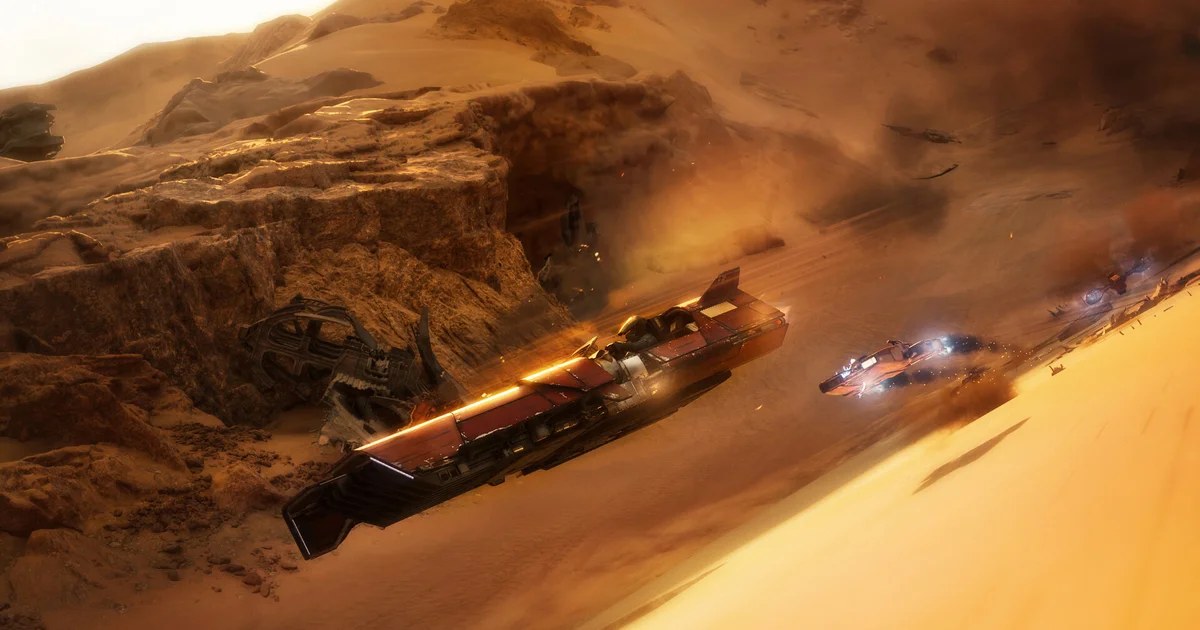
When Fuse Games set out to build Star Wars: Galactic Racer, the studio’s answer to capturing the adrenaline of Burnout-style arcade racing did not begin on a screen. Instead, as revealed in a new interview with Eurogamer, the team prototyped its fast and punishing racer using an unassuming analog tool: a board game plastered with Post-It notes. The unconventional approach was designed to let developers capture and validate core emotions faster than any digital engine could, offering insight into how the studio crafted a racing experience that earned five stars from our own reviewers.
The revelation comes during a wider conversation about how Fuse Games managed to recapture the relentless full-ahead spirit of Burnout so effectively. While modern game engines can handle much of the heavy lifting in software, the team found that nothing quite matches the speed of scribbling an idea down on paper and discussing it with colleagues. That instinct drove the decision to reach for a board game rather than jump straight into code.
The Case for the Slow Tool
“What’s the fastest way we can get ideas down and then talk about them?” Fuse Games CEO Matt Webster told Eurogamer. “Modern engines are so capable that you can do a lot of it in-software, but there’s still something [about that which is] not as fast as getting a written idea down.”

Creative director Kieran Crimmin expanded on the philosophy behind choosing prototyping tools based purely on speed and emotional validation. “There’s a prototyping tool for every kind of system that you want to prototype, and the one that you pick should be the one that gets you there the quickest, and gets you to validate the emotion the quickest,” he explained.
“I mean, I say ‘board game’: a lot of it is Post-Its and a scribble and some dice. But we’re trying to validate those feelings as quickly as possible, so you just pick the best tool for the moment.”
Kieran Crimmin, Creative Director at Fuse Games
In practice, that board game became the canvas on which the team mapped out Galactic Racer’s upgrades and meta progression systems. Rather than building digital wireframes, developers stuck Post-Its to a physical board, rolled dice, and sketched mechanics by hand. The method reflects a broader studio ethos: prioritize getting an experience into playable form over perfecting every detail in early development.
Validating the Game-Feel
Crimmin stressed that game-feel cannot be confirmed through design documents alone; it must be felt by players. “We have loads of ideas, and we have references and emotions that we’re trying to get to. But you can’t know if you’ve got game-feel. You can’t know if you can feel the system until you can play the system,” he said. The studio’s strategy was therefore to push prototypes into players’ hands as quickly as possible, watching for whether those intended emotions landed.

“Rather than worry about whether it’s the right set of things,” Crimmin added, “we worry about getting it as a play experience as quickly as possible and seeing if it feels right.” The board game covered in Post-Its was simply the fastest route to that milestone for Galactic Racer.
The approach appears to have paid off. We’re big fans of Star Wars: Galactic Racer, having awarded the game five stars in our review, and we also spoke to developer Fuse Games to better understand how it recaptured the Burnout spirit so well. Reviewer Christian Donlan was particularly enamoured with how the game blends modern unlockables and roguelite traits with tight course design.
A Racing Game That Never Forgets Itself
In the Star Wars: Galactic Racer Eurogamer review, Donlan wrote that “Galactic Racer never forgets that between the loot and the loadout and the story choices this is still a racing game. The game has that ceaseless full-ahead pelt that Burnout offers and each corner is a set-piece, even before you tip your Skim Speeder onto one edge.” That balance—layering deep progression systems atop a core loop that remains thrilling to race—is precisely the kind of emotion Fuse sought to validate early through its analog prototype.
The story has resonated across the community, where developers and players alike have praised the studio’s willingness to embrace low-tech methods in an era dominated by sophisticated engines. It serves as a reminder that innovation often begins with the simplest tools: a board, some notes, and dice.
Looking Ahead
Star Wars: Galactic Racer stands as a testament to Fuse Games’ hands-on design philosophy, proving that validating emotion can matter more than polishing pixels in early development. As the studio continues to refine its racing pedigree, fans will be watching closely to see how these analog roots continue to influence future projects.























1 comment