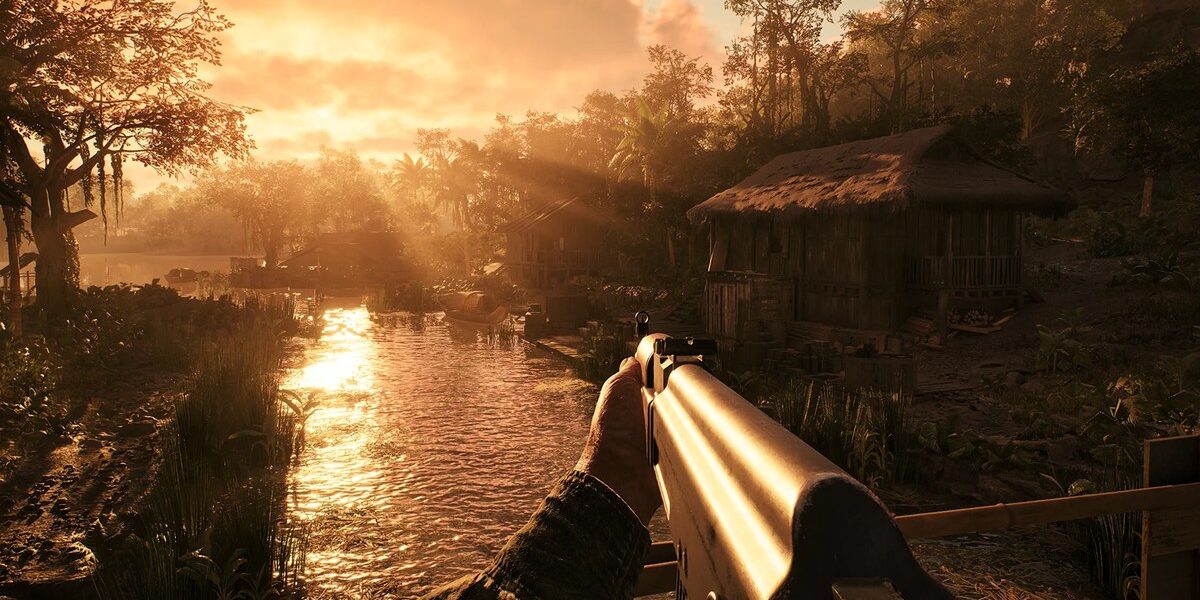
Hell Let Loose: Vietnam isn’t just a reskin; it’s a visceral return to the brutal realities of war. While sharing DNA with titles like Big Walk in its emphasis on communication and large-scale maps, Hell Let Loose: Vietnam distinguishes itself with a level of authenticity that sets it apart from more spectacle-driven shooters.
A War Unlike Any Other
The most striking aspect is how much Hell Let Loose: Vietnam mirrors the gameplay loop of Big Walk. Both games demand players traverse vast landscapes, rely on excellent map design, and prioritize communication above all else. However, where Big Walk gently encourages player interaction through ingenious puzzles and a positive atmosphere, Hell Let Loose: Vietnam throws you into the deep end, forcing you to communicate with your random squadmates or face the consequences – namely, getting blown to smithereens.
Grappling with Hell Let Loose: Vietnam can be daunting. Its teaching style is harsh, but it yields rewards. When everything clicks—dozens of players working in tandem to overcome the enemy—the resulting display is utterly captivating. Unfortunately, these moments are not frequent enough to justify the pain of getting to them.
From Normandy to Southeast Asia
If you’re familiar with the original Hell Let Loose, Vietnam essentially takes that game’s structure and transplants it from the hedgerows of 1940s Normandy to the jungles of Southeast Asia. One hundred players split evenly between the US Army and the North Vietnamese Army clash for supremacy across sprawling maps using combined-arms warfare.
Unlike Battlefield, which prioritizes spectacle, Hell Let Loose emphasizes authenticity. Often, you’re fighting at such a distance that you have to squint to see your enemy, and sprinting around the map will get you killed faster than on roller skates. Teamwork is paramount.
Command and Control
Alongside familiar roles like medics and grenadiers, Hell Let Loose employs a rigid command hierarchy. Groups of six players are overseen by squad leaders who can place spawn points to quickly reinforce the fight. Each army is directed by a Commander who can call in supplies, airstrikes, and more.
Asymmetry on the Battlefield
While the original Hell Let Loose featured armies that played virtually identically, Vietnam attempts to incorporate faction asymmetry, reflecting its historical inspirations. The US Army gets helicopters, while the NVA relies on a network of underground tunnels for fast travel. While these asymmetric elements don’t drastically alter the moment-to-moment experience, they add another layer of strategic depth.
The Jungle’s Embrace
What truly sets Hell Let Loose: Vietnam apart is the environment itself. Most maps are covered in dense vegetation, making it incredibly challenging to spot enemies. You’re often crawling through long grass, trying to identify enemy positions by sound alone. Even when fully alert, you might almost step on an enemy before seeing them. The lack of explicit kill registration adds another layer of tension; unless you’re close enough to hear the enemy squeal and see them collapse, you might not know if they’ve actually died.
Map Design Masterclass
Expression Games has squeezed an impressive amount of variety from the environments, considering they are mostly comprised of trees, rice paddies, and the occasional village. Highlights include Thanh Hóa Bridge, with its titular railway bridge spanning a river that bisects the center of the map, offering both long sightlines and close-quarters combat. Huế Outskirts, a mountainous area with several industrial zones where elevation plays a prominent role, is another standout.
Scale and Strategy
These maps are also vast, significantly larger than the comparatively hemmed-in environments of games like Battlefield 6. This not only makes infantry transport vehicles useful but also gives Commanders room to breathe strategically. This is especially true in modes like Conquest and Domination, where teams need to hold multiple areas simultaneously. Even in more linear modes like Offensive, there’s no rule against the attacking team setting up spawn points behind enemy lines for a rear assault.
Communication is Key
This emphasis on scale underscores the importance of communication in Hell Let Loose: Vietnam. Players need to constantly talk to each other about enemy positions and movements. When players communicate effectively, Hell Let Loose: Vietnam can be fantastic. In one Offensive match as a Medic, our squad leader’s accurate calls, directed grenadiers, and predictions allowed us to hold the first hardpoint against US forces.
The Dark Side of Multiplayer
However, when players don’t communicate, Hell Let Loose: Vietnam can be less enjoyable. It remains immersive and atmospheric, with napalm strikes erupting across treelines and helicopters whuk-whuk-whuk-ing overhead. It can also generate memorable anecdotes, like my debut helicopter ride ending in an immediate explosion that killed everyone inside – a more fitting introduction than any cutscene.
The Sniper Problem
Without good team coordination, Hell Let Loose can devolve into a frustrating sniper fest. While the game wisely limits actual snipers per team, part of the problem is that everyone feels like one. The most basic rifles are effective at medium-to-long range, even on full auto. At its worst, Hell Let Loose: Vietnam becomes a mire of spawn-killing and instant headshots from unseen enemies. The jungle can mitigate this somewhat, but it can also be a hindrance due to level-of-detail phasing.
A Step Behind the Competition?
As a pure shooter, I think Hell Let Loose: Vietnam is a step or two behind the competition. Movement is clumsy and sluggish, and when you’re close enough to see your target, the interaction feels strangely intangible. While I appreciate Expression’s refusal to use hit markers, it leaves players wanting more feedback on kills.
The Community Challenge
Finally, the emphasis on vocal communication inevitably exposes you to the less pleasant corners of the internet. Whether Hell Let Loose: Vietnam’s community is more or less toxic than any other online FPS community is debatable. I’ve encountered both angels and demons on my tour of duty, and thankfully, you can mute and block individuals acting inappropriately or, in one instance, watching Formula 1 at deafening volume. Did you know the Vietnam War featured live commentary by Martin Brundle? I didn’t!
Games that mandate engagement with other players need to actively foster a tolerant and welcoming community. With countless multiplayer games available, many of which allow you to play without enduring racist remarks or impressions, the bar is set high.
A Complex Experience
Ultimately, Hell Let Loose: Vietnam encapsulates the best and worst of online multiplayer gaming. When everything clicks, it offers more interesting battlefields than Battlefield. However, it’s less consistently entertaining and requires more effort and tolerance to fully appreciate.
Team17
A copy of Hell Let Loose: Vietnam was provided for this review by Team17.
Source: Eurogamer




Comments
Be the first to comment.