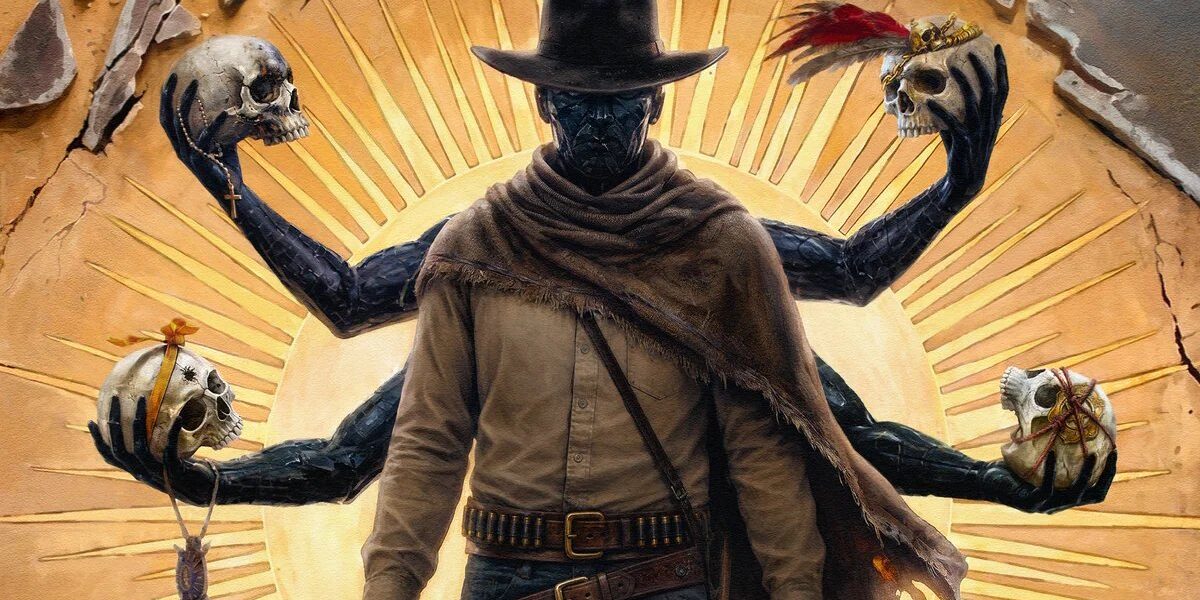
Look, I’m going to be honest: I struggled with Guns of Eschaton during my recent hands-on time. There were some very obvious reasons for that – it’s a challenging game that doesn’t immediately explain itself, and it blends the familiar Soulslike formula with classic campfire respawns and Weird West-inspired first-person shooting, which takes some getting used to.
A World Forged in Dust and Blood
Welcome to the Old South, a land of “dust, blood, false saints, broken history, and occult horror,” as developer Eschatology Entertainment puts it. It’s also a world envisioned by the late Viktor Antonov, the artist behind iconic video game spaces like Half-Life 2‘s City17 and Dishonored‘s Dunwall. His vision truly shines when you first see Guns of Eschaton’s sweeping vista – an endless desert of sand and flame, where a giant worm winds its way over fracturing mesa beneath looming planets and swirling stars.
You awaken as a man with no name (or perhaps just a name I didn’t catch), at the bottom of a ravine. This serves as a tutorial pit, introducing you to the game’s core mechanics: shooting, dashing, and parrying. While these might suggest nimbleness, Guns of Eschaton is deliberately paced. The weapon of choice, your six-shooter, adds to this feeling. Eschatology Entertainment, founded by alumni of War of Tanks developer Wargaming, opted for a pseudo-realistic approach. Shooting isn’t just pulling the trigger; it’s about cylinder management. With the default weapon, you have six shots before needing to reload, leaving you vulnerable. Crucially, after each shot, you must cock the hammer, adding a unique rhythm that can be frustrating when facing relentless enemies.
Eschatology Entertainment takes things further with supernatural elements. Simply shooting an enemy might not do much harm. Each enemy is weak to a specific sequence of attacks: your bottom-rung undead cowboy dudes need only a blast to the face, while others require a one-two-three punch of right leg, left arm, then head shot. As Eschatology’s CEO and creative director Fuad Kuliev explained, “In our game, not shooting is often better than shooting until you understand what you need to shoot at.”
This “sequence shooting” aims to create a “smart shooter, not a fast shooter,” focusing on thoughtful approaches. The enemy weaknesses are helpfully recorded in the Codex. But even with that guide, it felt overwhelming during intense combat. Thankfully, there’s an alternative: melee and ranged attacks can be countered, dealing increased damage after a well-timed parry. Add the dash – similar to Dark Souls’ roll, with a deceptively generous invulnerability window – and you have your toolkit for survival in Guns of Eschaton’s Weird West world.
I wish I could say it clicked immediately, that I wowed everyone with my skills. But I didn’t. Guns of Eschaton throws a lot at you early on: a mechanic that lets you ping bullets off objects to auto-target enemies; duels with specific rules of engagement (no shooting first); gunpowder reserves limiting shots and reloads before switching to a pokey knife; stamina for dashes and parries; different inventory belts, ammo types, ability upgrades, magic-like prayers, item buffs, curses, and more. It’s a lot to consider while my brain was still stuck on the “don’t forget to cock the hammer” bit. No wonder I died.
Once you reach the first proper area (split into discrete locations accessed via Hounds Camp), you face multiple enemies attacking from all directions, some charging from corners and others sniping from afar. Most areas require defeating a boss. Death is almost inevitable until you attune yourself to Guns of Eschaton’s ways.
Yes, Guns of Eschaton is structured like a Soulslike, with campfires (like Muttering Path) where you rest and recuperate, causing enemies to respawn. Dying causes you to return to your shame-puddle, holding all recently accumulated Memories used to buy upgrades at Hounds Camp. You’re forced to dash back before death arrives again. I even saw evidence of a Soulslike messaging system, allowing players to leave warnings (or otherwise) scrawled upon the world. Despite these familiar elements, there’s a unique rhythm to Guns of Eschaton’s gunplay that feels refreshingly distinct.
Kuliev explains that Guns of Eschaton is designed for different playstyles, suggesting I might have had better success if I tried something more radical. Stealth is a valid alternative, and players can unlock perks to help tilt combat in their preferred direction. Lovers of sneakery might opt for the perk allowing them to see enemies through walls, making long-range ambushes possible. Certain custom bullets create powerful synergies, such as those that increase weapon range. Players preferring a more direct approach can utilize magic-like prayers, briefly reducing incoming damage.
For players struggling, Guns of Eschaton has two more tricks: a Nightmare World, an easier version of the main world with a tutorial if you’re doing particularly badly; and optional two-player co-op, which technically makes the game harder but offers powerful synergy.
Yes, I was rubbish at Guns of Eschaton. I died a lot, swore (in my head), and felt mildly infuriated. But here’s the important bit: Guns of Eschaton is interesting – a refreshing FPS twist on a familiar formula that left me intrigued after just a couple of hours.
Source: Eurogamer




Comments
Be the first to comment.