

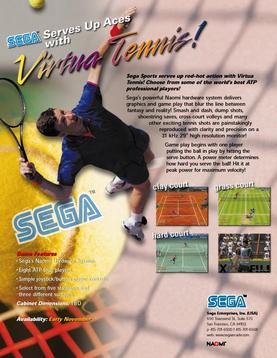
About this game
Virtua Tennis, known in Japan as Power Smash (パワースマッシュ, Pawā Sumasshu), is a 1999 tennis video game developed by Sega AM3 and published by Sega. Originally released for arcades on the Sega NAOMI hardware, it was ported to the Dreamcast in 2000 and later to Microsoft Windows, Game Boy Advance and N-Gage. The home versions expanded the arcade game with a World Circuit career mode in which players compete in matches and complete training minigames to improve their ranking.
The Dreamcast version received widespread critical acclaim and was nominated for Console Sports Game of the Year, Console Game of the Year and overall Game of the Year at the 4th Annual Interactive Achievement Awards. The game was followed by Virtua Tennis 2 in 2001 and became the first entry in the Virtua Tennis series.
Game modes
Arcade
The player must win five matches played on different surfaces and venues to win a tournament. If the player performs well enough, he is challenged by Master, one of the game’s bosses.
Exhibition
This is a single match in which the options are customizable.
The match can be played as singles or doubles with up to four human players (two for singles). The duration can be varied between one game and one set. Other options include the court that the match is played on and the skill of the opponent(s).
World Circuit
Users have to win matches and complete training exercises in order to progress and unlock new ones. The user enters with a rank of 300th, which improves as matches are won. These matches are unlocked by completing easier matches or training exercises. The focus of the training exercises are to be fun, rather than realistic. Each exercise has three levels, with the difficulty increasing progressively. By completing the hardest difficulty with a certain amount of time left or points scored, an outfit is unlocked, which players can wear in all modes.
Game Content
Playable Characters
- Jim Courier
- Cédric Pioline
- Tim Henman
- Tommy Haas
- Mark Phillipoussis (Playable on the Arcade version & the Dreamcast version only)
- Carlos Moyá
- Thomas Johansson
- Yevgeny Kafelnikov
Tour Competitions
- Australia Challenge
- French Cup
- U.S. Super Tennis
- The Old England Championships
- Sega Grand Match
Development
Virtua Tennis was developed by Sega AM3. The producer, Mie Kumagai, wanted to create a game that appealed to broad demographics of players, taking note of the large number of one-on-one fighting games that proliferated throughout Japanese arcades during the 1990s. She also wished to replicate the critical and commercial achievements of Sega AM2’s soccer title Virtua Striker, which was directed by Satoshi Mifune and was a hit among a wide range of age groups.
Kumagai began planning a game that could serve as a both a fun, casual experience and competitive, hardcore experience for people to play with friends and family in arcades and at home. Her initial proposal, a basketball game was rejected, while her alternative proposal, a tennis game, was accepted. However, the potential for the project’s success was still met with a large amount of skepticism within Sega. After Kumagai acquired a programmer, they made a trip to a tennis school for research, and began designing a unique paddle controller. By twisting this paddle, the user could switch between forehand and backhand shots, but after months of in-house experimentation it proved too difficult to operate. Taking advice from Mifune, the team simplified the controls to a more traditional joystick and buttons. User reception at location testing and in Sega’s offices proved to be very positive and development thereafter was smooth. Sega executives feared the game’s original Japanese title, Power Smash, would not translate well to overseas audiences. For its North American and European localizations, the name adopted the familiar Virtua label and was changed to Virtua Tennis.
Reception
The Dreamcast version received “universal acclaim”, the Game Boy Advance version received “favorable” reviews, and the PC version received “average” reviews, while the N-Gage version received “generally unfavorable reviews”, according to the review aggregation website Metacritic. Blake Fischer of NextGen called the Dreamcast version “The best four-player game in a long time, and an excellent single- and two-player diversion. Don’t avoid this because it’s not football – you’ll get more playtime out of it than you think.” In Japan, Famitsu gave the same console version a score of 33 out of 40.
Also in Japan, Game Machine listed the arcade version in their February 1, 2000 issue as the third most-successful arcade game of the previous year.
John Thompson of AllGame gave the same arcade version four-and-a-half stars out of five, saying: “With an excellent engine, beautiful graphics and sounds, and an intuitive, deep gameplay system, Virtua Tennis is one of the best arcade games in recent memory. Sega dominated arcades of the late ’90s, and with excellent titles such as this, it’s easy to see why.” Bryan Melville, however, gave the Dreamcast version four stars, calling it “a game that will go down as one of the best arcade ports on the 128-bit system.” Edge gave the same Dreamcast version eight out of ten, saying: “Were it not for the irritation caused by the almost unbeatable players in later stages and the inability to play more than a single set per match, Virtua Tennis would have been a near-perfect sports game.” The D-Pad Destroyer of GamePro called the same console version “one of the most purely fun sports games in a long time, up there with Sega Bass Fishing in the Games You’re Embarrassed To Enjoy category. If you’re a sports fan, go get it.” Four-Eyed Dragon said of the Game Boy Advance version: “Even with sluggish controls and so-so visuals, Virtua Tennis still delivers, especially in the winning career mode where you train your custom-made athletes (both male and female) to become the number-one ranked in the world.”
The Dreamcast version has been ranked in the top 100 games of all time by IGN both in 2005 (#91) and 2003 (#89). Game Informer placed the Dreamcast version 50th on their top 100 video games of all time in 2001. It was also featured in Guinness World Records 2017: Gamer’s Edition where it says that the Dreamcast version got GameRankings score of 91.37% based on 33 reviews.
The Dreamcast version was a runner-up for the “Best Multiplayer Game” and “Best Sports Game (Traditional)” awards at GameSpot‘s Best and Worst of 2000 Awards, both of which went to Quake III Arena and NFL 2K1, respectively. During the 4th Annual Interactive Achievement Awards, the Academy of Interactive Arts & Sciences nominated the Dreamcast version for the “Console Sports”, “Console Game of the Year” and “Game of the Year” awards; the first two went to SSX, while the latter went to Diablo II. Two years later, the Game Boy Advance version was also a runner-up for the website’s “Best Sports Game on Game Boy Advance” award, which went to Tony Hawk’s Pro Skater 3. The PC version was a runner-up for PC Gamer US‘ “2002 Best Sports Game” award, which ultimately went to Tiger Woods PGA Tour 2003.
In the United Kingdom, Greg Howson of The Guardian awarded the Dreamcast version four stars out of five, praising its graphics, accessible controls, World Circuit mode and four-player doubles. He described it as the “outstanding sports game of the year”.
Commercial performance
Following its North American release, Virtua Tennis appeared among the best-selling video games in the United States. According to PC Data figures reported by GameSpot, during the week of August 13–19, 2000, it was the third-best-selling Dreamcast game and the ninth-best-selling video game across all platforms.
In the United Kingdom, the Dreamcast version debuted at number one on the combined-formats software chart for the week ending September 9, 2000.
In 2025, GameSpot, using lifetime United States retail tracking data supplied by Circana, ranked Virtua Tennis as the twelfth-best-selling Dreamcast game by unit sales and twentieth by dollar sales.
Legacy and Influence
Virtua Tennis was credited with helping popularize tennis video games. In a 2003 review of Top Spin, GameSpot stated that Sega had “brought tennis to the video gaming masses” with Virtua Tennis, noting that numerous imitators subsequently appeared but had failed to match its quality until the release of Top Spin. The game was also cited as a personal favorite by professional basketball player Chris Paul, who told IGN in 2005 that after growing up playing sports games including Madden NFL, NBA Jam and NFL 2K on the Dreamcast, “The game I really loved was Virtua Tennis.”
Notes
References
External links
- Virtua Tennis Game Manual
- Power Smash at the Killer List of Videogames
- Virtua Tennis at the Killer List of Videogames
- Virtua Tennis at MobyGames
- Virtua Tennis (Game Boy Advance) at MobyGames
Gallery
Join the conversation