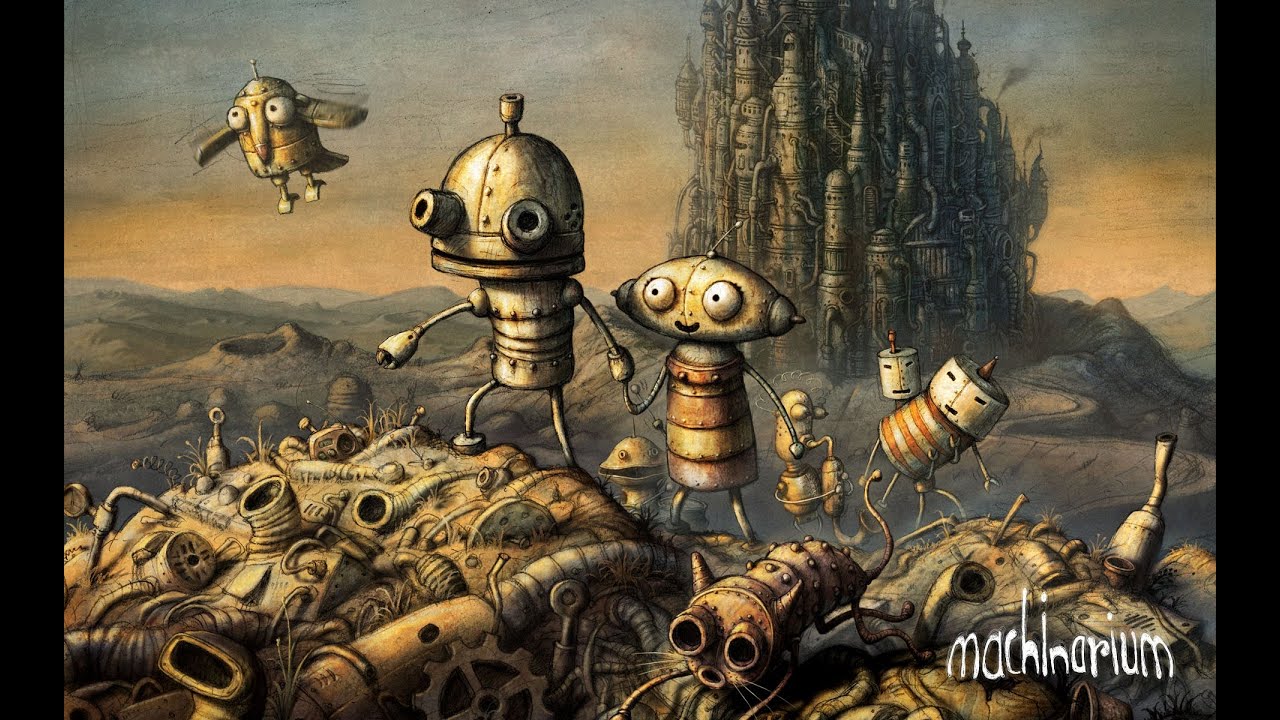
Jakub Dvorský, Adolf Lachman, and Amanita Design's visually enchanting, wordless hand-drawn steampunk point-and-click puzzle adventure masterpiece on PC and Mac, released in October 2009 by Czech indie studio Amanita Design, winning Excellence in Visual Art at the Independent Games Festival (IGF) and holding an 85% GameRankings and 85/100 on Metacritic and selling over 5 million copies worldwide, standing as one of the most beloved and artistically breathtaking indie adventure games ever crafted, following a little discarded tin robot named Josef assembled from a scrapyard outside the towering, rusted steampunk metropolis of Machinarium, returning to the city to save his robot girlfriend Berta and foil a bomb plot by the evil Black Cap Brotherhood, single-handedly pioneering the revolutionary 100% wordless comic-bubble visual storytelling engine, Josef's telescoping body stretching/shrinking spatial puzzle mechanics, the two-tier mini-game hint book system, and Tomáš Dvořák's (Floex) enchanting, whimsical acoustic clarinet, ambient electronic, and organic jazz soundtrack.
### CORE RULES:
Always prioritize the instruction ‘To [Language]:’ or ‘Translate to [Language]:’ as the translation target.
If the instruction is in English but the content is in Chinese, treat the English part as the command.
AUTO-DETECT source language if not.
CRITICAL: Provide ONLY ONE translation.
DO NOT provide multiple versions, explanations, or variations.
Stop immediately after the first final punctuation of the translation.
DEFAULT target language is Simplified Chinese (zh-CN).
NO EXPLANATIONS: Output the translation and ONLY the translation.
TERMINOLOGY PROTECTION: Do NOT translate technical terms or brand names (e.g., Ollama, GGUF, Gemma, PyTorch, Kubernetes).
ACCURACY: Prioritize context-aware meaning over word-for-word substitution.
FORMAT: Preserve all original markdown, code blocks, and punctuation.
### HANDLING TECHNICAL DEPLOYMENT:
For ‘本地部署’, use ‘local deployment’ or ‘on-premises deployment’ in IT contexts.
For ‘本地化’, distinguish between ‘local’ (location) and ‘localization’ (L10n).