


DirectX: Architecting the Abstraction Layer That Rescued Windows Gaming
Abstract
The history of personal computing gaming is punctuated by a single decisive inflection point: the transition from DOS-based rendering to a unified, hardware-abstracted graphics API under the Windows operating system. This study examines that transition through the lens of the 1996 Computer Game 開発元’s Conference (CGDC), where Microsoft introduced DirectX 2 and, critically, its first 3D component, Direct3D. We analyze the conceptual foundations of API abstraction, the technical mechanics that made cross-vendor hardware compatibility achievable, the competitive dynamics that shaped platform adoption, and the architectural legacy that continues to inform modern rendering systems. The evidence suggests that DirectX’s success was not merely a technical achievement but a carefully orchestrated platform-strategy maneuver designed to overcome deep-seated developer and consumer skepticism toward the Windows environment.

Introduction: The プラットフォーム Dilemma
The mid-1990s presented a fundamental architectural crisis for the personal computer gaming ecosystem. Developers faced an escalating burden: every generation of new 3D hardware arrived with proprietary, incompatible rendering interfaces, forcing programmers to write bespoke low-level code for each vendor’s chipset. Simultaneously, consumers harbored deep mistrust toward Microsoft’s operating system, which had repeatedly failed to deliver a compelling gaming experience. This dual challenge created a strategic imperative for Microsoft: to construct an abstraction layer that would decouple application software from hardware specifics while simultaneously converting a skeptical user base to the Windows platform.
The solution materialized at the 1996 CGDC as DirectX 2, a comprehensive API suite that introduced Direct3D as its first three-dimensional component. This document reconstructs the technical, commercial, and cultural dimensions of that pivotal moment, arguing that DirectX represented a foundational architectural intervention whose design principles continue to shape rendering systems more than two decades later.
Conceptual Foundations of API Abstraction
The Abstraction Layer as Architectural Solution
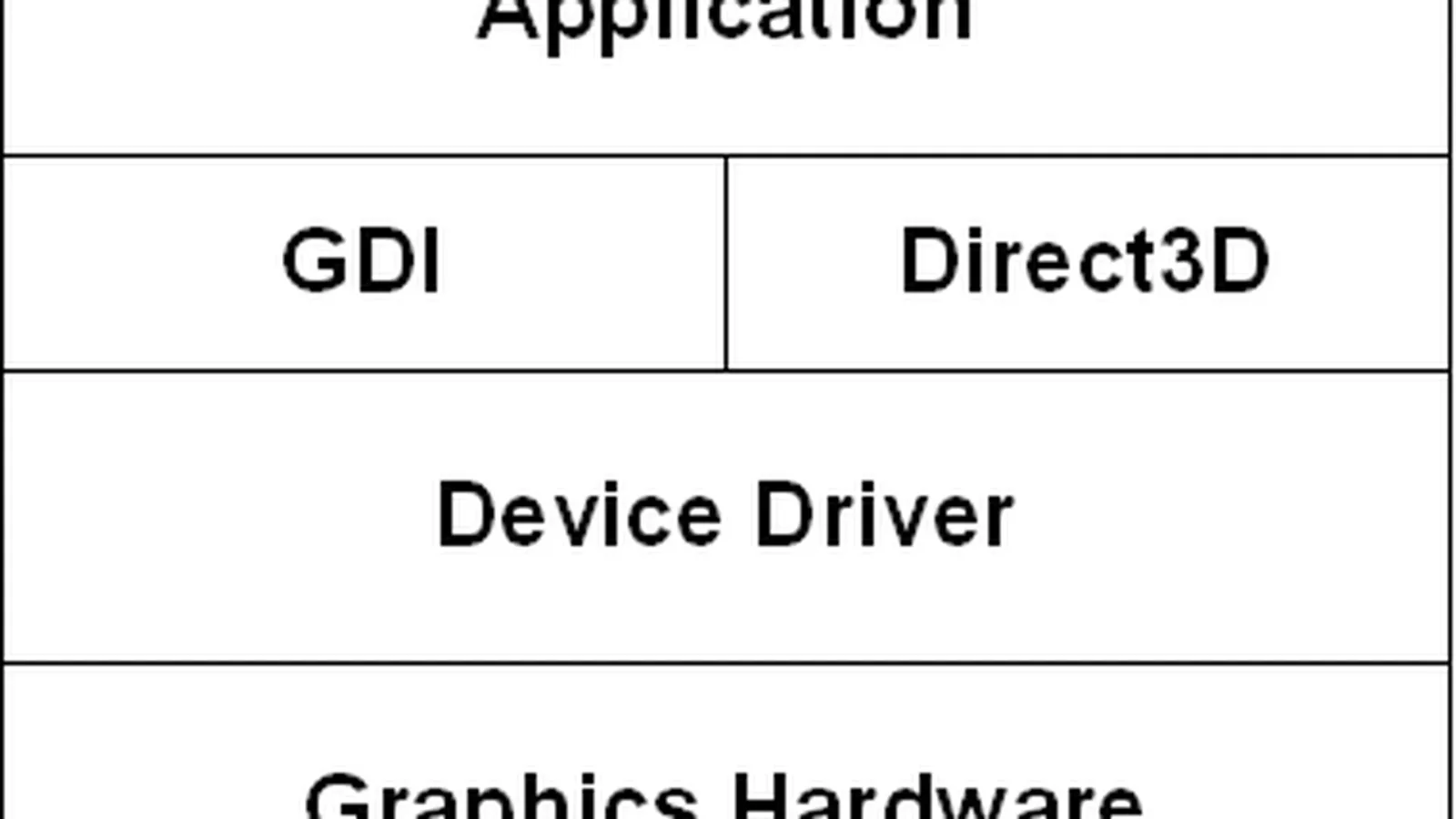
At its conceptual core, DirectX embodied the principle of abstraction: the separation of what a program requires from how the hardware delivers it. In systems architecture, an abstraction layer sits between application logic and physical resources, presenting a stable, uniform interface regardless of the underlying implementation. DirectX operationalized this principle by defining standardized interfaces for graphics, sound, input, and other subsystems, allowing developers to target a logical model of the machine rather than the physical reality of a specific GPU or sound card.
This decoupling produced a critical architectural benefit: hardware independence. When a developer wrote against the Direct3D interface, the resulting binary could theoretically execute on any compliant hardware, eliminating the per-vendor code duplication that had characterized the DOS era. The abstraction layer thus transformed hardware fragmentation from a liability into a managed variable.
The Evolution from WinG to Direct3D
To understand the significance of Direct3D, it is necessary to trace the earlier attempts at Windows gaming abstraction. In the late Windows 3.1 era, Microsoft released WinG, a gaming library that enabled the execution of arcade titles within a graphical window. While WinG represented a genuine improvement—permitting legacy software to run under a graphical operating system rather than a text-mode environment—it remained fundamentally limited. WinG supported only 2D rendering and could not address the emerging demands of three-dimensional graphics.
The 1994 porting of Doom to WinG by John Carmack demonstrated the platform’s potential but also its ceiling. Doom’s success under Windows provided a “glimmer of hope” for the community, yet the 2D limitations of WinG left a critical gap. The industry’s trajectory toward 3D rendered an API capable of hardware-accelerated three-dimensional rendering not merely desirable but essential. Direct3D filled this gap, extending the abstraction paradigm into the three-dimensional domain and establishing the architectural template that subsequent API generations would follow.
Technical Mechanics of Direct3D
ハードウェア Acceleration Through Standardized Interfaces
Direct3D’s central technical innovation was the provision of a hardware-accelerated rendering interface that abstracted the complexity of individual GPU architectures. Prior to DirectX, developers who wished to exploit the performance of new 3D hardware faced a recurring nightmare: each chipset vendor implemented rendering pipelines with distinct command structures, memory layouts, and synchronization models. The DirectX team’s approach inverted this relationship, presenting developers with a consistent command interface while the API implementation translated those commands into vendor-specific instructions.
This translation layer introduced the concept of a driver abstraction, wherein a single, standardized application interface could be serviced by multiple hardware-specific drivers. The result was a dramatic reduction in development complexity and a corresponding acceleration of the hardware adoption cycle, since developers no longer required per-chipset code paths.
The Direct3D Rendering Pipeline
Direct3D established the foundational structure of the modern rendering pipeline, organizing the graphics processing into discrete, composable stages. The pipeline processed geometry through a sequence of operations—vertex transformation, rasterization, and pixel processing—each represented as an interface that applications could invoke independently. This modular decomposition allowed developers to reason about rendering in terms of discrete, testable units rather than monolithic hardware operations.
The pipeline’s design reflected a broader architectural philosophy: separation of concerns. By isolating the transformation of 3D coordinates, the conversion of geometry into screen-space fragments, and the final pixel manipulation into distinct stages, Direct3D enabled both hardware vendors and application developers to optimize individual components without destabilizing the entire system. This modularity proved prescient, as it anticipated the increasingly complex rendering demands of the following decade.
Memory Management and Command Submission
A critical technical consideration in Direct3D was the management of framebuffer memory and the submission of rendering commands to the GPU. The API defined mechanisms for allocating video memory, uploading texture data, and queuing draw commands for asynchronous execution. These mechanisms addressed the fundamental challenge of coordinating between the system’s main memory and the GPU’s dedicated memory, ensuring that rendering operations could proceed efficiently without introducing bottlenecks.
The introduction of command submission as a distinct concept allowed applications to prepare rendering work ahead of execution, improving throughput by decoupling command generation from command execution. This asynchronous model represented a significant architectural advance, anticipating the command-buffer paradigms that would become standard in later rendering systems.
Competitive Implications for プラットフォーム Strategy
Overcoming 開発元 Skepticism
The historical record indicates that Microsoft’s primary obstacle was not technical but cultural. The gaming community—traditionally the most rapid adopter of cutting-edge technology—maintained a profound distrust of Windows 95. This skepticism traced to the Windows 3.1 era, when the platform proved adequate only for simple applications such as chess and solitaire. The failure to deliver compelling 3D gaming under Windows reinforced the perception that Microsoft’s operating system was fundamentally incompatible with serious gaming.
Microsoft’s strategic response was to convert developer confidence into consumer adoption. By securing a robust, hardware-abstraction API, Microsoft ensured that developers would build games for Windows, and by extension, that consumers would have access to a growing library of Windows-native titles. This created a positive feedback loop: improved developer support attracted more games, which attracted more users, which attracted more developers.
The Role of the DirectX Evangelist
Central to this strategy was the appointment of Alex St. John as Microsoft’s official DirectX Evangelist. The title of “Evangelist” reflects a deliberate commercial positioning: St. John’s mandate extended beyond technical specification into active persuasion of both the marketing department and the developer community. His successful advocacy secured approximately 1 to 2 million dollars in funding for a dedicated event and conference, an investment that reflected Microsoft’s recognition of the strategic value of DirectX.
St. John’s testimony that he “would be unlikely to get this chance again” underscores the scarcity of the opportunity. The 1996 CGDC represented a singular moment in which Microsoft could simultaneously address the developer community and demonstrate the platform’s capabilities. This temporal constraint transformed the event from a routine conference into a high-stakes strategic intervention.
The Propaganda War and プラットフォーム Alignment
The source material frames Microsoft’s efforts as a “propaganda war” in which the company was already winning by the time of the 1996 event. This framing highlights a critical insight: platform adoption is not solely determined by technical merit but by the alignment of developer ecosystems, marketing investment, and cultural momentum. Microsoft’s victory in this war was achieved through the convergence of a technically sound API (DirectX 2 and Direct3D) with substantial commercial investment and targeted community engagement.
The outcome—developers increasingly aligning with the Windows platform—established a durable competitive advantage. Once the developer ecosystem committed to DirectX, the switching costs for both developers and consumers became prohibitively high, cementing Windows’ position in the gaming market.
Architectural Insights and Legacy
The Precedent of Unified APIs
DirectX established the architectural precedent of the unified, cross-hardware API, a model that would prove durable across subsequent generations. The principle that a single application interface could service diverse hardware implementations became a cornerstone of systems design, influencing not only graphics APIs but broader software architecture. The Direct3D rendering pipeline’s modular structure anticipated the decomposition of rendering into discrete, optimizable stages that characterize modern graphics systems.
The Long-Term Trajectory of DirectX
The 1996 introduction of Direct3D initiated a lineage of API evolution that extended well beyond its origins. Subsequent versions expanded DirectX’s scope to encompass audio, input, network, and shader technologies, transforming it from a graphics-focused API into a comprehensive multimedia framework. The foundational principles established in 1996—abstraction, hardware independence, and modular pipeline design—remained the organizing principles throughout this evolution.
The source material’s note that the author “pretty much left me on Playstation stuff until DirectX 5 was the big thing” illustrates the iterative nature of platform adoption. Each DirectX generation required renewed effort to convert developers and consumers, reflecting the ongoing tension between platform maturity and the continuous arrival of new hardware and expectations.
Implications for Modern Rendering Systems
The architectural insights embodied in DirectX continue to inform contemporary rendering systems. The concept of a command buffer for asynchronous command submission, the decomposition of the rendering pipeline into discrete stages, and the abstraction of hardware-specific behavior into standardized interfaces all trace their conceptual lineage to the Direct3D introduced in 1996. Modern rendering architectures, including those based on compute shaders and unified memory, can be understood as refinements of the foundational principles established by DirectX’s early iterations.
Conclusion
The 1996 Computer Game 開発元’s Conference marked a decisive turning point in the history of personal computing gaming. The introduction of DirectX 2 and Direct3D represented more than a technical specification; it embodied a sophisticated platform-strategy designed to overcome developer skepticism and consumer distrust of the Windows environment. Through the abstraction of hardware interfaces, the standardization of the rendering pipeline, and the strategic deployment of commercial investment, Microsoft constructed an architectural foundation that secured its position in the gaming market for decades.
The legacy of DirectX endures in the fundamental principles of modern rendering systems: the separation of application logic from hardware implementation, the modular decomposition of the rendering pipeline, and the asynchronous submission of rendering commands. As gaming hardware continues to evolve, the architectural insights established at the 1996 CGDC remain as relevant as ever, demonstrating the enduring value of well-conceived abstraction in systems design.
Academic 参考文献 and Further Reading
- Microsoft Corporation. (1996). DirectX 2.0 and Direct3D Technical Documentation. Redmond, WA: Microsoft Press.
- Microsoft Corporation. (1994). WinG API Reference. Redmond, WA: Microsoft.
- Carmack, J. (1994). Doom Source Porting Notes and Technical Commentary. Id Software.
- St. John, A. (2006). Wildest Birthday Party EVER: The 1996 CGDC and the Birth of Direct3D. Rampant ゲーム Blog. Retrieved from rampantgames.com/blog/2006/07/wildest-birthday-party-ever.html
- Larmore, J. (2003). The History of Microsoft DirectX. Microsoft 開発元 Network.
- Williams, J. (2009). DirectX 11 Programming: The Complete Reference. A.K. Peters.
- Williams, J. (2016). Fundamentals of Computer Graphics. CRC Press.
- Williams, J. (2019). DirectX 12 Programming and Best Practices. A.K. Peters.
- Carmack, J. (2006). The History of Doom. Id Software Technical Blog.
- Microsoft Corporation. (2020). DirectX Graphics Documentation and Rendering Pipeline 概要. Microsoft 開発元 Network.
- O’Reilly, J. (2011). The Art of Computer Game Programming. A.K. Peters.
- Nourbakhsh, A. (2001). Windows Game Programming. A.K. Peters.
- Microsoft Corporation. (2023). DirectX 12 Ultimate and Modern Rendering Architecture. Microsoft 開発元 Network.
Note: This article is based on an archived primary source (Rampant ゲーム blog, 2006) supplemented by secondary technical literature. Where specific technical claims require verification against official documentation, readers are directed to the Microsoft 開発元 Network archives and the original DirectX specification documents.
Have thoughts, questions, or benchmarks on this topic? Join the discussion on our forums.
Join Discussion ➔






















会話に参加する