

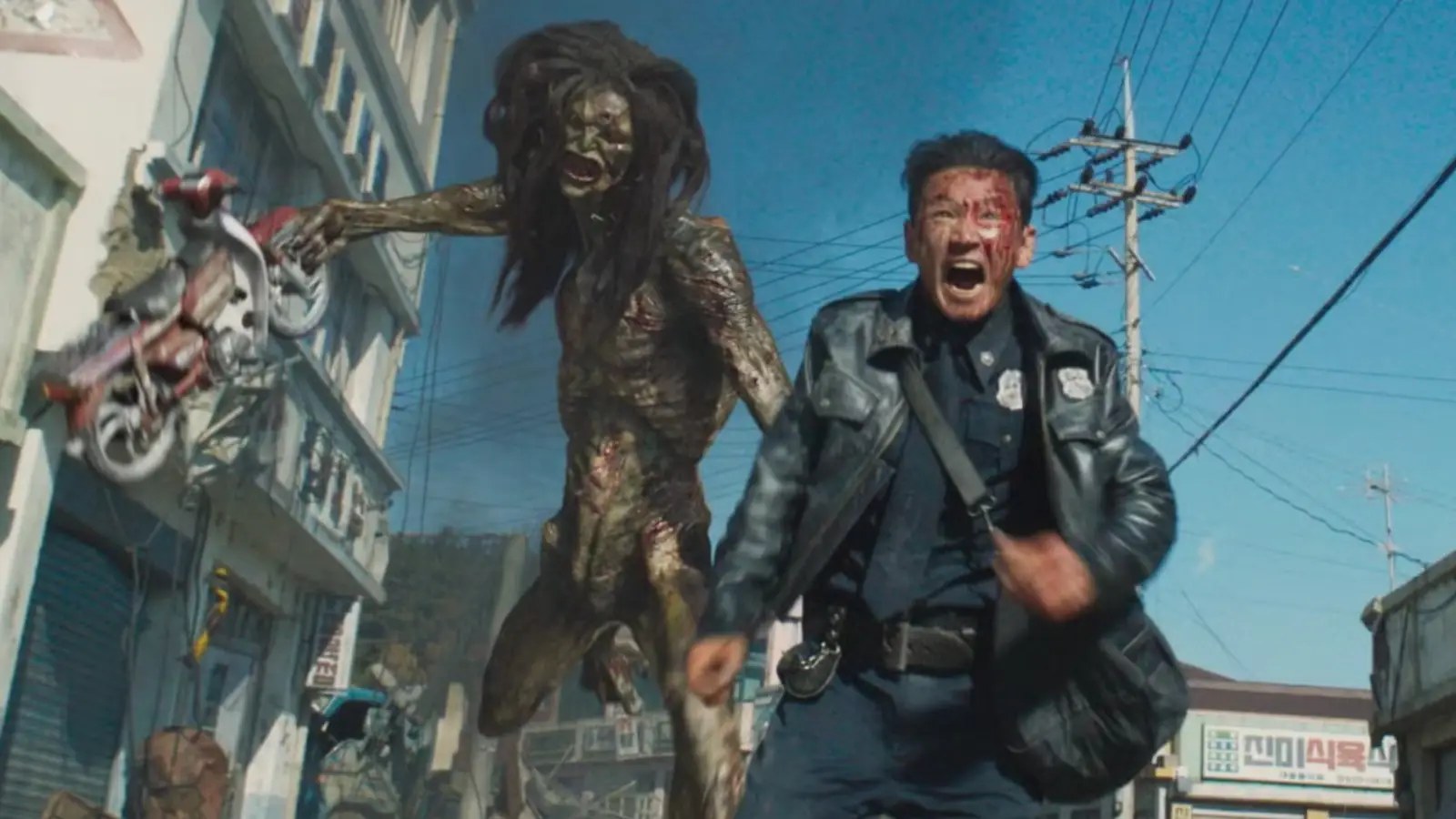
After nearly a decade away from the director’s chair, acclaimed Korean filmmaker Na Hong-jin has returned with Hope, a sprawling sci-fi action thriller that trades the slow-burn mystery of his last film for an unrelenting monster movie built around relentless momentum. The 156-minute feature arrives in U.S. theaters this week following its South Korean debut, marking the first time since The Wailing that audiences have seen new work from the director whose tightly-wound thrillers like The Chaser and The Yellow Sea redefined modern genre cinema.
Polygon spoke with Na ahead of the film’s American release to discuss the picture’s breakneck pacing, the years-long process behind its unsettling creatures, and his singular obsession with capturing a sense of speed. “When we were shooting, that was the main thing we were focused on,” he said. “We really wanted to continue this pace, this sense of speed, and have it persist throughout the entire runtime of the film. Doing that during production was extremely fun.”
Welcome to Hope Harbor
Hope unfolds in a remote seaside village where police chief Bum-seok, played by Hwang Jung-min, and rookie officer Sung-ae, portrayed by Jung Ho-yeon, are called to investigate a series of bizarre maulings attributed to a mysterious large creature. As tensions escalate, hunter Sung-ki, played by Zo In-sung, leads a group into the surrounding mountains to track the beast—only to discover they may be the ones being hunted.
The film opens as a tense thriller in which Bum-seok pursues the creature while witnessing only its deadly aftermath, but by roughly the one-hour mark an extraterrestrial disaster envelops the entire town. Na refuses to let any moment settle still, filling the runtime with cameras mounted on grilles of speeding cars, characters sprinting through forests as monsters tear behind them, and vehicles barreling across the rippled landscape.
A Monster That Never Slows Down
The film’s sense of speed extends directly into its creature design. For Na, Hope represented an opportunity to build a monster that defied genre conventions. “When you see films like this, a lot of the time, the monster will be very slow,” he said. “That is an approach we didn’t really want to take.” He noted that his team deliberately avoided current creature trends in order to create something more original. “Whether it was games or animation, we really wanted to get a very untraditional look at this kind of monster, and that’s why speed was an incredible focus for us.”
“It’s supposed to be an alien and almost anonymous, without a sense of identity. I looked a lot to folklore, and Korean folklore actually doesn’t have a lot of creatures like this, so we had to kind of go more far and wide for inspiration.”
Na Hong-jin, director
The design process spanned several years. Na explained that realism anchored the creature’s conception early on, but as development dragged on, his team repeatedly reconsidered what would feel fresh. One of the film’s main aliens bears a resemblance to Labyrinth Madman from FromSoftware’s Bloodborne, sharing its long-haired silhouette and chaotic, animalistic movements even though it stands smaller than the 10-foot-tall monster in Hope. Na insisted that game did not influence the design directly and that his creatures drew on no pre-existing fiction or mythology.

Toning Down the Gore
Despite a reputation for graphic violence, Na actually pulled back from the gore despite Hope’s extensive visual effects capabilities. “At the end stages of post-production, the VFX supervisor would show me some cuts that were incredibly violent,” he said. “It was almost disgusting to look at. I asked them specifically to tone it down a little bit.” He believed his collaborators exaggerated the violence because they had studied his previous films.
Rather than filling the screen with blood, Na sought impact through restraint. “For Hope itself, I really wanted to tone down a little bit of the red in the film, and to be able to create impact through exaggeration and exclusion, not necessarily through just a complete bloodbath.”
Returning to Familiar Ground
The reduced gore does not signal an abandonment of the instincts that defined his earlier thrillers. Na continues to rely on isolated Korean communities as pressure cookers, transforming Namchang-ri in Haenam County into Hope Harbor by redressing its old bus terminal as a police station and converting its streets, shops, and coastline into the film’s confined setting. “I personally love really small villages in Korea,” he said. “I’m not particularly interested in Korean cities because I don’t find them to be particularly unique.”
The location sits only about two hours from Gokseong, where The Wailing found its nightmare—a town that was his grandmother’s hometown. Yet Na insists the two films move toward opposite emotional destinations. “The Wailing really deals with sort of the bottomless pit of despair and misfortune,” he said. Hope, by contrast, builds around a different idea tied to its title.
“Like the title itself, the characters have a genuine sense of hope. I wanted to explore the idea that once a desire comes true, the hope itself disappears.”
Na Hong-jin, director
A Thriller at Heart
For all the film’s expansion into CGI spectacle and maximalist action set pieces, Na does not view Hope as a radical departure. He said he intends to return to thrillers when none have graced theaters in a while. “Thrillers are what I’ve always done, and it’s the genre I love the most,” he said. “I really want to make the type of thriller movie that I want to watch.” The film nonetheless exposes darker territory as the villagers unravel under pressure.
“By the end of the film, it definitely highlights a lot of negative aspects of humanity,” Na said. “It also tells the audience that we shouldn’t be like this.” For a director long known for leaving viewers emotionally drained, his ultimate goal remains surprisingly simple: “I hope that they think, ‘That was really exciting, that was really cool,’ as they leave the theater.”























1 comment