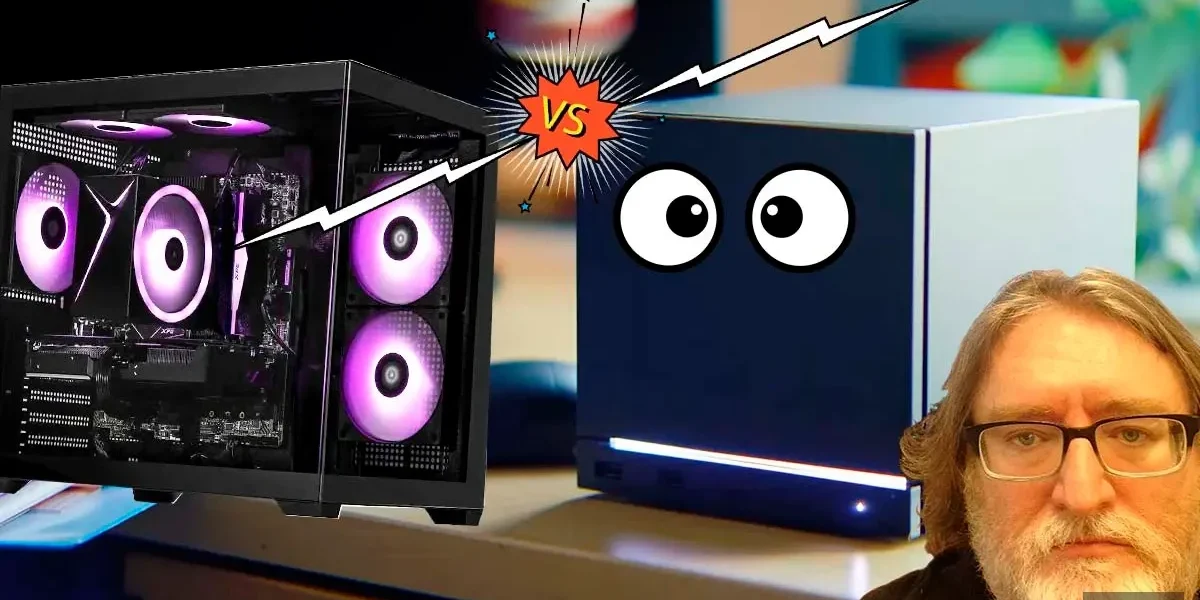
Valve has officially confirmed the launch of its long‑anticipated Steam Machine, a move that marks a significant expansion of the company’s hardware portfolio beyond the beloved Steam Deck. While the device boasts a polished SteamOS 3 pre‑installed and comes in four factory‑configured models, early performance reviews reveal that the company has struggled to sidestep the ongoing memory and storage price surge that has been plaguing the industry for months.
In response to the steep price point, the gaming community is increasingly turning to pre‑built or DIY rigs that deliver superior processor and GPU performance, double the memory, and expanded storage at comparable or lower costs. This trend places Valve’s new offering in a precarious position against traditional desktop competitors.
For instance, a ready‑to‑go system featuring an Intel Core i5‑14400 (10 cores) paired with an Arc B570 GPU (10 GB), 16 GB DDR4 RAM, and a 1 TB drive is available for $849. Similar configurations with RTX 5060 (8 GB) and RTX 5060 Ti (8 GB) GPUs are priced at $899 and $999 respectively—prices that match or undercut the cost of Valve’s Arc B580 (12 GB) alternative.
While 16 GB of RAM is more than enough for most modern games, upgrading to 32 GB is still the best choice for the ultimate experience. A 32‑GB system featuring an RTX 5060 graphics card and an i5‑14400 processor is currently on sale for $1,100—just $50 above Valve’s own model—yet it delivers double the memory and storage and a noticeably higher overall performance.
It’s worth noting that the Steam Machine’s graphics capability only rivals a desktop RX 7600—and sometimes falls short of it—making other high‑end builds far more enticing. For instance, a rig with a 10‑core Intel Core i5‑12600KF, 32 GB of RAM, and an RX 9060 XT can be found for $1,349, while ASUS variants with an 8‑core AMD Ryzen 7 8700F go for $1,199. Once you cross the $1,300 threshold, DDR5‑based systems become common, offering longer future relevance. Yet, for those who prioritize pure savings, a DIY build using budget‑friendly yet quality components can be assembled for around $800, proving that traditional PC parts still deliver the best bang for the buck despite rising manufacturing costs.
The economic and technological gap hasn’t gone unnoticed online, and users are echoing the experts’ opinions after testing the Steam Machine. Renowned YouTube channel Gamers Nexus quickly released its own comparisons and buying guides, showing how to assemble a comparable system for less money. In this digital debate, a gamer took to X to share a candid reflection on the real investment difference when deciding whether Valve’s new product is worth purchasing.
“Huge kudos to Gamers Nexus for demonstrating how to build a comparable rig (with slightly better performance than the Steam Machine) for $979 versus $1,050. Grab an Xbox controller on sale for $50 instead of the $99 Steam controller… You save about $120,” the user noted.
In a recent review of the eye‑catching Steam Machine, Gamers Nexus highlighted that comparing the unit’s price to building a comparable system from scratch requires more than just reading the spec sheet—it demands a realistic assessment of how the hardware performs in actual gameplay.
The core revelation is that the Steam Machine’s CPU and GPU are essentially laptop‑grade components, mirroring the AMD R5 7540U and RX 7600M. Because these parts are integrated, they cannot be purchased individually in standard PC retail stores.
For those looking to assemble a desktop that mirrors the Steam Machine’s performance, the closest match would be an AMD R5 7400F paired with an RX 7600. While these components deliver comparable technology and speed, they consume significantly more power, lacking the stringent power‑savings constraints Valve imposed to keep the system cool and quiet.
Despite these technical limitations, Gamers Nexus points out that the Steam Machine remains a compelling value proposition. When benchmarked against high‑end compact builds like the HP Omen 16L—priced around $1,350 with very similar parts—the Steam Machine offers a base model roughly $300 cheaper. This price advantage secures its position in the market for gamers who prefer a plug‑and‑play solution over the hassle of building a PC from scratch.
❓ Frequently Asked Questions (FAQ)
Where can I find more details about At Steam Machine price, get a faster PC with double RAM & storage?
Further details and updates can be followed through official game channels and the source link provided in the article.
News Source: Tarreo





Comments
Be the first to comment.