
For more than three decades, one of the most celebrated graphic adventures ever made has quietly waited for its moment to be revisited—and now PC Gamer is giving it that spotlight. The Hull-based studio Revolution Software and designer Dave Gibbons’ Beneath a Steel Sky, originally reviewed in the magazine’s very first issue back in December 1993, returns as an archived classic, complete with its verdict still ringing true: “A must-buy for all serious adventure fans.” The piece, penned by veteran critic Garry Whitta, resurfaces today to remind a new generation of players why this near-future techno-thriller remains a landmark title in the point-and-click genre.
The game arrived after two years of development and an extraordinary amount of preview coverage—so much that Whitta wryly notes it had “more column inches of enthusiastic preview copy than is healthy.” It also marked a dramatic departure for Revolution Software, moving away from the magic and mythology of its 1992 debut Lure of the Temptress toward something far more oppressive. As Whitta puts it, Beneath a Steel Sky “borrows heavily from the pioneering sci-fi works of Philip K Dick and William Gibson,” blending Blade Runner with Gibbons’ own Give Me Liberty graphic novel and a healthy dose of Total Recall.
A World Built on Corporate Ruin
The story unfolds in a near-future where global government has collapsed, leaving corrupt corporations free to seize control of the planet. As pollution ravages the ecology, the nouveau riche retreat underground while the less fortunate are forced to live and work in claustrophobic towers high above the surface. Beyond it all lies “The Gap,” a desert outland home to those who refuse city life—and the setting for our hero, Robert Foster.
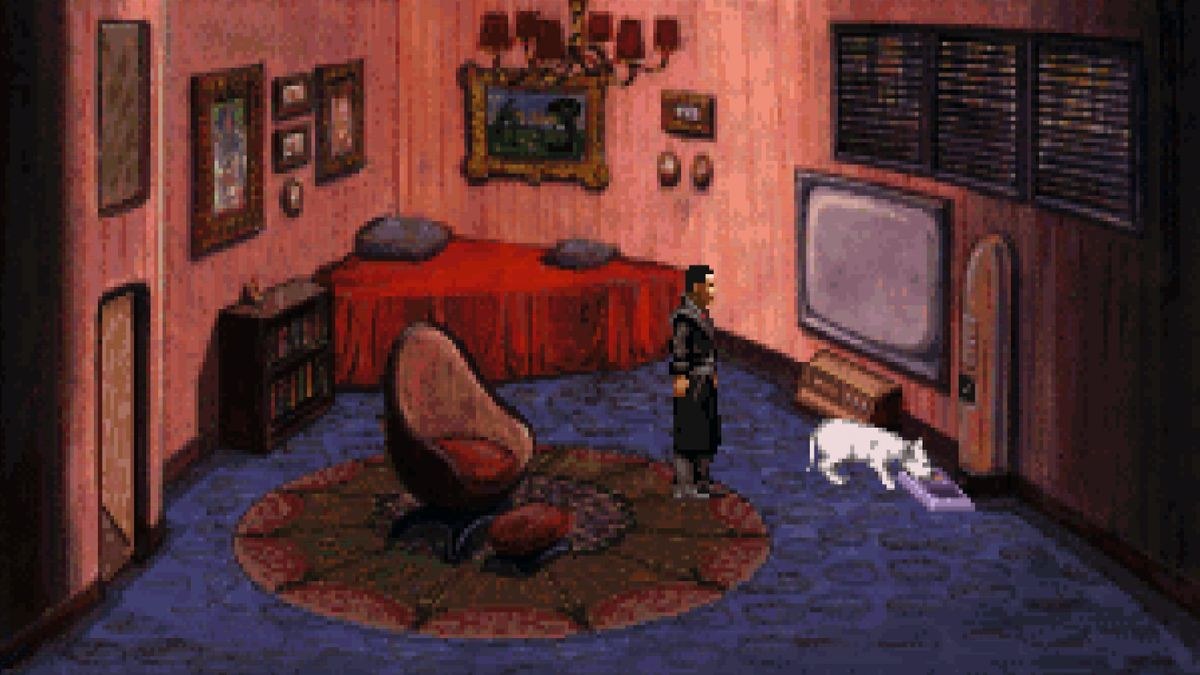
Foster is a raincoat-clad everyman thrust into the plot after sinister police kidnap him from his home without explanation and a helicopter crash strands him alone in the upper reaches of the towering metropolis. Whitta highlights that the game deliberately withholds information at its outset—hardly explaining why you’ve been abducted, what you must do, or even where you are—which he calls “one of the game’s strongest aspects.” Half the fun, he argues, lies in unravelling the mystery as the plot slowly unfolds.
 ” alt=”Beneath a Steel Sky review screenshot from PC Gamer #1″>
A Conventional Engine, a Richly Plotted World
Despite its ambitious premise, Whitta is candid that Beneath a Steel Sky is “pretty conventional in its approach.” As an adventure game there is nothing radically original on offer—it is big though, spanning around 100 locations and featuring countless puzzles alongside a myriad of genuinely interesting characters. A particular highlight is Joey, the robotic companion who begins as a lowly circuit board but can be plugged into various cybernetic bodies to assist with tasks.
“The well-scripted love-hate relationship between the two characters really helps bring them both to life,” Whitta observes. Progress itself mirrors the world’s layered geography: starting near the top of the city, players must descend to the surface and ultimately underground to solve the mystery and crack the central conspiracy—while dodging security forces, contending with an all-powerful central computer, and navigating numerous sub-plots and red herrings.
The Tone That Won’t Decide Itself
If there is a flaw, Whitta identifies it clearly: the game struggles to commit to a single tone. Readers arriving expecting “a dark, gloomy and atmospheric vision of a sleazy, corrupt future” are instead met with too many distracting factors that dilute the mood—even as Gibbons’ beautifully realised background artwork and accompanying mini-comic do their best to set it.
The comedy is another casualty. Whitta admits that Beneath a Steel Sky “just isn’t funny,” noting it rarely even attempts to be, unlike the joke-heavy Monkey Island titles of its era. He concedes this may not be fair criticism for a game that never promised humour—but he does suggest that “a few jokes would have spiced things up.” The music fares no better, with themes that occasionally sound more like jolly Radio One jingles than haunting score.
In the end, Whitta attributes these missteps to ambition: “The game simply spreads itself too thin, trying to be at once wildly atmospheric, comedic, menacing and tongue-in-cheek.” He acknowledges he may just be “a jaded bastard,” yet insists that as a classic LucasArts-style adventure it is difficult to fault.
Looking Ahead
The verdict remains unambiguous. Whitta ranks Beneath a Steel Sky at least as good as anything LucasArts has produced in the preceding year, while gently dismissing the marketing claim that it was “The World’s First Computer-Based Animated Comicbook Adventure.” His advice is pragmatic: take the game for what it actually is rather than for what it may pretend to be. For players revisiting this foundational title today, that guidance still rings true—Beneath a Steel Sky endures not as a movie or high-brow novel, but as a richly plotted, thoughtfully constructed adventure whose legacy continues to shape the genre.






Comments
Be the first to comment.