

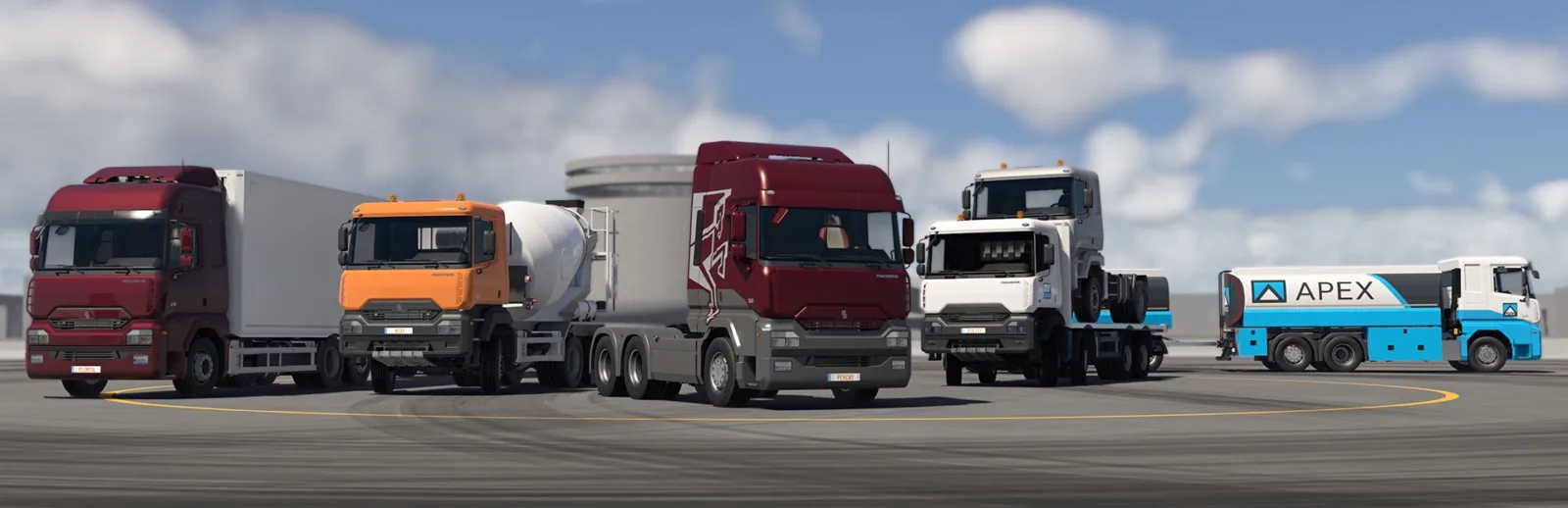
Hello, truckers, and welcome to a Behind the Scenes blog for our brand-new European-style truck, the Cherrier Percheron.

It’s finally here! The Cherrier Percheron, the long-awaited European-style truck, is now out, and the team is very excited to tell you all about the process of building it.
The Percheron is named for the French draft horse breed, known for their immense size, good temperament, and incredible stamina.

The name seemed perfect for our own European-style truck – it’s large, it has incredible durability, and while we can’t comment on its personality, this Pigeon doesn’t seem at all afraid, does it?

What is it and why?
The Percheron is our first European heavy truck. When we first introduce a new vehicle category, we usually prefer to create something more widely representative, instead of something very specific or unique. The idea is that the first vehicle of a new category should be able to stand in for the entire category, be easily recognized as a vehicle from that category, and have a basic appeal to fans of that type of vehicle.
That being the case, the Percheron is designed to be recognizably European in its appearance and operation. It does a solid job at representing the concept of ‘A European truck’, but the styling and some of the specific design details add a uniquely Beam flair to it.
The Percheron uses a 12.8 liter inline-six engine, which matches the 12-13 liter six-cylinder engines that this type of vehicle usually sport. There are several tuning options available at launch, ranging from 310 to 500 horsepower. Sounds a bit low, right? That’s because trucks like this are designed around torque, durability, and the ability to move heavy loads, rather than high horsepower. The Percheron is built for hauling, not speed, and its torque numbers are a reflection of that – the Percheron’s torque goes from 1500 Nm on the 310 horsepower variant up to 2450 for the 500.

It’s also one of the most flexible vehicles we’ve ever designed, including five frame lengths, numerous axle layouts, three cab types, and a host of upfit and trailer options.
Let’s talk about design
So, why does the Percheron look the way it does? When compared to typical American trucks, the design of European trucks may look a little weird, but there are actually pretty solid reasons for that, and they’re not all bureaucratic.
The Percheron’s flat-fronted, cab-over-engine design reflects European vehicle design regulations. While American trucks are more or less free to look however their designers desire, European trucks are subject to regulations regarding length, width, and height, which caused European truck designers to strive to be as space-efficient as possible when it comes to fitting everything a truck needs.

Back when the United States had size restrictions on trucks, they were also built as cab-overs – but since those regulations have been relaxed, US truck manufacturers have largely returned to the long-nose conventional trucks American drivers may be more used to. Some European truck manufacturers used to make long-nose trucks, but they are rather niche. The majority of European long-noses in use today are the result of aftermarket modification, with the exception of ones like the Volvo VNL, which is made by a Swedish company but only sold in the US.
Flex, Baby, Flex
Throughout the design process, the core principle was always ‘Flexibility’. The Percheron – although it wasn’t called that at the time – was always intended to be a hugely ambitious vehicle, pushing the game’s capabilities to the limit, and that started literally from the ground up – with the frame lengths.
The Percheron comes with five main frame lengths ranging from 6.17 to 9.8 meters. The team spent a lot of time curating the selection, and the frame lengths were chosen to allow for a broad range of use cases without needing a separate chassis for every possibility.

The shortest frame is intended for basic two-axle tractors and equipment such as skip loaders, while the mid-range frames allow for things like tankers and concrete mixers. The longest frames are intended for large boxes, larger mixers, and other outsized items.
In real life, manufacturers are able to customize their designs to the proposed purpose. In BeamNG, however, that’s simply not feasible. Allowing for the kind of variety in frame that real life presents would have very quickly led to a completely unmanageable number of parts and configurations. The challenge, therefore, was to create something that allowed for a realistic number of variations without spending the rest of eternity crafting a hundred bespoke frames and breaking the game and making modders’ lives more difficult than they need to be.
Building Blocks
The solution turned out to be building blocks. The Percheron is designed in a modular way, allowing various parts to be exchanged to create a huge number of potential configs. Fifty-three of them, to be a little more exact.
Once the team had finished the individual modules – such as the cab, frame, suspension, and so on – it became relatively easy to combine them into many different variants.
Relatively easy, of course, doesn’t mean the same as actually easy.
A massive amount of work went into making sure that the interchangeable parts were actually interchangeable. This involved making sure that the parts connected to the correct mounting points, that the mounting points were in the right place, that the parts didn’t clip through each other, behaved correctly, and – and this was the tricky one – didn’t completely tank performance. We’ll get into why that last one is a concern later in the blog, but for now it’s enough to let you know that more than one potential config had to be scrapped because it was massively impacting the game’s performance due to the sheer complexity of the parts.
The modular design the team embraced allows for both realistic factory-style configurations and every BeamNG driver’s favourite thing: shenanigans. The Percheron’s flexibility gives drivers the freedom to create entirely impractical builds that could never work in real life. Of course, they most likely won’t work in the game either – but we would never stop our beloved players from making completely impractical builds that are likely to explode or fall apart the moment they’re asked to carry anything heavier than a napkin. Where would be the fun in that?
An Alignment of Axles
The Percheron released with more than ten axle layouts, ranging from a 4×2 all the way to an 8×8. There were several additional configurations created during the development process, including a legendary Nightmare variation literally named ‘worstNightmare.pc’ – which was a five-axle test design with every possible part equipped, specifically created as a performance test, and which had such an effect on performance that it was impossible to actually release even if the team had wanted to.
The number of axle variations available offers enormous flexibility. Drivers can decide how many axles they want, where they should be located, and whether they need to be driven or not. This, of course, has a massive effect on the way a build performs.

For example, a 4×2, the simplest conventional layout, has one front steering axle and one rear drive axle. This version is nothing special, mostly useful for highway driving. A 4×4, on the other hand, has both axles driven. This gives it more traction and makes it more suitable for agricultural use, rough roads, and construction work.
This rule holds true even at higher numbers – a 6×6, for example, combines a driven front axle with two driven rear axles. This configuration is intended for very heavy-duty work that requires maximum traction, like terrible roads.
It gets a little more complicated than that, of course. If a vehicle has only two steering front axles, there’s no need to think any further about it. However, there are times when that’s not the case, in which case more symbols are needed.
A 6×2/4, for example, has six wheels, two of which are driven and four of which are steered and located ahead of the drive wheels. This is the second most common semi-tractor layout, and gives a higher payload than comparable configurations.
A 6×2-4, on the other hand, has got six wheels. Two are driven, and the four steered wheels are located behind the drive wheels. This is the most common rigid truck layout, with a considerable agility advantage over the 6×2/4, and is often used for highway-going box trucks.
An 8×2/6 is a strange combination, suitable for road-going vehicles that need a lot of payload but not so much traction.
An 8×4/4, on the other hand, is a heavy-duty layout that can be found as single-steer or a twin-steer. The former is mostly used for heavy haulage, while the latter is suitable for vocational rigid trucks like dumpers and mixers.
And then of course there is the 8×8. Our version is only available as a twin-steer, and the layout is ideal for vocational mixers and dump trucks working in rough terrain.
Springs, Bags, and Bumps
Of course, adding axles is not the whole story. How they attach to the truck is also important.
The Percheron offers leaf-spring and air suspension, so drivers will be able to choose which one suits their purposes best.
Leaf springs are simple and durable – they have minimal moving parts, and are well-suited to heavy loads. The problem comes in when the heavy load is absent: a spring strong enough to support several tons is going to be very stiff when the truck is empty. This, of course, means that an unloaded truck can be a little overenthusiastic when it comes to letting its driver know what road conditions are like.

Air suspension is more adaptable, allowing for adjustments depending on the load – you can increase the pressure for more support when the truck is heavily loaded, or decrease it to provide a smoother ride for delicate cargo (or a driver’s delicate stomach). The weakness of air suspension is durability – airbags, valves, and an air supply are all needed to make an air suspension go, which is more points of failure than a simple massive spring.

Heavy-duty tandem configurations can also use walking-beam leaf suspension. As one axle rises over an obstacle, the assembly encourages the other to move downward, helping both axles remain in contact with uneven terrain.
The Percheron also has a hydraulic retarder for long descents. It connects to the transmission and converts the truck’s mechanical energy into heat, which slows the truck without having to solely rely on the service brakes. This will reduce brake wear but isn’t an infinite fix: the retarder is connected to the engine’s cooling unit, so overusing it can lead to overheating your engine.
The detail the team put into the suspension has a noticeable effect in the game. Load a concrete mixer and you can watch its springs compress under the weight. Remove the load, and they return to their original shape. Choose an axle arrangement that leaves too little weight over the driven wheels, meanwhile, and you may discover that having more axles does not necessarily mean having more grip.
Turning a Corner
Περισσότερα axles will let a truck carry more weight, but they bring their own issues too: maneuverability.
Several fixed axles can’t all follow the same curved path, so when turning some of the tires have to slide sideways across the road. This is called tire scrub, and increases wear, resistance, and steering effort while making tight turns more difficult.
The Percheron can address this issue with steering tag and pusher axles. These auxiliary axles turn to follow a more natural path through the corner, effectively shortening the truck’s turning wheelbase. Their steering ratio changes with frame length, because a short truck requires a sharper angle than a longer one.

The auxiliary axles are hydraulically operated and modeled as part of the truck, rather than simply animated. If you switch off the engine, the mechanically connected front wheels can still turn, but the hydraulic auxiliary axle won’t respond until the engine is on again.
Some European trailers, and some of the trailers in-game, tackle tire scrub with passive steering instead. Their rear wheels use caster geometry to follow the direction in which the trailer is being pulled, a bit like the wheels on a shopping cart. This works beautifully while moving forward, but causes issues when reversing. When the truck is moving in reverse, the wheels can attempt to turn the wrong way and will bind, unless the mechanism is locked. Because naturally, reversing a trailer needed to be even more complicated.
Most auxiliary steering systems will progressively disengage above about 38 km/h. This prevents small steering inputs from producing outsize results at higher speeds – generally considered desirable in something tall, heavy, and carrying several tonnes of concrete.
Fun and Παιχνίδια
The Percheron is our most interactable vehicle yet. While other vehicles feature highly detailed interiors, the interactivity is limited because after all, they are designed only to be driven, while the Percheron is designed to be an experience.
The openable sunroof – first of its kind – had to be individually jbeamed so that it would function just like any part, while the steering wheel folds up to make entering and exiting easier.
There’s a baggage compartment under the sleeper bed that can be opened from either side of the cab. While in a real truck of this type this compartment would go all the way through, the Percheron’s engine hump and air filter box prevent that, so instead the compartment is split into two, with access from both sides of the cab. For security, these compartments can only be opened with a lever from inside the cab.
The microphone cord of the cab radio was also individually jbeamed to react realistically when interacted with, because why not?
Cab Comforts
Fortunately, the Percheron makes an effort to protect the driver from all this heavy machinery.

The truck launches with three types of cabs: the short S cab is intended for local work, and doesn’t have a bed. The L cab has a bed and is intended for overnight use, while the tall-roofed XL cab is intended for long-term use and offers more headroom, storage, cabinets, and other long-distance creature comforts.

The cab is suspended separately from the frame. It pitches forward when braking, leans back when accelerating, and rolls when cornering, isolating the occupant from some of the shocks passing through the frame. The driver’s seat has its own air suspension as well, and the in-cab camera moves with it.
This means that the movement you see from inside the cab is the combined result of the tires, axle suspension, flexible frame, cab suspension, and seat suspension. The team had to strike a balance here: enough movement to communicate the scale and behavior of the truck, but not so much that it would need a warning label.
The cabs also offer red night-lighting, which will allow players to see enough to navigate the interior of the truck without blinding them with the glare from interior lights.

For maintenance, the entire cab can tilt forward so that the engine is exposed. Just open the front service panel so it doesn’t catch on the cab, and an electro-hydraulic pump will do all the heavy lifting.

Being the size of a small building does create a few visibility problems, so the Percheron is fitted with an extensive collection of safety equipment. Supplemental mirrors cover the areas immediately beside and in front of the cab, while French angles morts stickers warn other road users about the truck’s blind spots. Side marker lights, upper corner lights, reflectors, and retroreflective markings also help communicate the vehicle’s considerable length, width, and height at night. After all, nobody likes surprise trucks when night driving.


The Percheron’s safety features conform to UNECE regulations for things like headlight and marker light positions, frontal and rear underride guards, retroreflective devices, and other markings – if it was a real vehicle, it would be road-legal to the best of our ability. Taking realism too far? Maybe, but on the other hand, why not?


Upfit to Be Tied
The Percheron’s modularity doesn’t end with axles and suspension. Its upfits can be combined with multiple chassis layouts, giving drivers access to insulated boxes, flatbeds, concrete mixers, and a wide variety of other options.
Some of the available upfits will adapt to the truck they’re on. Boxes can change wheel openings according to the selected axle arrangements, while the front section adapts to the chosen cab. A short day cab will allow the body to extend further forward, while a sleeper cab will cause the upfit to shrink slightly to leave room. The trailers were a significant challenge for the team, what with all the different variations the Percheron offers, and the solution turned out to be a modular axle jbeam system which can be used to create as many variations as necessary.
The flatbed and box are built on the same platform, so that one underlying structure can support several uses. The tanker bodies, on the other hand, are more specialized. The fuel tanker has its own equipment compartments and pipework, while the milk tanker uses stainless steel construction, food-transport fittings, and sampling equipment.


The same philosophy applies to the new European trailer family, which includes platforms, flatbeds, insulated boxes, container carriers, tankers, and drawbar trailers. Several share a common base structure, while axle options range from sensible tandem arrangements to combinations that may be considerably less sensible once cargo is added.
The Percheron can also pull American trailers, while the T-Series can hitch up to their European counterparts. Both use fundamentally compatible fifth-wheel and kingpin systems, although differences in kingpin position and cab-to-trailer clearance may require some adjustment.
Invisible Work and Optimization
Making all of this work took a massive amount of JBeam engineering – the part of vehicle development that nobody notices unless something goes wrong.
The Percheron’s modular axles can be reused in different positions to create tandem drives, steering auxiliaries, twin-steer layouts, and trailer groups. Each arrangement still needs the correct suspension, steering, and power path, though, which helped produce roughly twenty driveshaft variants across the project.
Even the fenders required their own adaptable system. Fully calculating continuous collision between every tire and fender would be expensive, so support structures extend from the wheel towards the bodywork. These allow the fender to react to the installed tire without imposing the same performance cost. The system also remaps each fender section to the correct wheel as the axle layout changes.
Every additional axle adds nodes, beams, collision triangles, suspension links, wheels, and drivetrain calculations. Textures bring their own demands on memory, especially when several trucks appear in traffic. The team therefore had to balance visible detail against performance on minimum-spec PCs, consoles, and busy maps.
A Long Time Coming
The Percheron took longer than any other vehicle in our roster to complete. There were several reasons for that, including a change in design direction and the incredible complexity of the vehicle itself.
The initial plan for the Percheron was fairly simple, but was scrapped early in the process in favor of the current setup – instead of a simple European-style truck, the team decided to go for the most European-style truck. The final scope of the project became massive, so the team knew they were in for the long haul.
And then there’s the problem that always arises when you take on long-term projects in a game that is constantly evolving. As BeamNG changed, so did the quality that players, as well as the vehicle team themselves, expected from a BeamNG vehicle. This meant that several times during development, parts that had been nearing completion had to be overhauled to match current quality standards. There was no point, the team felt, in releasing a vehicle that felt like something from five years ago – they wanted to make the best vehicle they could to the game’s current standards, and to do that there was a lot of going back and updating or upgrading things that had already been finished.
It was a long and occasionally painful road, but the team is very proud of what they’ve managed to achieve.
### 🎯 BeamNG.drive Tactical Meta Breakdown: Real Τρόπος παιχνιδιού Impact
| Weapon / Component | Official Tuning | Practical Τρόπος παιχνιδιού Impact | Handling & Recoil | Meta Tier |
| :— | :— | :— | :— | :— |
| This rule holds true even at h | This rule holds true even at higher numbers – a 6×6, for example, comb | Handling pacing and transition ergonomics updated; adjustments reward disciplined trigger control. | Standard / Unchanged / Unchanged | A-Tier (Solid Pick) |
> Competitive Tip: These adjustments directly alter weapon handling and TTK breakpoints. Hop into the training grounds or firing range to dial in your crosshair placement before queuing into Ranked.
Have thoughts, questions, or benchmarks on this topic? Join the discussion on our forums.
Join Discussion ➔






















Συμμετάσχετε στη συζήτηση