

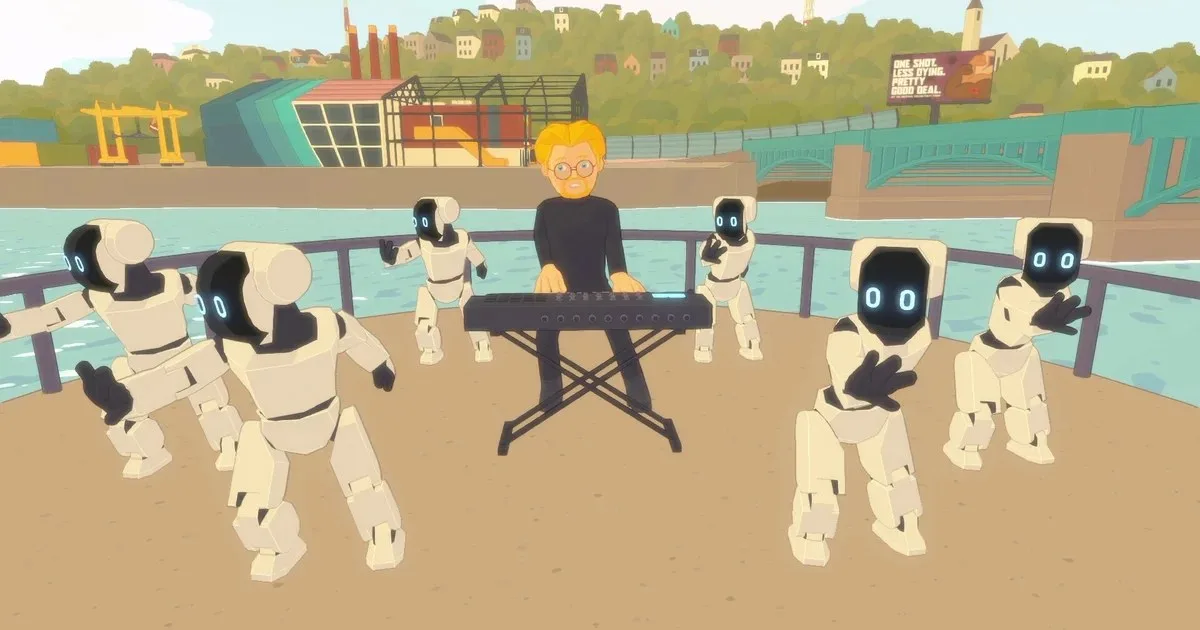
Molleindustria called on ChatGPT and Claude for a “tiny fraction” of code

Prominent capital-p political game developer and left-wing academic Paulo “Molleindustria” Pedercini has revealed that he used generative AI tools for aspects of his recent ecosocialist satire Future? No Thanks!. According to Pedercini, “a tiny fraction of its code was written with AI support” towards the end of the project, specifically to assess and fix bugs.
The game also uses text-to-speech voice-acting for a couple of characters, generated with ElevenLabs software, with Pedercini noting that the characters in question are intended as a spoof of wonky artificial intelligence. He insists that none of the game’s art or writing is AI-generated. These insights arrive weeks after the game’s Steam release, which was delayed due to Valve’s concerns about sexual material. Back then, there was no genAI disclosure on the game’s store page. There is one now.
Pedercini fessed up about using generative AI on his blog yesterday. “Every independent gaming festival and showcase in the year 2026 requires some kind of generative AI disclosure,” he begins. “That is great! Slop and vibe-coded games are a scourge, AI is a technofascist, anti-human and anti-art project, and it’s imperative to create spaces of resistance.
“Future? No Thanks! is a game that tackles the impact and limits of artificial intelligence head-on,” Pedercini continues. “It satirizes generative AI and the careless ways it can be used, even in an enlightened ecosocialist world. It also dramatizes beneficial uses, such as coordinating a planned economy, voice recognition, and talking robots. And yet, I can’t say it’s a 100% AI-free game.”
In a breakdown of the development of Future? No Thanks!, stretching back to 2021, Pedercini comments that “99% of its code base was written before AI was even viable as a coding tool”. As for why he decided to use it during the closing stages, he argues that “ChatGPT or Claude” can be “a powerful semantic search engine” when fixing bugs.
“بحث engines have been enshittified to death, specific technical queries don’t yield meaningful results anymore,” Pedercini writes. “Most search engines produce low quality AI responses anyway. Such coding assistance was used for things like fixing a shader I didn’t write which broke after an update, or diagnosing a one-frame loading glitch when loading sequences. Finishing touches and minor debugging.
“Unlike assets that can be easily swapped, AI-generated code is hard to remove once introduced,” he goes on. “I wouldn’t be able to tell which lines I wrote, which were generated, and which were somewhere in between.”
Regarding the game’s voicework, Pedercini argues that “text-to-speech used to be an uncontroversial technology and an early application of neural networks. Then the AI bros started commercializing AI voices as a way to replace human actors, so it’s now problematic.”
Apparently, Future? No Thanks! features “about two minutes” of generated voicework “for an automated toilet and a personal assistant that mis-translates Roman idioms”. Pedercini spells out that “the humor of these scenes relies on uncanny voices doing their job poorly”. The Future? No Thanks! team experimented with human voices for these roles, he adds, but found “they just weren’t working as well”. He includes a clip of the PA character for reference.
Early demos of the game also featured some AI-generated “fake doo-woop tunes” with “AI” in the lyrics that “were supposed to make fun of losers who listen to slop”. The referencing of AI in the lyrics was “conceived as a kind of mandatory watermark this future society imposes on AI-generated music,” Pedercini explains. “I thought they were hilarious, but over time the association with a plagiarist tech company started to bother me so I replaced them with royalty-free loops. By the way, royalty-free samples that are certainly AI-free are increasingly hard to find, but I found an old site untouched since 2016.”
Pedercini closes his blog (as of writing, at least) with some reflections on the debate around generative AI in games, noting that the “100% no-AI stance/requirement” embraced by a fair number of developers and players “is very recent, and the game was being developed before a consensus emerged”. He adds that “as an educator I have to look into these tools which most of my students use, and I was trying to figure out if there are non-brain-rotting ways to do so. I’m grateful to those who allow some nuance in approaching the issue, especially regarding coding.”
An earlier version of the blog contained more extended thoughts on genAI, in which Pedercini argued that being “AI-free” is “the only truly ethical position” for game developers, given the technology’s links to “energy and water use, IP theft, cheating, unemployment, spam, and so on”. Nonetheless, he contended that the evils of genAI reflect broader structural problems that cannot be remedied through individual action, while arguing that “holding your fellow artists to the highest ethical standards won’t stop the actual bad actors”, and that enforcing “AI-free” within a “progressively minded community” may come at “a high cost of division, suspicion, and bad vibes”.
These closing thoughts have since been deleted following some forceful responses on Bluesky, with Pedercini now commenting that they “made people upset and made me a strawman for arguments and positions I abhor”. Screen captures of the removed paragraphs can still be found circulating online.
I enjoy what I’ve played of Future! No Thanks?, and this is obviously a more “nuanced” injection of stochastic parrotry than the countless quick cash-in games that consist purely of ‘human-reviewed’ generated code, or the blockbuster projects jamming it in at the behest of investors and executives. I broadly agree with Pedercini that generative AI is just the freshest wart on the arse of a callous social order that puts economic growth above everything else. I respect the intention to use the technology in the service of a story or theme, and I take the point about certain machine learning technologies, hitherto less damaging, being absorbed into the genAI crusade. And sure, people do like to tell each other off on social media, don’t they?
That said, I find all this pretty disappointing. Given Pedercini’s clear grasp of all the problems with generative AI, and given that Future? No Thanks! itself offers criticism of the tech, the least you’d expect is that he’d make his case for using the stuff before selling the game. It would be a show of good faith. Pedercini also doesn’t specify whether he sought out genAI tools that aren’t as steeped in infamy as Claude, ChatGPT and Suno.
While I don’t want to lean too much on commentary that has now been withdrawn, I also think Pedercini sets up too hard a binary between “individual action” and “structural problems” in the older version of the post. I agree that harping about “personal responsibility” is one of the weapons capitalism deploys to pit its discontents against each other, but a community that wants to create “spaces of resistance” against “a technofascist, anti-human and anti-art project” needs to hold members to an appropriate standard.
A number of other developers have responded to Pedercini’s blog, including Necrobarista and Eternal Strands writer Damon Reece, and Riot الألعاب IP creative adviser Dante Douglas, who is also narrative lead on Airborne Empire. I imagine Pedercini will have more to say soon.
Have thoughts, questions, or benchmarks on this topic? Join the discussion on our forums.
Join Discussion ➔






















انضم إلى المحادثة