🏢 Freebird Games📅 01 Nov 2011🎮 Sigmund Corp / Freebird Games
Kan 'Reives' Gao and Freebird Games' deeply emotional, tear-jerking, and universally acclaimed narrative adventure masterpiece on PC, Mac, Nintendo Switch, and mobile platforms, released in November 2011 by independent developer Freebird Games on RPG Maker XP, winning Best Story of the Year from GameSpot (triumphing over big-budget titans *Portal 2*, *The Witcher 2*, and *Batman: Arkham City*) and holding an 81/100 on Metacritic and selling over 3 million copies, standing as one of the most poignant, beautifully written, and tearfully unforgettable storytelling achievements in video game history, following two memory-alteration doctors—Dr. Rosalene and Dr. Watts from Sigmund Corp—entering the mind of dying elderly man Johnny Wyles on his deathbed to fulfill his lifelong unfulfilled dream (*"I want to go to the moon... but I don't know why"*), traversing his memories backward in reverse chronological order from old age to childhood to uncover the tragic love story between Johnny and his autistic wife River, the mystery of the origami paper rabbits, the lighthouse, and Kan Gao and Laura Shigihara's immortal, award-winning acoustic piano masterpiece soundtrack featuring "For River" and "Everything's Alright".
The Genre Genesis: From Modern Titans to 2011 Pioneers
GAMER24H.COM
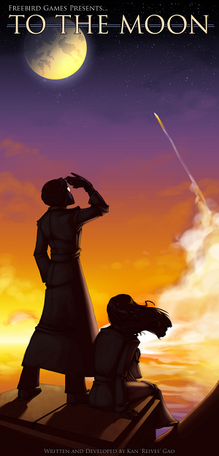
📸 Official HD Capture: To the Moon - The Genre Genesis: From Modern Titans to 2011 Pioneers
Reverse-chronological psychological interactive storytelling, emotional memory traversal, and narrative-first pixel adventure architecture (stepping into the fading neural synapses of a dying man on life support: linking emotional mementos to travel backward through decades of forgotten memories from a lonely seaside cliff house in old age to bittersweet wedding days, high school encounters, and childhood stargazing fairs to fulfill a dying wish to go to the moon), paired with a profound portrayal of neurodivergence, grief, and love—from Finding Paradise, Impostor Factory (Freebird), Rakuen (Laura Shigihara), OMORI, What Remains of Edith Finch, Before Your Eyes, and interactive narrative art—trace their undisputed, most emotionally transcendent origin to November 1, 2011 with Kan Gao's crowning masterpiece, To the Moon.
Written, designed, programmed, and composed by Canadian indie auteur Kan 'Reives' Gao at Freebird Games with guest vocals and piano by Laura Shigihara (*Plants vs. Zombies*) on an engine built with RPG Maker XP, To the Moon was an epochal artistic triumph. Winning Best Story of the Year at GameSpot's 2011 Awards over multi-million-dollar AAA competitors, it proved that narrative heart and music surpass graphical fidelity.
Platform Context & Gaming Environment
Sigmund Corp provides a medical technology that artificially alters a dying patient's memories so they can die peacefully believing they fulfilled their greatest life dream. Doctors Eva Rosalene and Neil Watts arrive at a lonely clifftop lighthouse mansion where elderly Johnny Wyles lies in a coma. When asked what his dream is, Johnny states he wants to go to the moon, though he has no idea why. Connecting neural helmets, the doctors travel Backward in Time Through Johnny's Memory Timeline:
Old Age & The Lighthouse: Exploring the house filled with thousands of folded paper origami rabbits and Johnny mourning the death of his late wife River.
Middle Age & Anya the Platypus: Uncovering River's Asperger's syndrome diagnosis, her obsession with the paper rabbits, and the financial sacrifice to save the coastal lighthouse.
Youth & Marriage: The bittersweet wedding and road trips.
Childhood Carnival & The Tragic Truth (Climax): Uncovering a repressed childhood tragedy (the death of Johnny's twin brother Joey) and the forgotten stargazing promise made to River under the night sky: *"If we ever get lost, we'll meet up on the moon."*
Popularity & Cultural Standing: Niche vs. Blockbuster
To the Moon was an astronomical indie success selling over 3 million copies. The iconic acoustic piano song "For River" (played with two repetitive notes symbolizing Johnny and River) and Laura Shigihara's climactic vocal ballad "Everything's Alright" brought millions of players to tears worldwide and are celebrated as timeless masterpieces of video game music.
Gameplay Mechanics & Technical Innovations
To the Moon established standard-setting narrative adventure mechanics:
The Reverse-Chronological Memory Traversal Engine: Navigating Johnny's mind from old age backward to early childhood; exploring each life era to collect emotional Memory Links (a dead flower, a pickled olive jar, a stuffed platypus, an origami rabbit).
The "Memento Matrix" Tile Flip Mini-Game: Once five Memory Links are collected, players solve a rotating spatial tile puzzle to unlock the primary Memento and leap backward to the preceding chronological memory.
Dynamic Dual-Protagonist Interplay: Playing as Dr. Rosalene (serious, professional) and Dr. Watts (sarcastic, comedic pop-culture banter); balancing humor and profound emotional weight.
Profound, Authentic Depiction of Neurodivergence: One of the first video games in history to authentically and respectfully explore Asperger's syndrome and autism spectrum communication through the character of River.
Award-Winning Interactive Musical Score: The piano soundtrack serves as a primary narrative storytelling device; leitmotifs evolve as memories are reconstructed, culminating in the triumphant launch of the space shuttle to the moon in Johnny's final heartbeat.
Historical Legacy & Archival Preservation
To the Moon is permanently celebrated in game design history as Freebird Games' defining masterpiece that proved video games can evoke profound empathy, grief, and tears as powerfully as the greatest works of literature.
Official 1080p Screenshots Gallery
Authentic in-game captures and visual assets (Click to view full resolution).
Authentic vintage visual direction representing landmark era aesthetic standards.
⚡ Action Pacing & Physics Engine
Systemic interaction and engaging pacing designed for historical immersion.
🎯 Performance & Launch Trajectory
An essential milestone preserved in masterclass gaming archival standard.
To the Moon is a 2011 adventure game developed and published by Freebird Games. It was originally released for Windows and was later ported to Linux, OS X, Android, iOS, and the Nintendo Switch. The story follows two doctors who offer to fulfill a dying man's last wish using artificial memories. The game features relatively few gameplay mechanics, with the player controlling the two doctors, exploring the narrative, and solving puzzles as they try to reconstruct the dying man's memories in order to fulfill his wish.
The game was designed by Kan Gao using the RPG Maker XP toolkit. Development started in 2010, when Gao was struck by questions of mortality following his grandfather's life-threatening condition. To the Moon would become Freebird Games' first commercial product, following smaller, experimental games released for free on the studio website. The game was later updated to include two free downloadable content chapters called "minisodes" to give more context to the main characters. A sequel, Finding Paradise, was released in 2017, and a third entry, Impostor Factory, was released in 2021.
To the Moon received praise for its narrative, music, thematic material, and emotional power. The game was nominated for several awards and considered by many to be a leading example of artistic expression in video games. An animated film adaptation is in development, partially scripted and supervised by Gao.
Gameplay
GAMER24H.COM
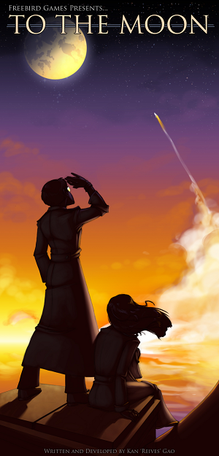
📸 Official HD Capture: To the Moon - Gameplay
To the Moon is built on the RPG Maker XP engine, which is used to create 16-bit 2D role-playing games in the style of Suikoden 1 and 2. However, unlike a typical RPG, To the Moon has no battle system (aside from a joke battle near the beginning), inventory system, or party system. As the game is mostly story-driven, the gameplay focuses on puzzle solving, interpreting information from the subject's (Johnny's) life, and finding ways to get deeper into his memories.
The gameplay mostly consists of exploring Johnny's memories to find significant objects and collect energy from them to strengthen the memory and connect to a more distant one, from Johnny's old age leading back to his childhood. Occasionally, the player will have to explore Johnny's house and the surrounding area for certain clues, if they cannot gather enough energy from a certain memory, or don't know how to proceed to a further one.
Once the items are all gathered and the player has seen every memory, they can connect certain objects that exist across two different memories to move freely between them. At this point, the player can begin manipulating the memories, by changing around characters, objects, and events, to make Johnny believe he had achieved his dream of going to the Moon.
Plot
Sigmund Corp. uses a technology that can create artificial memories. Since they conflict with the patient's real memories, the procedure is only legal to do on comatose patients without much time left to live. Thus, they offer this as a "wish fulfillment" service to people on their deathbeds.
Sigmund Corp. employees Dr. Eva Rosalene and Dr. Neil Watts are contracted with fulfilling the wish of the dying Johnny Wyles. Johnny wants to go to the Moon, but is unable to state why. The doctors insert themselves into an interactive compilation of his memories and traverse backwards through his life via "mementos", items of great personal significance to Johnny that act as a link between his various memories.
With each leap to an important moment in Johnny's memories, they learn more about him, largely revolving around his somewhat unhappy marriage to his teenage sweetheart, River. However, Rosalene and Watts are unable to find any kind of explanation for Johnny's wish. The doctors also encounter an unusual gap in Johnny's earliest childhood memories, rendering them inaccessible. Nevertheless, the doctors insert his desire to go to the Moon into his earliest accessible memories of his teenage years. In theory, Johnny's mind would create new memories based on that desire, thus fulfilling his last wish.
Johnny's mind does not create the new memories as planned, prompting the doctors to find a way to access the missing childhood memories. The doctors later uncover medical records explaining that Johnny once received a large dose of beta blockers as a child despite not having a heart condition, causing significant memory loss. The doctors then use a combination of their tech and external stimuli to forcefully restore Johnny's earliest childhood memories, where it is revealed that Johnny and River first met as young children at a carnival. They looked at the night sky together and made up a constellation: a rabbit with the moon as its belly. The two agreed to meet at the same place the following year, with Johnny promising that should he forget or get lost, the two would "regroup on the Moon", finally explaining the motivation behind his last wish.
Sometime later, Johnny's mother accidentally kills his twin brother Joey in a car accident. In her grief, Johnny's mother deliberately gave Johnny the beta blockers to erase all memories of Joey. This also causes him to forget his first encounter with River, but Johnny would later meet her again in school and would eventually marry her. River later realized that Johnny had forgotten their meeting at the carnival, greatly upsetting her. River, who is implied to have Asperger syndrome, would never directly tell Johnny about their first meeting. Instead, unaware of the reasons behind Johnny's memory loss, she would spend the rest of her life trying to no avail to jostle Johnny's memories by cutting her hair and crafting numerous paper bunnies, including a dual-colored one representing the constellation they made up during their first encounter. River died without ever explaining her actions to Johnny, leaving him sad and confused. Rosalene then concludes that the only way to fulfill Johnny's wish is if River is removed from Johnny's memories after their first meeting.
Over Watts' protests, Rosalene removes River from Johnny's memories except their first meeting. She then implants a memory sequence in which Joey did not die, thereby averting Johnny's amnesia. As a result, Johnny never meets River in school and would spend his entire youth working on becoming an astronaut to fulfill his promise to her. Johnny would not meet River again until they started working together at NASA. As the comatose real-life Johnny begins to die, he imagines going on a Moon mission with River. As the Space Shuttle leaves Earth, River wordlessly holds out her hand to Johnny. The Moon comes into view, and Johnny takes River's hand just before his heart monitor flatlines. In the epilogue showing Johnny's revised memories, Johnny and River get married like before. They build and retire to the same house as they did in real life. The only difference now is Joey's presence in all of Johnny's major life events, and the friction between Johnny and River caused by his original amnesia is absent. Rosalene and Watts, now back in the real world, look to Johnny's grave, placed adjacent to River's, behind their home. Rosalene receives a phone call, and the doctors move on to their next patient.
Development and release
To the Moon was developed and published by Freebird Games, the independent game studio of Canadian designer Kan Gao as their first commercial production. Made using the RPG Maker XP engine, development began in 2010 after Gao's grandfather became seriously ill, an event that made Gao question mortality and death. His thoughts on regret before one's death eventually inspired the concept for the story of the game.
To the Moon was originally released on the author's website and various digital download portals. Later, it was also made available via major digital distribution sites like Steam in November 2011 and GOG.com in June 2012. Originally available only for Windows, it was later released for Linux and OS X through Humble Bundle's "Humble Indie Bundle X" in January 2014. Amaryllis Kulla ported the game with the open-source and cross-platform RPG Maker XP game engine recreation MKXP. Later this engine was also used for ports to other systems like the OpenPandora handheld. In May 2017, To the Moon was also released on Android and iOS by X.D. Network Inc. with the cross-platform game engine developed by Unity Technologies. The game was localized in Chinese, German, Italian, Spanish, French, Polish, Russian, Brazilian Portuguese, Vietnamese, Dutch, Korean, and Turkish. The score of the game was composed by Gao, with a theme song titled "Everything's Alright" being written and performed by Laura Shigihara. The soundtrack was released on Bandcamp on November 4, 2011.
A downloadable minisode was released on December 31, 2013, which centers on Dr. Rosalene and Dr. Watts during a holiday party at their local Sigmund Corp. office. A second minisode was released on February 18, 2015.
Reception
To the Moon received generally favorable reviews, according to review aggregator Metacritic. Critics, while noting that the gameplay itself was lacking, praised the story and music.
Legacy
In August 2016, Gao announced that a mobile remake of the game was being developed by X.D. Network Inc. After about a year, the remake released for Android and iOS on May 12, 2017. The remake features high-definition graphics, as opposed to the 16-bit graphics of the original PC release. The game released for Nintendo Switch on January 16, 2020, and released for China Nintendo eShop on February 8, 2021, remade using the Unity engine.
A game set in the same universe, titled A Bird Story, was released in November 2014. While not a direct continuation of the story, it serves as a bridge between To the Moon and Finding Paradise, a sequel which was released in December 2017. An animated film adaptation is in development. The film will be a collaborative project, with it being partially scripted and supervised by Gao with Japanese companies leading production and Chinese company Ultron Event Horizon funding it. The series received a third entry, Impostor Factory, in September 2021, and a fourth and final entry, Just a To the Moon Series Beach Episode, in September 2024. A classic RPG-style spin-off game, The Last Hour of an Epic TO THE MOON RPG, is in development.
Awards
In GameSpot's 2011 Game of the Year awards, To the Moon was given the "Best Story" award, which was won against Catherine, Ghost Trick: Phantom Detective, Portal 2, and Xenoblade Chronicles, which were also voted in the same category. The game was also nominated in the categories of "Best Music", "Most Memorable Moment", "Best Writing/Dialogue", "Best Ending", and "Song of the Year". In 2015, it was included on GamesRadar's top 100 games of all-time list. In 2018, the mobile version was nominated for the "Game, Original Adventure" and "Original Light Mix Score, New IP" categories at the National Academy of Video Game Trade Reviewers Awards.
Notes
References
External links
Official website
Official 1080p Screenshots Gallery
Authentic in-game captures and visual assets (Click to view full resolution).