

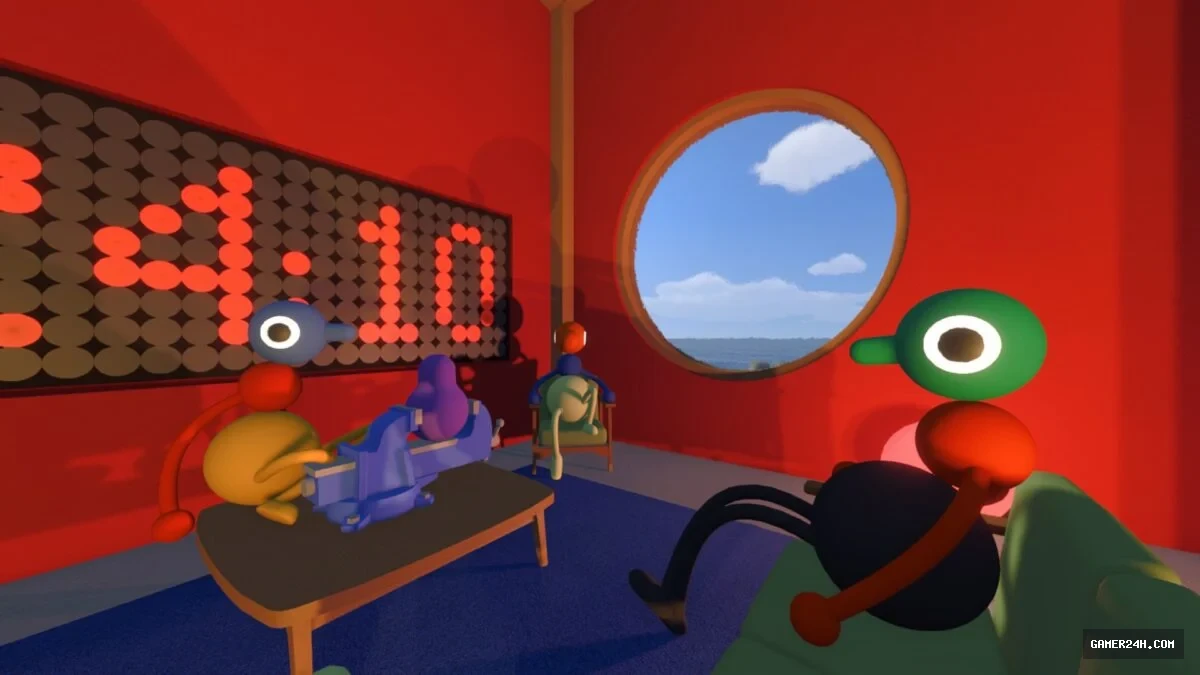
After a decade of navigating a highly remote sector that both covers and operates in isolation, I find myself weary of the endless Zoom calls that dominate my schedule. Most of my conversations with developers unfold in cramped video windows, plagued by subpar webcams, muffled audio, and a pervasive sense of detachment. While not all of my interviews suffer from this, there’s an undeniable allure to meeting someone face‑to‑face—an opportunity to forge a genuine connection and elicit richer, more candid responses.
Yet even in person, the format can feel awkward, largely because of the inherent oddity of sitting across from someone for an extended period while interrogating them. This has driven me to crave more relaxed, conversational approaches, especially when the goal isn’t to interrogate a CEO about their latest misstep but to engage in a friendly dialogue with an artist whose work I truly admire.
That’s why I’m thrilled that the creators of Big Walk welcomed me into their world for an interview. I spent nearly an hour and a half walking alongside Stuart Gillespie‑Cook, Jake Strasser, and Nico Disseldorp—three of House House’s five full‑time developers. We didn’t need elaborate setups; we simply sat, waved our miniature characters, and let the whimsical environment of the game dissolve the usual stiffness that plagues virtual Q&A sessions.

Whether the setting itself or the engaging personalities of Gillespie‑Cook, Strasser, and Disseldorp made the difference, I chose not to fragment this dialogue into smaller segments. The entire exchange felt worth preserving in full, so I’ve lightly edited the responses for brevity and clarity. One question about the “log out” sound was relocated from the very end of the interview to a spot that flows better for readers, but the overall pacing remains untouched.
Each of the trio identified simply as “developer” in official listings, yet they shared early insights into their specific responsibilities, giving us a glimpse into the creative forces behind the game.
Gillespie‑Cook, whose portfolio includes “Capital G Game Design” and animation oversight, has recently shifted focus to quality assurance. In the accompanying images, he appears in a sequence of red, blue, and yellow hues, underscoring his versatile contributions to the project.
Strasser, tasked with crafting the game’s environment, works in tandem with Kalonica Quigley—House House’s inaugural hire during its expansion from a quartet to a quintet between the launch of Untitled Goose Game and the forthcoming Big Walk. He admits to scattering rocks throughout the level, handling extensive technical art, and perhaps adding a touch of navigational challenge for players. In the visuals, he is represented by green, red, and brown figures.
Disseldorp, a dual‑role programmer and designer, collaborated with Gillespie‑Cook to craft numerous challenges for Big Walk. In the screenshots, he appears in blue, red, and gold tones, highlighting his integral role in shaping the game’s gameplay mechanics.
The last key contributor to House House who hasn’t been featured yet is Michael McMaster, the creative lead responsible for the game’s visual style.
A final heads‑up: this interview delves into every facet of the title, even the conclusion. Expect substantial spoilers—read on at your own risk.
We begin our journey in the tutorial chamber, stepping through a large portal into a region of the island that players typically explore later. Our destination is a train station perched just beyond the hill, where the carriage will ferry us to a spot I nickname the “Five‑Minute Room” for our interview segment. Gillespie‑Cook carries an orb‑shaped lantern from the tutorial area that can be toggled on and off to illuminate the space.
Having perused several prior conversations with the team, I learned that this project emerged during the pandemic and that you managed to craft a prototype of Big Walk in just one week. Could you describe that initial build? What did it feature, and what were the core activities you tested?
In a candid exchange, Disseldorp reflected on the game’s visual style, noting that the protagonist resembled a lively model that seemed to bounce with every movement.
Gillespie‑Cook added that early iterations offered players a choice between two distinct characters, each bringing its own flavor to the gameplay experience.
During a pivotal moment at the train station, the team paused on the platform to await the next departure, with Strasser consulting the timetable. The scene showcases a whimsical, duck‑like character composed of three spherical bodies, each adorned with limbs, a design that has been a hallmark of the title from its inception.
❓ Frequently Asked Questions (FAQ)
Where can I find more details about The Big Interview With The Developers Of Big Walk?
Further details and updates can be followed through official game channels and the source link provided in the article.
News Source: Kotaku























Join the conversation