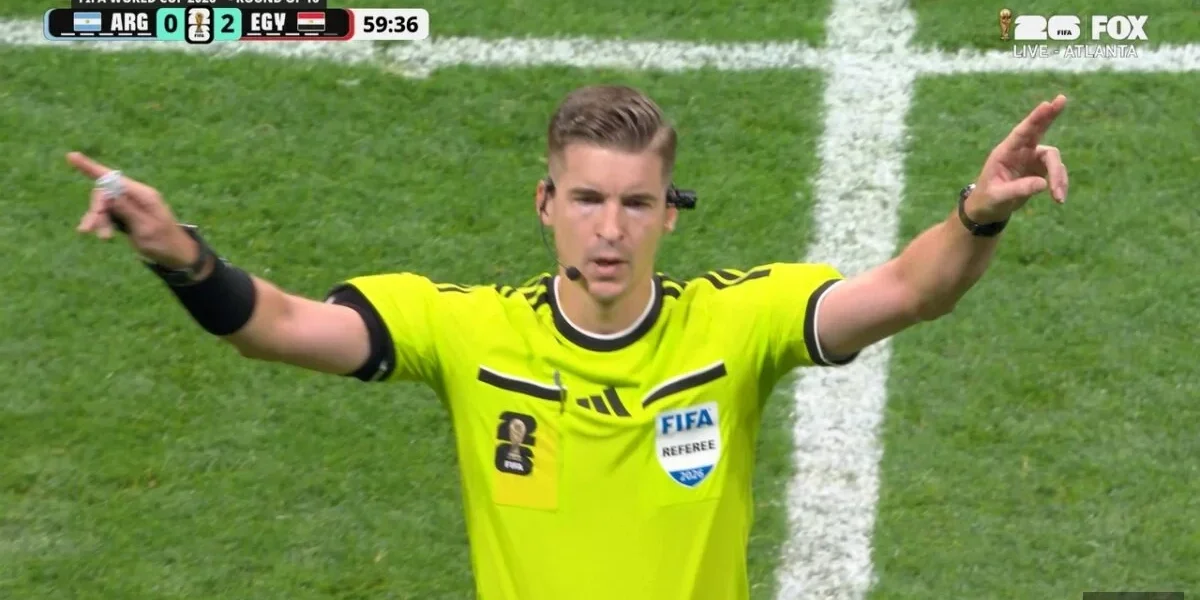
I have long championed VAR, yet I would never wish to witness a referee pause a match to scrutinize footage as if solving a crime. That sentiment will echo increasingly in the coming days. Critics have long argued that an overemphasis on rule‑by‑rule erodes the game’s soul, and the recent clash between Egypt and Argentina in Atlanta only underscores that claim.
With Messi’s side trailing, the Pharaohs launched a daring counter‑attack that sliced through several Argentine defenders, culminating in a breathtaking second goal. Mohamed Salah delivered a pinpoint pass to Mostafa Ziko, whose clinical finish captured the very drama that fans expect from a World Cup encounter.
However, the celebration was cut short by a contentious foul earlier in the play. VAR intervened, compelling French referee François Letexier to address a seemingly minor infringement that seemed worlds apart from the spectacle that had just unfolded. Egyptian midfielder Marwan Attia was shown a card for a light step on Lisandro Martínez’s foot before the build‑up, effectively erasing Egypt’s first second‑goal attempt against Argentina.
Egypt managed to find the net once more, but the match concluded 3‑2 in favor of Messi’s men after a dramatic Argentine rally. Rather than remedying an error, VAR cast a pall over the remainder of what could have been a flawless contest. The collective disdain from supporters has never been more palpable.
During the World Cup showdown, a VAR review of a foul 100 yards away erased Egypt’s second goal against Argentina—a decision that was broadcast live on Fox.
The Egyptian strike was disallowed for a distant infringement, yet a similar situation minutes later allowed Argentina to score, sparking accusations of uneven application and favoritism toward marquee players.
Had VAR examined the play more closely, Egypt’s 80‑yard, fluid run—characterized by precise passing—might have been awarded, potentially becoming one of the tournament’s most memorable goals.
In a tense encounter, Egypt’s goal was struck down by VAR, a decision that many argue stretches the technology beyond its intended purpose. The replay was triggered by a seemingly minor tackle far from the final phase of the counter‑attack, a situation that the system was never designed to scrutinize.
During the build‑up to Argentina’s third goal, a quick flick from Salah’s right foot was interrupted by a subtle trip. The referee did not flag the incident, and the video assistant referee never intervened, leaving fans and pundits baffled.
Ultimately, the disallowed goal clashed with the tournament’s established refereeing standards, raising questions about consistency and fairness across matches.
Egyptian player reacts with disbelief to officiating: “Unfair, it’s clear and obvious.”
I’ve gone beyond merely advocating for the removal of VAR; I’m now envisioning the arrest of every VAR official, consigning them to a medieval tower.
Critics point to uneven application—some fouls trigger VAR while others are ignored. Others argue the issue lies not in VAR itself but in how it was executed in this particular case. I’m not a paid pundit or professional athlete; my only stake is that I crave thrilling, unpredictable football, not the disappointment that follows a referee’s reversal of a spectacular play.
Unlike most professional sports that treat the clock as a precise ledger, football has deliberately abandoned the notion of perfectly timed contests in favor of preserving the game’s rhythm. The result is a messy, subjective spectacle that feels far more captivating than the last two minutes of an NFL or NBA match, where time stretches and commercial interludes dominate.
VAR has long posed a risk to that fluidity, and now it increasingly jeopardizes the unforgettable moments that ought to linger in fans’ memories for years.
❓ Frequently Asked Questions (FAQ)
What was the main controversy involving VAR in the Egypt vs Argentina World Cup 2026 match?
VAR intervened when French referee François Letexier reviewed a light step by Egyptian midfielder Marwan Attia on Lisandro Martínez’s foot. The review resulted in a yellow card and the annulment of Egypt’s first second‑goal attempt, sparking criticism that the decision was disproportionate to the play.
How did the VAR decision affect the flow and outcome of the match?
The VAR call disrupted Egypt’s momentum, erasing a goal that could have altered the scoreline. It also contributed to a perception that VAR overemphasizes rule‑by‑rule at the expense of the game's flow, with Argentina ultimately winning 3‑2 after a dramatic rally.
What are the broader implications for VAR usage in future tournaments?
The incident fuels debate over VAR’s influence on match flow and fan trust, potentially prompting governing bodies to revisit review protocols to better balance fairness, speed, and the spirit of the game.
News Source: Kotaku






Comments
Be the first to comment.