
About this game
Sokoban (倉庫番, Sōko-ban; lit. ‘warehouse keeper‘) is a puzzle video game created in 1981 by Hiroyuki Imabayashi. In Sokoban, the player pushes boxes in a warehouse to get them onto storage locations. The game is viewed from a top-down perspective. Boxes can only be pushed, never pulled, and only one box can be pushed at a time. The principal challenge is planning moves correctly to avoid causing a deadlock, a situation where a box or the player becomes permanently trapped, making the puzzle unsolvable.
Imabayashi’s company, Thinking Rabbit, released the first commercial version in Japan in 1982. Following that debut, Thinking Rabbit and its licensed partners developed a series of new titles until 2000. The game debuted internationally in 1988 with the U.S. release Soko-Ban. Falcon, a Japanese software company, acquired the Sokoban rights in 2001. Since then, new installments have been published either by Falcon under the Thinking Rabbit brand or by licensed partners.
Over its history, the Sokoban series has sold over 4.1 million copies worldwide, with more than 40 official games released across various platforms. Reviewers have highlighted the game’s simplicity, its addictive and challenging nature, and the depth of thought required.
Sokoban’s core mechanics have been replicated in numerous clones, and the game has inspired thousands of community-created levels. The Sokoban puzzle concept of pushing boxes to clear a path or move them to targets has also appeared in other video games. Furthermore, Sokoban has been studied in the fields of computational complexity and artificial intelligence.
Gameplay
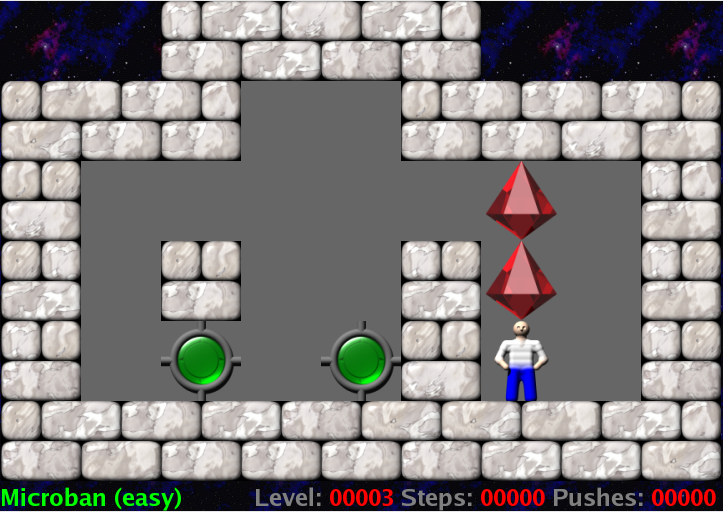
Sokoban takes place in a warehouse viewed from above and composed of walls and floor squares. A floor square may be empty, occupied by the player, or occupied by a box. Some floor squares are storage locations. The number of storage locations equals the number of boxes. The objective of the puzzle is to push all boxes onto storage locations.
The player can move one square at a time, either horizontally or vertically, onto an empty floor square. Boxes and walls block the player’s movement, but the player can walk up to a box and push it to an empty square directly beyond it. If a box is pushed against a wall or another box, it does not move. Pulling boxes is not possible.
Sokoban requires players to plan several moves ahead and consider all possible outcomes. Careless moves could leave a box permanently trapped against a wall or another box, stuck in a dead end, or permanently prevent access to boxes that still need to be moved. Any such situation creates a deadlock that makes the puzzle unsolvable, regardless of future moves, unless the player undoes enough steps.
History
In 1981, Hiroyuki Imabayashi created the Sokoban video game for the NEC PC-8001 as a hobby, featuring text-based graphics and five original levels. He had long been intrigued by the movement of a character pushing luggage in action game Aldebaran #1 (1980), in which luggage was used as an obstacle to block radiation; he implemented that movement as a puzzle using BASIC in spring, envisioning a warehouse setting where incorrect box placement could make further progress difficult or even impossible. In autumn, he completed the design of levels that proved challenging even for his friends. That winter, his wife’s parents owned a record store, and there was talk of setting up a small computer section in it; at the time, a salesman who happened to see the game suggested to Imabayashi that it had commercial potential.
Imabayashi then began preparing Sokoban for commercial release; using a NEC PC-8801 in the computer section, he decided on the design, enhanced the graphics, and expanded the level count to twenty. He founded Thinking Rabbit, and Sokoban was released as its first commercial title. The timeline of these events varies across sources: official records report a 1982 founding and a December 1982 release, while other sources give 1983 as the release year, with differing months: April, May, and June, as well as a June 1983 company debut or incorporation.
In August 1983, the Japanese magazine PC Magazine published Sokoban Extra Edition as a type-in program with ten new levels, developed by Thinking Rabbit at the magazine’s request. In 1984, Thinking Rabbit released Sokoban 2, which included fifty new levels and a puzzle editor. Throughout the 1980s, new titles appeared on various Japanese platforms, including home computers such as the MSX and PC-9801, and consoles like the Famicom, Sega SG-1000, Sega Mega Drive, and Game Boy. These releases were developed either by Thinking Rabbit or by other companies under license agreements. Spectrum HoloByte in California licensed Sokoban from Japan’s ASCII and adapted the MSX version for IBM PC, Apple II, and Commodore 64, adding features for the U.S. market; it was released as Soko-Ban in early 1988. Falcon, a Japanese software company, trademarked the game’s kanji name “倉庫番” in 1988. New titles in the official series were released in Japan throughout the 1990s for platforms including the Super Famicom, Windows, Macintosh, and PlayStation.
Around 2000, Thinking Rabbit became inactive but remained a legal entity. In 2001, Falcon acquired the copyrights for Sokoban, and trademarked the Latin-script name “Sokoban” in 2003 and the name “Thinking Rabbit” in 2011. From 2004 to 2007, Falcon developed several titles for Japanese mobile phones. Between 2015 and 2018, Falcon developed five Sokoban titles for Windows and the smartphone game Sokoban Touch (2016), publishing each under the Thinking Rabbit brand. Notably, Falcon bundled four of these Windows titles into the Sokoban Complete Pack (倉庫番 コンプリートパック) (2016) to commemorate the series’ 35th anniversary, which was published by Skill Information. Falcon developed three Sokoban titles for Japanese digital terrestrial television broadcasters in 2018. Unbalance developed and published an official title in 2021, The Sokoban, for the Nintendo Switch and PlayStation 4.
Games
Sokoban has a fixed set of gameplay rules; however, certain official releases have expanded the rules or introduced variations on the core mechanics. For example, the first commercial release of the game, Sokoban (倉庫番) (1982–1983), allows certain walls to be broken from level 11 onward. The PlayStation version of Ultimate Sokoban (究極の倉庫番) features a set of levels in which boxes must be stored in an arrangement that completes an electrical circuit. Sokoban Special of Tears (涙の倉庫番スペシャル) and Sokoban Legend: Land of Light and Darkness (倉庫番伝説 光と闇の国) each offer a game mode that follows standard Sokoban rules. Additionally, each offers another mode featuring action-oriented mechanics; in the former title, the mode allows the use of tools such as ropes, whereas in the latter title, the mode requires pushing enemies into holes and puppets onto magic circles. Super Sokoban (Super倉庫番) retains the classic gameplay and offers a versus mode where two players race to complete the same puzzle with random screen rotation. Conversely, Power Sokoban (Power倉庫番) is an action-puzzle game that deviates from the warehouse keeper mechanic; the player shoots orbs and fills holes with boulders.
More than 20 official Sokoban titles have been released across over 30 platforms. The following table lists titles in the Sokoban series; it is not exhaustive.
Reception
The first Sokoban title became a bestseller in Japan, with over 25,000 copies sold by July 1984. Junji Tanaka wrote that the first level of the PC-8801 version perplexed puzzle enthusiasts upon release. Titles for Japanese home computers, such as the NEC PC-9801 and Sharp X1, were said to have sold more than 100,000 copies combined. The MSX version alone, published by ASCII, sold over 400,000 copies and was considered a commercial success. The U.S. release, Soko-Ban, sold over 50,000 copies by mid-September 1988. By c. 1996, after 13 years of availability, the series had sold over one million copies; By c. 1998, after 15 years, total sales, including Ultimate Sokoban (究極の倉庫番) for PlayStation exceeded 1.4 million units across all platforms, including game consoles, word processors, and electronic organizers. By 2018, Chukyo Television Broadcasting reported that the series had sold over 4.1 million copies worldwide since its 1982 release.
The 1990 book PC Games 1980s Chronicles (パソコンゲーム80年代記) described Sokoban as “the king of PC puzzles”, listing Sokoban 1, Sokoban 2, and Sokoban Perfect. It included Sokoban 1 (1983) in its top 10 games of the 1980s, a list selected by 71 industry experts based on titles they considered most memorable rather than personal preference.
Reviewers often emphasized the game’s addictive nature. In 1983, Micomgames staff remarked that players would find it difficult to stop playing Sokoban. In 1988, Roy Wagner of Computer Gaming World suggested that anyone trying the US version, Soko-Ban, would likely remain absorbed for an extended period. The Computer Entertainer newsletter described the game as “fascinating” and “almost impossible to stop playing”. In its console reviews, Computer and Video Games magazine called Sokoban for Game Boy “an infuriatingly addictive little title” and said its appeal was “not far off” from Tetris. In 1990, Famicom Winning Guide (ファミコン必勝本) recognized Sokoban as a staple puzzle game, citing its difficulty, depth, and continued presence across multiple platforms.
Commentators often highlighted one or more aspects of the game: its simplicity, the depth of thought it required of players, or its challenging nature. Micomgames staff described the first Sokoban title as simple yet requiring deep thought comparable to playing Go or Shogi. The 1988 book Video Games: Complete Collection of TV Games (テレビゲーム: 電視遊戯大全) described Sokoban as a pure computer-based puzzle game with a logic akin to Japanese disentanglement puzzles. It stated that while the game appears simple, the boxes are “cleverly” arranged; some levels require moving other boxes for twenty moves just to shift a single target box one space. Henk Rogers of BPS wrote that Sokoban was “incredibly simple” yet “fun”, and Satoru Sato of ASCII wrote that, despite its visual simplicity, it was “outstandingly fun”.
A 1989 review in MSX Magazine cited Sokoban as the representative example of a purely logic-based puzzle, distinguishing it from puzzles that incorporate action elements such as enemies or time pressure, and those involving elements of chance. Family Computer Magazine‘s All Catalog supplement described Sokoban for Game Boy as great due to the simplicity of its gameplay, and Computer and Video Games magazine staff described it as one of the Game Boy’s “simple but effective puzzle games”.
Reviewers for the German magazine Happy Computer praised Soko-Ban as a brilliant logic puzzle that kept players thinking without pressure and recommended that players carefully observe a level before moving a box, and in Computer Gaming World, Wagner summarized it as “very playable and mentally challenging”. In Game Player’s magazine, Tom R. Halfhill reviewed Shove It! for the Sega Genesis, noting it was challenging and would require players to plan their moves carefully, and reviewing Boxxle for Game Boy, he stated that it required careful planning or plenty of trial and error (usually both). He later commented on Boxyboy for the TurboGrafx-16 that while the initial rooms were not difficult, players would eventually encounter one that “seems impossible”.
The series faced occasional criticism for a lack of variety. Tom R. Halfhill wrote that the puzzles in Shove It! were “essentially the same”, and noted that in Boxxle, variation was limited to crate count, placement, and room shape. Reviewing Boxyboy, he described it as “virtually identical” to the others, concluding that all three games required players to enjoy solving the same type of puzzle repeatedly.
Legacy
Sokoban was regarded in 1990 as a pioneer in puzzle games. It sparked a “puzzle game boom” in the Japanese personal computer market starting in 1983 and continuing for a time. In the decades since, the series has attracted many enthusiasts in Japan and overseas. The game’s core mechanics have been replicated in numerous clones across a wide variety of platforms, including the web. The Sokoban community has created thousands of levels distinct from the official releases, freely available online and ranging in difficulty.
Puzzles resembling Sokoban, involving pushing boxes or similar obstacles to the correct targets, have been present in gaming, particularly in 1980s and 1990s action-adventure games with grid-based movement. The Legend of Zelda series and titles such as Adventures of Lolo (1989) and LIT (2009) incorporate Sokoban-style elements into their gameplay; for example, The Legend of Zelda: A Link to the Past (1991) has a puzzle in which blocks must be pushed to clear a path to a treasure chest. Resident Evil 2 (1998) includes a puzzle similar to Sokoban in which two statues must be pushed onto corresponding marked floor areas, with the correct matching inferred. Additionally, Sokoban-like games such as Sokomania 2 (2014) introduce new mechanics, including switches and conveyor belts.
Research
In computational complexity theory, deciding whether any given Sokoban puzzle is solvable is a problem known to be NP-hard and PSPACE-complete. In artificial intelligence research, Sokoban serves as an experimental testbed. As a problem domain, it exhibits a variable branching factor, and solution lengths significantly longer than in other domains.
In the standard XSokoban test suite, consisting of ninety problems, box counts range from 6 to 34, and with up to four potential pushes per box, the branching factor ranges from 0 to 136. Reported solution lengths for this suite range from 97 to 674 pushes. These lengths far exceed the maximum solution lengths of the 15-puzzle and Rubik’s Cube, which require at most 80 and 20 moves respectively. The search space for 20×20 Sokoban mazes is estimated at 1098.
The first documented automated solver, Rolling Stone, was developed at the University of Alberta. It employed a conventional search algorithm enhanced with domain-specific techniques such as deadlock detection. A later solver, Festival, introduced the FESS search algorithm and became the first automatic system to solve the standard test suite, which had eluded a complete solution for more than twenty years. Despite these advances, some puzzles that humans can solve are beyond the reach of state-of-the-art solvers. Humans solve Sokoban puzzles by breaking them down into subproblems, recognizing patterns and exceptions, and drawing on learning from prior puzzles.
See also
- Logic puzzle
- Sliding puzzle
- Transport puzzle
- Motion planning
Notes
References
External links
- Official Sokoban site (in Japanese)
- The University of Alberta Sokoban page
Gallery
Join the conversation