

Avatar: Seven Havens is shaping up to be a far more mystery-driven entry than its predecessors, with the season premiere already seeding clues about the cataclysm that supposedly destroyed most of the world—and why Avatar Korra may be remembered as its villain.
The first episode, “On the Horizon,” premiered Oct. 9, and details in it suggest the writers have planted hints about what’s driving the story.
Symbols hiding in plain sight
In the premiere, Ellora—the Haven where this season is set—celebrates a festival marking its founding after the cataclysm. Actors performing a play recounting that history wear a rainbow of colors, matching charts of the seven chakras. An overhead shot of Ellora shows the Haven of Wind and Sand built from red-hued rocks, the color tied to the root chakra—and “The Root Chakra” is also the title of the season finale.

The franchise draws on Buddhist mysticism around reincarnation, with Aang, Korra, and the new Avatars Pavi (Saheli Khan) and Nisha (Aishu Devan) all part of that cycle. Co-creators Michael Dante DiMartino and Bryan Konietzko previously explored chakras in “The Guru,” a season 2 episode of Avatar: The Last Airbender, when Guru Pathik trained Aang to clear blockages from his seven chakras to gain control over the Avatar State.
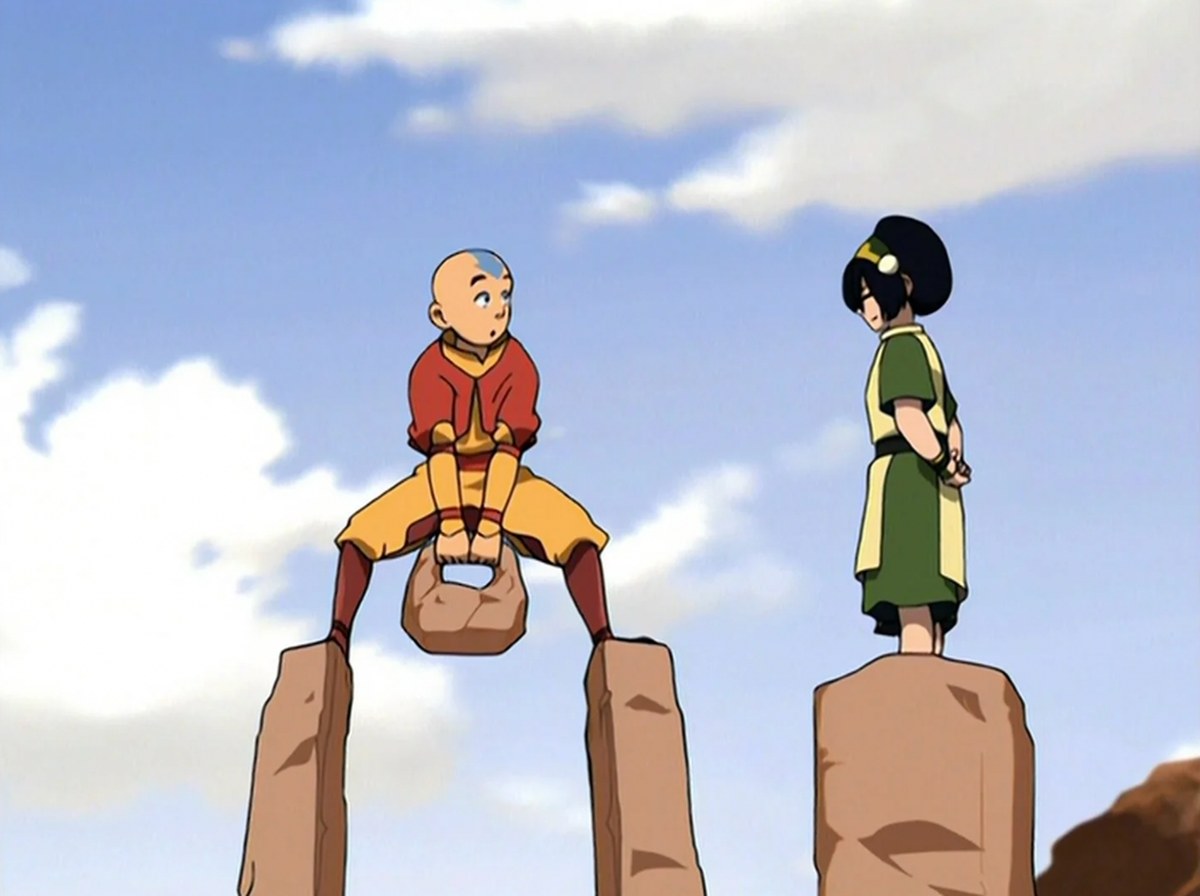
The root, or earth, chakra is the first Aang learns to open. According to Pathik, it sits at the base of the spine and concerns survival—it’s blocked by fear. Ellora’s motto is “For the survival of Ellora,” and its people stay vigilant against new threats. Fewer benders are being born each year, and all are conscripted into the Bending Brigade to protect the Haven; in the Seven Havens trailer, that imbalance appears to manifest as angry red energy spreading across Ellora.
Each season of Avatar: The Last Airbender was named for the element Aang focused on mastering, while The Legend of Korra broke that pattern with seasons subtitled Spirits, Change, and Balance. Season 1 of Avatar: Seven Havens is Book 1: Survival, suggesting Pavi and Nisha must figure out how to bring Ellora back into balance—fitting since both are earthbenders.
Is Korra really the villain?
Most people in Ellora view Korra as a monster and fear the return of the Avatar. Historically, the Avatar is described as a bridge between the mortal and spirit worlds whose power stems from an ancient bond with the primordial spirit Raava. Rather than close the two portals to the spirit world at the North and South Poles in the material plane, Korra left them open after Harmonic Convergence at the end of season 2. That led people around the world to become airbenders, restoring a natural balance disrupted when the Fire Nation killed almost all the Air Nomads at the start of the Hundred Year War.
If fewer benders are born each year during Seven Havens, that may signal the connection to the spirit world has grown too weak. In the final season of Korra, the Avatar stopped earthbender general Kuvira from using spirit vines to power a weapon of mass destruction, and it’s possible someone tried again in the 225 years since—prompting Korra to intervene. Similar to how she created a third portal when redirecting the energy from Kuvira’s weapon, such a confrontation involving spirit energy could have accidentally triggered the cataclysm.
Korra shared a unique relationship with Raava—one of perhaps the strongest since the original Avatar Wan. The spirit was pulled from her and seemingly destroyed, but Korra found Raava’s spark inside its cosmic opposite, Vaatu. After reuniting with Raava and regaining her powers, she remained cut off from the memories of every previous Avatar—a phenomenon that may have carried other side effects.
For the first time ever, two Avatars are alive simultaneously. It could be that one twin carries the power of Raava and the other the energy of Vaatu, setting up a classic evil-twin arc—or that the twin Avatars were the universe’s attempt to achieve balance. Without the wisdom of past generations to draw on, Pavi and Nisha may need each other to heal a broken world—and perhaps the spirit of Korra herself.






















Join the conversation