

When Rockstar Games debuted an extended look at Grand Theft Auto 6 on Netflix, the reveal played like a one-off episode of a crime thriller. The gameplay showcase delivered compelling characters, building tension, slick action and cinematic camera direction that felt closer to a film than a typical game launch.
The studio has long drawn inspiration from cinema. Its breakout title was a love letter to Goodfellas, while its most recent open-world release reads as the greatest Western never filmed. But that cinematic ambition truly took shape in 2004 with Grand Theft Auto: San Andreas.
The game’s predecessors, GTA 3 and Vice City, were packed with references to classic crime cinema and voiced by genuine Hollywood talent. For the ’90s-set Californian epic that followed, Rockstar wanted players inside the movies rather than merely watching them from outside.

The result was missions designed to feel pulled straight from the silver screen, trading some of the open world’s freedom for a tighter, more authored experience. It remains true today that the vast majority of Grand Theft Auto’s missions take place outdoors in its city sandbox, where players are free to roam every road, alley and freeway.
But indoors offers something the open world cannot: control, direction and oversight. Rooms and corridors provide perfect containers for scenes untouched by the continual simulation of metropolitan life. As Carl “CJ” Johnson, players stealthily murder their way through a music mogul’s mansion, steal rifles from a sleeping weapons hoarder and rescue someone from a burning condo.

If only crime were that simple. As soon as Sweet enters the building, police arrive in force. Ryder and Smoke flee — “It’s every motherfer for himself!” — but CJ heads into the motel to rescue his brother.
Confined by the complex’s small rooms and enclosed hallways, San Andreas transforms from an open-world playground into a third-person shooter. The motel’s layout functions like a level in a linear video game, its corridors guiding players through pre-determined moments and combat encounters.
The tense atmosphere is apparent immediately: a fellow Grove Street member is shot to pieces and sent flailing over the hall’s upper balcony, another lies dead in the stairwell, and a woman runs for her life. As players head up to the main floor, they face an unexpected jump scare as a SWAT officer rolls through the door and opens fire.
The motel’s corridors are lined with invisible trigger points, each one kickstarting a unique scenario that turns a generic shootout into a cinematic vision of a building under siege. A civilian runs across your line of fire, a door blows off its hinges, gangsters light up troopers crashing through a skylight and an officer hangs from an air vent to surprise you.
CJ can combat roll just as well as any armored cop, using it to shift in and out of cover. There is plenty of protection available — not just 90-degree corridor corners, but laundry baskets, sofas and upturned tables. This is a cover shooter map built two years before Gears of War made chest-high walls a trend.

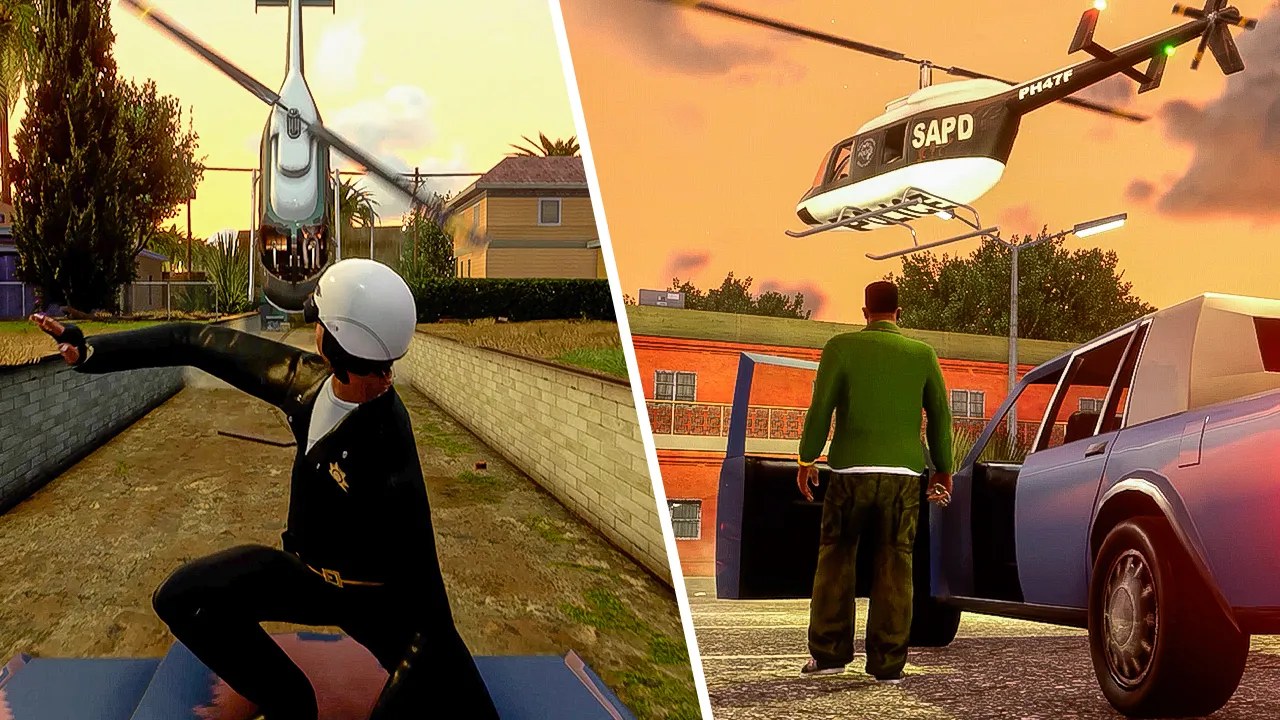
After creating a small mountain of corpses, CJ finally reunites with Sweet and the pair make their escape. A rooftop showdown with a police helicopter would normally act as the finale, but this mission has more in store. Sending the aircraft to its doom is just the halfway point.
With every cop in the city on their tail, a lifeline appears in Smoke and Ryder, who suddenly pull up in getaway wheels. The mission’s second half shifts from third-person shooter to an on-rails turret sequence, with CJ inside a car whose driver follows Rockstar’s script to the letter.
The journey becomes a rollercoaster ride through Los Santos. Police cruisers give chase, pumping magazine after magazine into the car’s bodywork. What begins as simple “blast what’s behind you” play becomes a 360-degree shooting gallery demanding constant assessment of all angles.
The cops are on rails just like the players, making CJ the sole dynamic component in this regimented excitement machine. Almost every stunt has been planned — the train will always ram into one of the initial interceptors, and pursuing vehicles have been primed to detonate with just a few bullets.
If you’re going to make an interactive action movie for the PS2, you nod to the greats while doing it. A mid-chase cutscene introduces motorcycle-riding cops in a shot lifted directly from the 1997 Nick Cage classic Con Air. As more bikers join the chase, they leap onto your car just like the T-1000 did in Terminator 2.
The mission’s grand finale sees Smoke drive into a narrow alley where a helicopter swoops low. The officer is chewed up in what is surely one of the goriest moments in any GTA before the getaway vehicle crashes through a Sprunk billboard and smashes into a fuel truck, triggering a mandatory giant explosion.
Reuniting the Families frequently appears in conversations about the best San Andreas missions. But it, and the design of San Andreas as a whole, marks the starting point for one of Rockstar’s greatest challenges: how to balance the freeform simulation of a living open world with cinematic ambitions.
By the time of Red Dead Redemption 2, the gulf between these two styles became completely clear. While exploring its sandbox frontier, players are given complete freedom to play their way, but when on a mission that freedom is almost completely taken away so Rockstar can put you in the movie and tell the story it wants.
The executive editor of features at IGN, Matt Purslow, wrote about how San Andreas did amazing things with its city sandbox while simultaneously creating linear missions that could be fantastic stealth infiltrations, home invasions or explosive getaways across Los Santos. Those moments, he noted, took players into CJ’s life and made him feel like a real person with a story to tell.
“That time he saved Sweet from the cops? Man, it was absolute cinema.”
Matt Purslow, IGN Executive Editor of Features























Join the conversation