“Fighting is everything.” This isn’s just a catchy phrase; it’s Miyamoto Musashi’s guiding principle, and it perfectly encapsulates Capcom’s Onimusha: Way of the Sword. After two decades in the shadows, this samurai saga returns with a modern makeover, ditching fixed cameras for a semi-open world where combat reigns supreme.
A Legend Reborn
The fifth mainline entry in the Onimusha series retains its core identity, blending Japanese history and mythology with Capcom’s signature creature design. While the semi-open world structure is a minor stumble, Way of the Sword marks an excellent return for the long-dormant franchise, evolving its swordplay with captivating aplomb.
Musashi, inspired by real-life samurai Miyamoto Musashi, embodies both legendary prowess and roguish charm. Yoshimasa Hosoya’s voice performance, coupled with stunning facial capture animation, brings this character to life. The resemblance to the late Toshiro Mifune adds another layer of authenticity.
In Way of the Sword, Musashi arrives in Edo-era Kyoto seeking to prove himself. After defeating a clan leader, he’s attacked by demonic Genma and granted an Oni gauntlet. Unlike previous protagonists, Musashi wants to rid himself of this power, believing it compromises his true skill.
This internal conflict is one of the game’s most compelling aspects. Musashi adheres to his own code, even when allies rely on him. This human touch makes him relatable, despite his legendary status.
A World of Conflict

The game’s narrative is fairly straightforward, with comically evil villains adding entertainment value to the many battles. While not as corny as Resident Evil, there are some killer lines, but it’s not something you’ll remember for long outside of some of its performances. There are some pacing issues early on, too. Control is frequently wrestled away from you during the first couple of hours as you’re dragged from one exposition-heavy cutscene to the next. It’s not a great first impression but does eventually relent, settling into a decent groove with conflict at the forefront.
At its heart, any action game lives and dies on how good its combat feels, and in this regard, Way of the Sword positively thrives. It’s not a combo-laden experience like Devil May Cry or Ninja Gaiden, nor is it as punishing and methodical as the many souls-likes that have emerged since Onimusha last appeared. Instead, it falls somewhere in the middle.
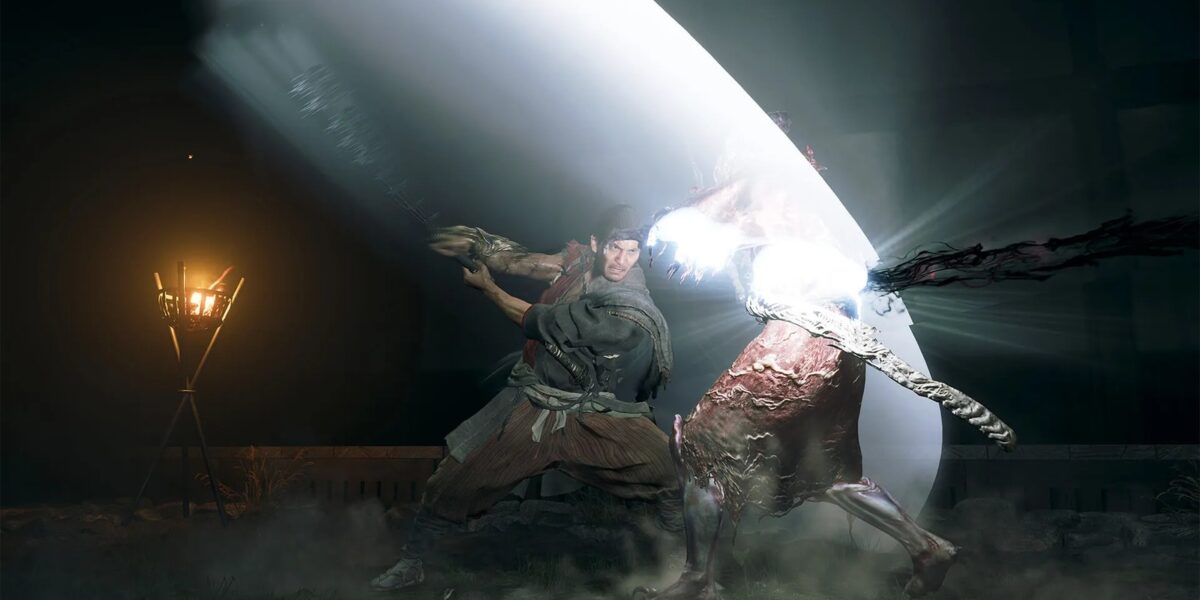
You’ve got your standard light and heavy attacks, and transitioning between them to create various combos is seamless and feels suitably hefty. Musashi moves like a regular person–you can clearly see him swinging his katana like he has to put some muscle behind each strike–and this makes his swordplay very deliberate, emphasizing defense as the ultimate key to unlocking your full offensive arsenal.
You can block and parry almost any attack, with the latter opening up your opponents for swift retribution. You can also deflect attacks, which doesn’t create the same opportunity to counter but does take a decent chunk out of the enemy’s stamina meter. Once this is fully depleted, your foes enter an exhausted state where you’re able to deal significant damage–even slowing down time so you can select a specific body part to target during boss fights, such as a pesky tail that you can slice off to prevent certain attacks, or a limb that grants a confluence of souls for you to absorb.
You can dodge attacks, too, performing a stylish Reflex Dodge if you evade an unarmed enemy strike at just the right time. This is also the only way to reverse grab attacks, just as deflecting is the only way to counter unavoidable attacks. Way of the Sword’s combat is built around reading and reacting to the enemy’s various tells and then responding in devastating fashion. Button mashing is quickly punished, but once you’ve got a handle on its slower cadence, there are stylish thrills to be had in each and every battle.
If you’re feeling particularly brave, you can even utilize an Onimusha mainstay: the Issen attack. By striking just before an enemy attack lands, you’ll hit back with a deadly counter that instantly kills most regular enemies. The timing on this is much more precise than either parries, deflects, or Reflex Dodges, but the reward is much greater, especially once you’ve unlocked the ability to chain multiple Issen attacks in a row by rhythmically timing your button presses.
All of this feels incredibly satisfying in action, mixing nuanced depth with some of the best animation work in the genre. As someone who loves parries, Way of the Sword executes them like no other game I can recall. Rather than enemy attacks simply bouncing off Musashi’s katana, you lock weapons with a palpable heft, sending a barrage of sparks flying as they slide against each other before Musashi uses the enemy’s momentum to reposition them. It’s very much coded in classic samurai cinema, producing these dramatic sword clashes within the flow of combat.
Chaining together parries and deflects also builds a meter that activates Blazing State, coating Musashi’s katana in a blue flame that boosts your attack power and causes enemies to drop more souls when they die, such as yellow ones that replenish your health and blue ones that power your Oni Armaments. While the younger Musashi hasn’t yet created the Niten Ichi-ryu style of dual-wielding he’s famous for, his familiarity with multiple weapon types is well realized.
You gradually gain access to more Oni Armaments throughout the course of the game, letting you unleash temporary attacks with a varied pool of weapons. The Two Celestials , for instance, are a pair of blades that deal straight damage and extract yellow souls from the Genma, while the Wind-Whipper is a naginata that conjures whirlwinds to wipe out groups of enemies. Elsewhere, the Earth-Shaker hammers excel at inflicting significant stamina damage, and the Firebird Flute summons flaming birds when played, allowing you to launch them at enemies.
Choosing which Oni Armament to utilize for each situation becomes a key part of your approach to combat, although Musashi isn’s opposed to using unconventional means either. Tables can be flipped and deployed as large shields before being booted at enemies, food carts can be rammed into startled mobs, and you can parry Genma into standing torches, setting them on fire in the process.
Unfortunately, the sheer excellence of Way of the Sword’s combat is also the only thing keeping the game afloat when mired in its disappointing structure. Eastern Kyoto is established early as a semi-open-world hub, and while there are traditional levels, a large chunk of the game takes place within this open area. You’ll find side quests, collectibles, and upgrade materials, and while the map starts small and gradually opens up, it’s never particularly large. This works in the game’s favor, however, as the side quests therein are dull and uninspired.
A subset of optional missions called “Mysteries of Kyoto” has you helping citizens and relaying their stories to Murasaki Shikibu, the historical author of The Tale of Genji. These yarns are rooted in Japanese mythology, covering the likes of the Three Worms, the Faceless, and the Night Parade, but calling them mysteries is a glaring misnomer.
The culprit is always just another Genma you need to kill, and the same rings true in the rest of the game’s side quests as well. Someone asks for your help, so you head to a location and dispatch every enemy you can find. The worst of these is a series of archery quests where you return to previous locations to shoot down specific Genma using your bow. You’re rewarded with upgrade materials for completing these quests, so skipping them puts you at a huge disadvantage. The one saving grace is that there aren’t many side quests, and engaging in more combat isn’s inherently bad, but Way of the Sword’s optional excursions are still incredibly formulaic and make the entire hub feel superfluous.
The game’s traditional levels are much better, often evoking a specific mood or atmosphere. One sees you venture into an underground lab where a particularly twisted Genma is conducting experiments, fusing humans, animals, and her own kind together to create unsettling monstrosities. Here, Capcom leans into its horror tendencies, casting shadows across the lab’s shoji to highlight the mutations happening just out of sight, while kimonos hang from the rafters as evidence of the people who were kidnapped and brought to this malevolent place. It’s an eerie and atmospheric location to explore.

Elsewhere, you’ll make the gradual trek up the slopes of Mount Oe during twilight, fighting through smaller forts and dodging giant, rolling logs to reach the palatial castle nestled at the top. If the whole game was just more levels like these, I would have very few complaints. Way of the Sword’s combat is exceptional, and it features some of the best boss fights I’ve ever seen, but there’s always this nagging feeling that it could’ve been even better.
It feels odd to be disappointed by a game with so many moments I absolutely adore, but that’s what happens when the potential to be greater is so obvious. The uninspired semi-open-world is a misstep that doesn’t justify its existence, yet Way of the Sword is still a fantastic and welcome return for the series, led by outstanding combat that firmly places it in the upper echelon of modern action games.
Review Verdict
Great
The Good
Miyamoto Musashi is an entertaining protagonist in many regards
Combat is incredibly satisfying and rewarding, full of hard-hitting, deliberate, and layered battles
Excellent animations bring its swordplay to life
Phenomenal boss fights
The Bad
The story suffers from some pacing issues early on
Side quests are dull and formulaic, failing to justify the semi-open-world
X profile of Richard Wakeling @richardwakeling



Comments
Be the first to comment.