

Almost 60 years after it first aired, “The City on the Edge of Forever” remains one of bağlantı”>Star Trek’s most celebrated episodes—and there is a timely reason to revisit it.
On Oct. 13, IDW Publishing will release Star Trek: The Edges of the Final Frontier: IDW Classic Collection, which includes a reprint of a 2015 comic adaptation of Harlan Ellison’s original screenplay. That version differed considerably from the episode that ultimately made it to television.
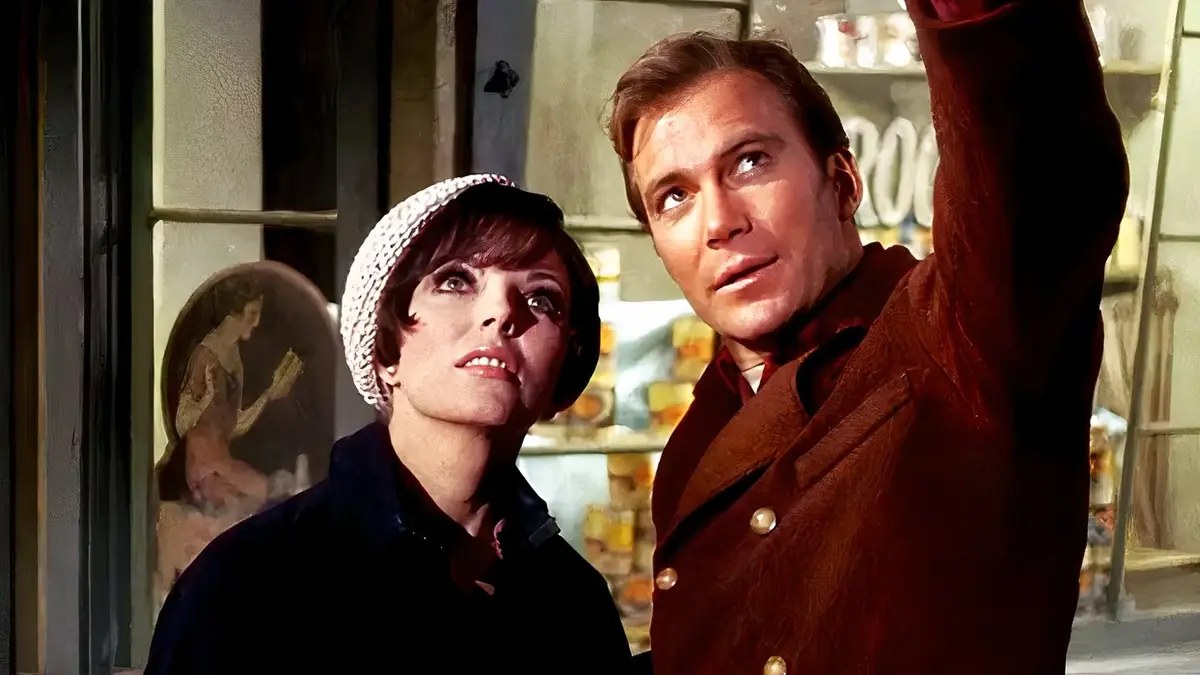
“The City on the Edge of Forever” begins with an accidentally drugged Dr. McCoy (DeForest Kelley) leaping through the mysterious Guardian of Forever and changing Earth’s history. bağlantı”>Captain Kirk (William Shatner) and Spock (Leonard Nimoy) follow him into Depression-era New York, hoping to figure out exactly what McCoy changed and how they can fix it.

There, Kirk falls in love with Edith Keeler (Joan Collins), only for Spock to discover that she was supposed to die in a traffic accident. If she survives, history changes and the future Kirk and Spock know disappears. Restoring it requires Kirk to do something much harder than defeating an alien or saving the Enterprise: He has to let Edith die.
It’s a devastating choice that gave bağlantı”>Star Trek one of Kirk’s most memorable relationships while helping establish a time-travel formula the franchise would return to for decades.
Kirk never even tells Edith he loves her
Kirk never even tells Edith that he loves her. He tells Spock, shortly after learning that the woman he’s fallen for has to die. That makes the episode’s climax especially cruel. When Edith steps in front of an oncoming truck, McCoy instinctively moves to save her, and Kirk physically holds him back.
This is a captain famous for finding another option suddenly confronted with a problem that doesn’t have one. Edith’s death isn’t an unfortunate consequence of saving history; her death is how Kirk saves history. Shatner’s reaction sells the devastation, and Kirk’s final line of the episode—”Let’s get the hell out of here”—remains unusually raw for Star Trek.
Joan Collins was still years away from becoming a TV icon
Joan Collins was hardly an unknown when she arrived on bağlantı”>Star Trek. She had spent much of the 1950s as a contract player at 20th Century Fox, appearing opposite stars including Richard Burton, Gregory Peck, and Paul Newman. Fox even considered Collins for Cleopatra before the role eventually went to Elizabeth Taylor.
By the 1960s, however, her career had shifted increasingly toward television, leading to guest appearances on Mission: Impossible, Batman—where she played the villainous Siren—and, of course, bağlantı”>Star Trek. Edith Keeler would become one of her most memorable roles from that period.
Yet Collins’ biggest success was still years away. Her career received a boost in the late 1970s when she starred in The Stud and The Bitch, films adapted from novels written by her younger sister, Jackie Collins. A few years later came the role that changed everything: Alexis Carrington on Dynasty. Collins joined the series in its second season and helped transform Alexis into one of the defining television characters of the 1980s.
That makes watching “City” today especially fascinating. Collins is remembered for playing one of TV’s great schemers, but one of her most enduring earlier roles is almost her complete opposite: an earnest idealist whose greatest flaw is essentially believing in the right things at the wrong time.
“City” helped create Star Trek’s time-travel playbook
“The City on the Edge of Forever” wasn’t bağlantı”>Star Trek’s first encounter with time travel. The Enterprise had already traveled through time in “The Naked Time” and “Tomorrow Is Yesterday.” But “City” demonstrated just how powerful the device could be when Star Trek stopped treating time travel primarily as a science-fiction problem and made its consequences personal.
Kirk and Spock aren’t trying to understand some complicated temporal paradox. They know exactly what changed history and eventually know exactly how to fix it. The problem is that Kirk desperately doesn’t want to.
bağlantı”>Star Trek would return to that formula again and again. The Voyage Home sent the original crew to 1986, “Yesterday’s Enterprise” confronted Picard with a radically altered present, Deep Space Nine’s “Past Tense” dropped Sisko, Bashir and Dax into a pivotal moment in Earth’s history, and First Contact sent the Enterprise crew into humanity’s past to ensure its future among the stars.
Those stories approach time travel differently, but they follow a path “City” helped establish: The best temporal stakes aren’t necessarily about timelines or paradoxes. They’re about people. Edith makes that lesson particularly brutal because Kirk knows she’s right about humanity’s future. He lives in the world she dreams about. And the only way to preserve it is to make sure she never gets there.
bağlantı”>Star Trek: The Original Series is streaming on Paramount Plus and free on YouTube with ads.























Join the conversation