During 2013‑2014, independent creator Matthew Brown emerged from obscurity to launch a trilogy of distinct puzzle titles, collectively known as Hexcells. The three installments were released in rapid succession, each surpassing its predecessor in polish and depth. The inaugural game set a high bar, and even after more than ten years, no other title has matched its exceptional quality, engaging difficulty, or sonic pleasure.
I have always relished logic puzzles. From Mario Picross to the hours I spent watching Cracking the Cryptic, these methodical games demand nothing beyond patience and analytical thinking—no special math or language skills. While Sudoku never captivates me, titles like Picross, Slitherlink, Mosaic, Campixu, and Kakuro feel like a rush. Hexcells, blending Picross, Mosaic, and Minesweeper, delivers a fresh, endlessly rewarding experience.
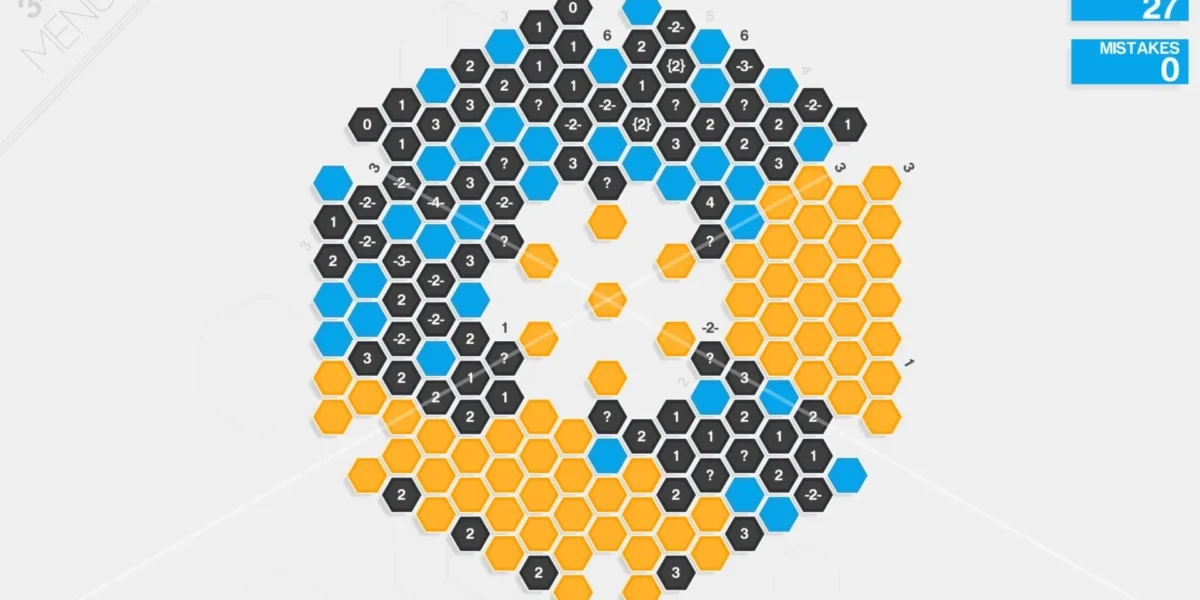
Describing the mechanics is tricky, so bear with me. A Hexcells puzzle starts with a grid of mostly orange hexagons, punctuated by a few cells that carry numbers. A cell marked “3” indicates that three of its neighboring cells must be colored blue, meaning three must be removed. A “0” instantly tells you to discard all six adjacent cells, revealing new numbers—or a “?” when the value is irrelevant—propelling you forward. Determining which cells are blue is the core challenge, requiring you to juggle multiple data sets and understand their intersections.
As you progress, additional constraints appear: Picross‑style numbers along the top or at the diagonal ends of rows reveal how many tiles in that line should be blue; special cells highlight the 18 surrounding cells and indicate how many of those are blue; and bracketed numbers impose further restrictions. A “[2]” means two cells are blue but must not touch, whereas a “{2}” requires them to be adjacent.
Hexcells is a uniquely computer‑only puzzle that thrives on the way new clues emerge as you highlight or erase its hexagonal tiles. Each click produces a pleasant, musical ping that blends seamlessly into the ambient soundtrack, while the crisp, minimalist graphics reward you with a satisfying polygonal burst whenever a cell is cleared. The soothing soundtrack and thoughtful design make the game feel almost therapeutic, even as you wrestle with that elusive clue that keeps you pulling at your hair.
When it first launched in September 2013, Hexcells was a revelation—though it only reached Steam a few weeks later, which explains the slight date discrepancy. The original title was praised for its elegant mechanics, though some players felt it was a touch too easy. That perception was short‑lived, however, as the sequel arrived just three months later.
Brown’s creative output continued with titles such as SquareCells and CrossCells, both of which deserve a play. He later ventured into more abstract territory with Cypher and Alchemia, puzzles that proved so demanding they left many fans—myself included—puzzled. After a six‑year silence, he returned in 2024 with Epigraph, a new challenge centered on decoding an entirely fresh language.
While other games like Tametsi have helped fill the void, none have matched the pure, unadulterated perfection of Hexcells. I still yearn for the day when Brown will surprise us with another 2D logic masterpiece that reshapes the mind in a brand‑new way.
For gamers looking for a brain‑teasing binge, the entire Hexcells trilogy is now available for a mere $9—a price that feels almost too good to be true. This unbeatable bundle makes the three puzzle‑adventures more accessible than ever, and I can’t recommend it enough. I’ll keep an eye on future deals, but for now, this is the best value in the genre.
❓ Frequently Asked Questions (FAQ)
Why has Hexcells remained the best logic puzzle game even after 12 years?
Hexcells has stayed at the top of the genre because of its perfectly balanced blend of elegant mechanics, deep strategic depth, and high-quality audio design. Each installment in the trilogy refined the core puzzle concepts—hexagonal grids, number clues, and color-based removal—while adding new layers of complexity without increasing the learning curve. The result is a game that feels fresh every time you play, offers a satisfying challenge for both casual and hardcore puzzle enthusiasts, and provides a polished, immersive experience that few other titles can match.
What sets Hexcells apart from other logic puzzle games like Picross, Minesweeper, or Kakuro?
Hexcells distinguishes itself by combining the best elements of several classic puzzle genres into a single, cohesive experience. It uses a hexagonal grid instead of a square one, which changes adjacency rules and introduces new spatial reasoning challenges. The numbered clues dictate how many neighboring hexes must be colored, merging Picross-style counting with Minesweeper-like removal mechanics. Additionally, the game’s audio cues and visual polish create a more engaging atmosphere than many other logic puzzles, making each solution feel rewarding and satisfying.
How did the release of the Hexcells trilogy influence subsequent indie puzzle designers?
The Hexcells trilogy set a new benchmark for indie puzzle games by demonstrating that a small, focused team could deliver a series of titles that are both mechanically sophisticated and commercially successful. Its emphasis on elegant, minimalistic design and immersive audio inspired other developers to prioritize clear mechanics, polished presentation, and thoughtful difficulty curves. As a result, many newer puzzle games now feature streamlined interfaces, rich soundscapes, and a focus on deep, low-barrier challenges that keep players engaged over long periods.
News Source: Kotaku



Comments
Be the first to comment.