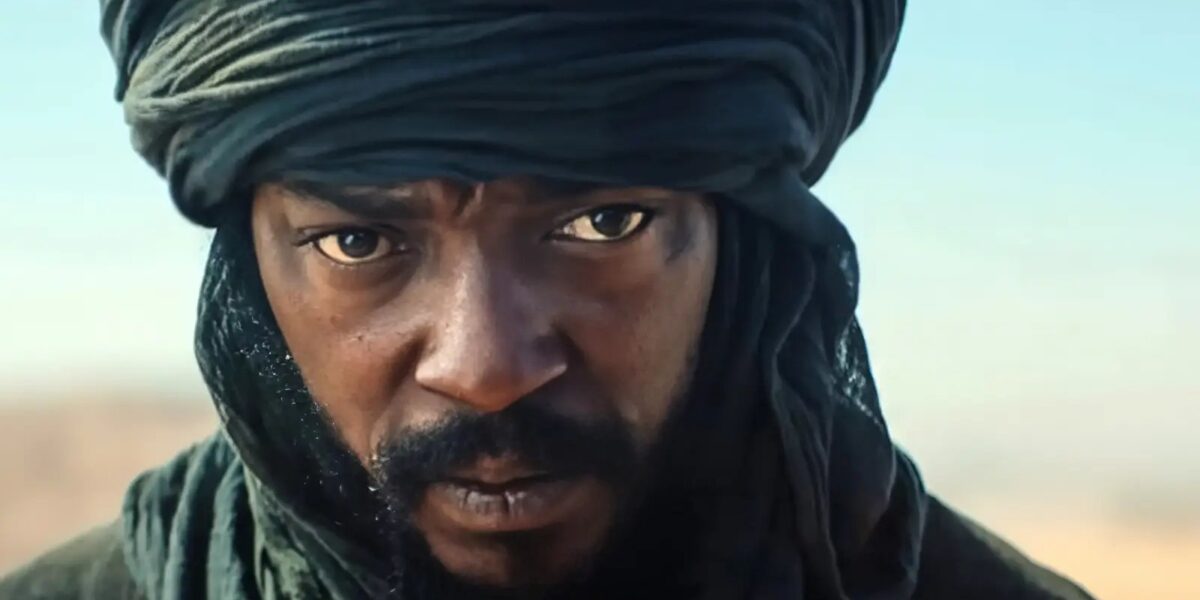
Remember “Desert Warrior,” the historical epic that crashed and burned at the box office, earning a measly $1 million worldwide? Well, get ready for a second chance! This ambitious but ultimately flawed film is now available to stream on Hulu, offering viewers a chance to decide if it’s a hidden gem or a truly spectacular failure. Let’s dive in.
A Tale of Princesses, Emperors, and Epic Battles
Set in 7th-century Arabia, “Desert Warrior” tells the story of Princess Hind (Aiysha Hart), who refuses to become a concubine for Emperor Kisra (Ben Kingsley). She escapes her homeland, pursued by the emperor’s army, and forms an unlikely alliance with Hanzala (Anthony Mackie), a charismatic bandit. Together, they unite warring tribes to confront the emperor in a climactic battle known as “The Battle of Ze Qar.” “The Battle of Ze Qar.”
Ambition Meets Reality: A Box Office Disaster
Rupert Wyatt (“Rise of the Planet of the Apes”) directed this visually stunning but narratively uneven film. Initially budgeted at $70 million, “Desert Warrior” ballooned to over double that amount, fueled by Saudi Arabian government funding intended to revitalize its film industry. The movie premiered internationally in 2025 before a brief theatrical run in America in April 2025. Its dismal performance made it a strong contender for the title of biggest box office flop ever.
A Slow Burn That Never Ignites
Having braved the two-hour runtime last night (a decision I now question), the core issue with “Desert Warrior” is its relentless boredom. Princess Hind’s journey fails to captivate, and the film meanders at a glacial pace, punctuated by jarring bursts of action. These action sequences feel shoehorned in, disrupting the already fragile narrative flow. Once the fighting stops, the story grinds to a halt again, leaving viewers adrift in a sea of sand.
Wyatt’s ambition was clearly to blend the sweeping grandeur of films like “Lawrence of Arabia” with modern action sensibilities. While “Desert Warrior” boasts moments of undeniable beauty, it consistently fails to engage on an emotional level. Staring at the desert for two hours is not inherently enjoyable, and without a compelling story to anchor the visuals, the action sequences lack impact.
Casting Concerns: Does Anthony Mackie Fit the Role?
Another significant problem lies in the casting of Anthony Mackie. While undeniably talented, his presence feels jarringly out of place. Born and raised in Louisiana, and currently portraying Captain America, Mackie simply doesn’s project the authenticity needed for the role. The attempt to portray him as a Middle Eastern bandit through costume and accent feels dated and unconvincing. It raises questions about representation and whether a more culturally appropriate actor would have been a better fit.
While this isn’t strictly “whitewashing,” Mackie’s presence highlights the disconnect between the character and the actor, ultimately undermining the film’s credibility. The supporting cast, comprised of actors with Middle Eastern heritage, further emphasizes this issue.
A Second Chance for Redemption?
Despite its flaws, “Desert Warrior” possesses a certain undeniable appeal. The production design is impressive, showcasing authentic costumes and meticulously crafted villages. The film offers glimpses of the beauty and majesty of Saudi Arabia, potentially inspiring viewers to explore the region. However, whether these visual merits can compensate for the narrative shortcomings remains to be seen.
“Desert Warrior” is now streaming on Hulu. Will it find a more receptive audience online? Or will it remain a cautionary tale of ambition exceeding execution?



Comments
Be the first to comment.